CPG Week: Kroger-Albertsons Break Up, Hershey Rejects Mondelēz
Episode 101
In this episode:
In this episode:
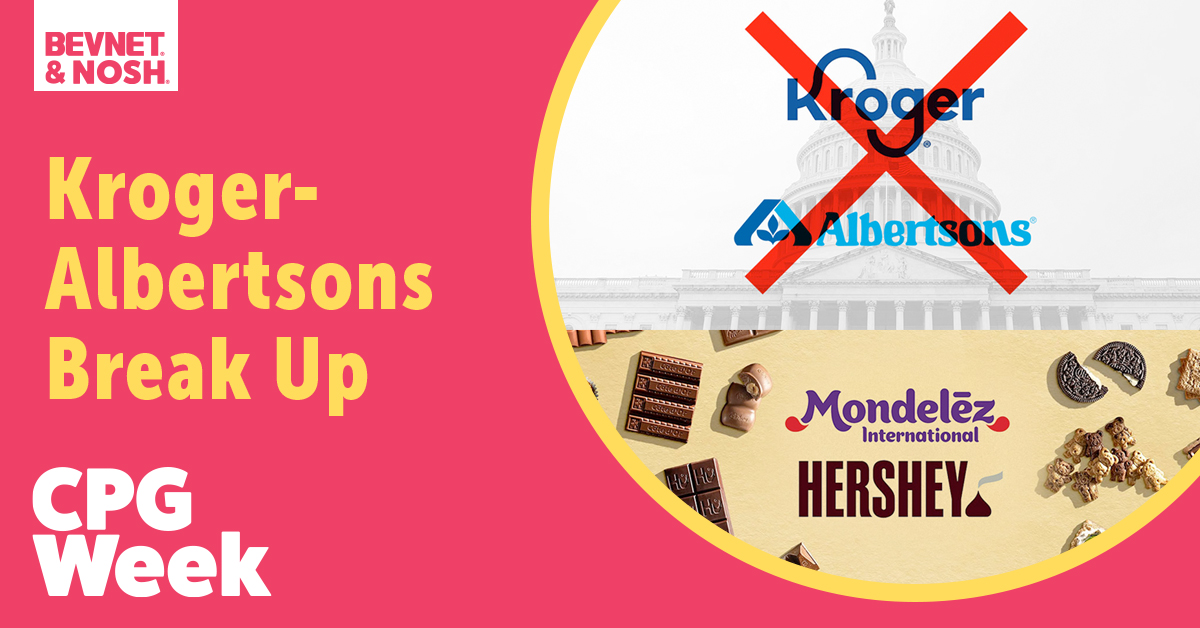
Fresh off of BevNET Live in Marina del Rey, Calif., the CPG Week podcast team jumps right back into the big M&A stories of the week. Nosh managing editor Monica Watrous walks the group through the Kroger-Albertsons failed merger and the fallout from it. Then, the team goes on to talk about Mondelēz’s second attempt to acquire Hershey. Finally, senior reporter Lukas Southard describes frozen potato product maker Lamb Weston’s recent problems and potential acquisition suitors.
NOTE: This episode was recorded before news broke of Post Holdings’ acquisition of Potato Products of Idaho.
Show Highlights:
0:30 – The CPG Week team recap their favorite moments from BevNET Live Winter 2024, which wrapped up last week.
4:30 – Find out how the planned merger of Kroger and Albertsons finally fell apart, why it’s not too surprising and what happens now.
9:45 – For the second time, Mondelēz has made an offer to acquire Hershey, and once again the deal has been rejected. Monica explains what has happened so far and why it might not have been such a bad deal for the chocolate maker, which is facing steep cocoa prices.
12:45 – Lukas tells the team about frozen potato food maker Lamb Weston’s struggles with activist investors and a class action lawsuit – and why it is drawing the attention of potential acquirers.
About CPG Week
CPG Week is the podcast that explores the latest happenings in the consumer packaged goods industry. Join our seasoned reporting team as they dish out the week’s stories in quick, easy-to-digest episodes. Catch up on the top headlines of the week, dive into exclusive insights with the BevNET and Nosh teams, and set yourself up to make more informed business decisions. Tune in to stay up-to-date on the latest developments in the dynamic world of packaged food and beverage.
New episodes are released every week. Send us comments and suggestions anytime to cpgweek@nosh.com.
Show Highlights:
The CPG Week podcast jumps into the latest M&A news with the failure of the Kroger-Albertsons merger, a denied proposal by Mondelēz to acquire Hershey and Lamb Weston acquisition rumors.
Episode Transcript
Note: Transcripts are automatically generated and may contain inaccuracies and spelling errors.
[00:00:05] Monica Watrous: Welcome to the CPG Week podcast by BevNET and Nosh, your source for the latest food and beverage industry news. I'm Monica Watrous, Managing Editor of Nosh, here with my co-hosts, Brad Avery and Lukas Southard. If you're enjoying the show, please subscribe on your listening platform of choice. On the podcast today, we are discussing a tale of two failed mergers and a potential deal in the works. But first, let's talk about BevNET Live, which just wrapped last week as of this recording. Brad, what were some of your favorite highlights of the event?
[00:00:37] Brad Avery: I really enjoyed the session from the co-founders of LifeAid, Aaron Hinde and Orion Millihan, where they walk through how they got the company to profitability. That's always something for me that I find fascinating when you hear companies say, well, we got profitable or we're working to become profitable. And it's so much easier said than done. That's maybe the understatement of the year. So, what they did on stage was they walked through what, here's what we had to do, here are the cuts we had to make, the hard ones too. They didn't sugarcoat it, they had to make some layoffs that they did not want to have to do and they were really regretful over, but it was necessary. So, I think just demystifying that process is really important to understanding how it works when your investor says, go get profitable. Okay, okay, I can, yeah, sure, it'll be done tomorrow, right.
[00:01:27] Monica Watrous: Lucas, what about you? What was your favorite highlight of DevNet Live?
[00:01:31] Lukas Southard: I mean, the sessions are always great and it's nice to see some people on stage that I've either talked to on the phone or on a computer screen, as we are often doing. But more importantly, I love just kind of walking around the halls and talking with people in real life and being able to shake hands with some of these people and really Kind of get some inside scoop about what they're seeing, what, who they're talking to and, and just kind of witnessing the interplay of the industry in general, who is talking to who and who knows each other from, you know, what is, is always really, really nice. And a great part of, of what BevNET has created in terms of the BevNET live. experience and there's just so many brands. I sometimes feel like Nosh is great because it's so intimate and there's, you know, it's a smaller event, but at BevNetLive, there's just so many people that it's really fun to just watch how the industry interacts with each other.
[00:02:30] Brad Avery: I still have people where I meet them and we realize, oh, this is the first time we've met face to face and we've known each other for like five years.
[00:02:38] Monica Watrous: The thing with these kinds of events, whether it's BevNET Live or Expo West, is you don't necessarily have to make an appointment to see somebody. The event just provides. You get to see those people that you were looking forward to seeing because your paths cross naturally, or at least that's been my experience. We also saw our friends from Brightfield who love this podcast and recognize her voices at the BevNET Live official party. So shout out to Julie and Kate. Thank you for listening.
[00:03:08] Lukas Southard: I ran into them a couple of times and it's always nice to talk with them because they have A lot of interesting insights. And then they're like, Oh, well, have you heard about this? And then I'm telling them about something and I'm like, okay, well, we, it looks like we need to schedule another call and, and touch base when we have our computers and our data in front of us.
[00:03:26] Monica Watrous: As for me, my favorite part of the events is always sampling new to me, brands and products. And my favorite from this one was Mellow, which Lucas, you were already familiar with because you had written about Kava based beverages. I had never tried it before. It's delicious. It's so tasty.
[00:03:43] Lukas Southard: Mellow's great and they did a tasting as people were registering throughout the whole two day event while they were also in the pitch slam. So they were like actually like getting some people to try their product even before they had pitched on stage. So good for them. It was a smart move and it's a good product. I like what they do.
[00:04:02] Monica Watrous: It didn't pay off though, they did not win the Pitch Slam, Recoup won the Pitch Slam, but I also thought a sticky move was seeing Grind with Gratitude give $2,000 to the finalist that was pitching after them. Some interesting moves there, but always a fun time. Now, of course, while we were at the event, the food and beverage industry news didn't stop for us, so we continued reporting on a couple of big deals that didn't quite transpire. The first one being the official termination of the Kroger and Albertsons' proposed $24.6 billion mega merger. Now, that deal was first announced two years ago. It's faced a lot of challenges and legal battles, antitrust concerns, folks who feel as if they would not be creating a competitive and fair grocery industry if those two got together. And ultimately, a federal judge agreed with the Federal Trade Commission, who sued to block the deal. And Washington and Oregon state courts also put permanent injunctions in place to halt the transaction. After this happened, Albertsons exercised its right to terminate the merger and is now suing Kroger for billions of dollars in damages, claiming that its shareholders have been denied the multi-billion dollar premium they would have received if the deal went through, but instead have been subject to decreased value as a result of Kroger's actions. On top of an immediate $600 million termination fee, Albertsons believes it is entitled to additional relief for the multiple years and hundreds of millions of dollars spent pursuing the deal. In the lawsuit, Albertsons outlined five distinct failures revolving around Kroger's willingness to divest an adequate package of stores and non-store assets, as well as delaying communications with regulators, mismanaging the process for finding a divestiture buyer, and not cooperating with Albertson's, quote, in good faith. The suit goes on to claim that Kroger squandered its credibility by presenting regulators with an indefensible divestiture package that elevated its own bottom line rather than meeting its contractual obligations to Albertson's. Kroger said Albertson's claims are baseless and without merit and refuted the allegations in, quote, the strongest possible terms. It's such a nasty breakup.
[00:06:27] Lukas Southard: Yeah. I mean, things did sour. I don't want to say fairly quickly because this whole saga has been going on for a while, but they soured and they soured kind of hard. And I mean, Albertsons appears to be going after getting some restitution for it. I mean, one thing that stood out to me in some of the The back and forth that we've been seeing in the last couple of days is one of Albertson's lawyers said that Kroger was willfully deficient approach to securing regulatory clearance is to blame, which, you know, I don't know the inner details of what happened, but it did seem like Kroger, especially in the last couple of weeks, seemed to be kind of hedging that this this deal wasn't really materializing in the way. that they wanted and with all these different lawsuits and injunctions that they were going through it was becoming obviously very expensive for both parties to be fighting this and you know at a certain point somebody has to throw in the towel I suppose but it's uh it's it's kind of ugly
[00:07:27] Monica Watrous: Yeah, and Albertsons is claiming that Kroger had buyer's remorse before the ink could dry on their agreement. So the accusation is that Kroger purposefully squandered the deal, which doesn't appear to be what happened based on how much Kroger fought in court for it to go through, but we don't know the behind the scenes.
[00:07:48] Brad Avery: The combined entity would have had over 5,000 stores and over 4,000 pharmacies. As far as an antitrust argument goes, I think there probably was a pretty legitimate one. There are certain markets where they would have had effectively all or most of the grocery stores in that area. So I think the fact that if Kroger had buyer's remorse from the get go, I don't know what this would all be speculation on my part, but certainly seeing the antitrust battle that was ahead of them could maybe be part of it. Because look, you're talking about legitimately controlling major markets for effectively almost all grocery stores in certain areas of the country. So it absolutely was going to run into regulators. And I can understand if Albertsons was annoyed that Kroger wasn't willing to divest more in order to avoid those monopoly issues that they were facing.
[00:08:41] Monica Watrous: So this frees Albertsons up to maybe have a different potential partner down the line. And Kroger says it's moving forward from a position of strength. And its plans are now to invest in lowering prices, which it says it's been doing for decades. raising wages and charitable contributions, and remodeling its stores. And additionally, Kroger's board of directors approved a new $7.5 billion share repurchase authorization, which replaces its existing $1 billion program that was approved in 2022.
[00:09:14] Brad Avery: I'm curious what also is going to happen with the list of 579 stores they announced this summer that were going to be divested to CNS Wholesale Grocers in order to help the deal along. So with this no longer happening, is that deal off? Are those stores still getting divested? That's something I would be curious to read more about.
[00:09:34] Monica Watrous: Well, you can read more about that on BevNET and Nosh, because we will be continuing to follow this developing story. Also last week, Mondelēz reportedly tried to buy Hershey for a second time. According to Bloomberg News, Mondelēz International made a preliminary approach to acquire the Hershey Company. Now that deal would bring together such brands as Reese's, Ritz, Oreo, Skinny Pop, Jolly Rancher, Twizzlers. and the combined business would generate a total of $50 billion in sales. Hershey is valued around $45 billion, according to Bloomberg, and that would make a potential deal bigger than Mars agreement to snap up Kelinova for nearly $36 billion. Now, this wasn't the first time Mondelēz had its eye on the chocolate maker, as we alluded to. In 2016, Mondelēz offered to acquire Hershey for $107 a share in a transaction valued at $23 billion. Hershey rejected that bid, indicating it would not negotiate a deal for an offer of less than $125 per share. And Mondelēz moved on from discussions, noting there was no actionable path forward toward an agreement. Any transaction would need to be approved by the Hershey Trust, which maintains about 80% voting power over the company. And it has opposed selling it in the past. But last week, the Hershey Trust said the offer, Mondelez's new offer, is too low. Hershey has quite a few problems. It just reported less than stellar earnings for the third quarter, and it's battling skyrocketing cocoa prices and consumer demand that has weakened. A lot of investors and analysts are saying because of the use of weight loss drugs, people might not be eating as much chocolate. And price elasticity has not been as strong as in previous times of economic decline. So Hershey could potentially use some help here. And I think Mondelēz also sees that as an opportunity to expand its C-store footprint, where Hershey has a big presence. Also, Mondelēz, we know, doesn't have a big North American footprint for chocolate. It's the maker of Cadbury and international markets. But it, I think, claims maybe 1% of the North American chocolate market. Now after Hershey Trust reportedly rejected that bid, Mondely's board of directors announced a new share repurchase authorization of up to $9 billion of Class A common stock, effective January 1st. And that authorization, which is effective until the end of 2027, replaces the current $6 billion authorization. Mondelēz reaffirmed its commitment to an acquisition strategy focused on bolt-on assets, similar to its recent acquisitions of Chipita, Cliff, and Riccolino. Mondelēz hasn't confirmed that it's done with its pursuit of Hershey, so we may still see a deal yet, if the price is right. But in other M&A news, Lucas, you are following a potential deal with Post Holdings. Can you tell us more?
[00:12:55] Lukas Southard: This is not the only story that seems to be bubbling up at the end of the year when it comes to larger food strategics and consolidation. Reuters reported last week that Post Holdings was exploring an acquisition of frozen potato food maker Lamb Weston. The company Lamb Weston has come under fire in the last few months. It was listed as part of the quote potato cartel, which was accused of price fixing in a class action suit that also included McCain Foods, J.R. Simplot company and Cavendish farms. But more importantly, though, Lamb Weston has been targeted by activist investor group Janna Partners, which has called on a leadership change at the potato food company. Janna owns about 5% of Lamb Weston and is calling for a significant board and leadership change. So in terms of the possible acquisition, there is a lot of upside for Post Holdings if they are able to get this deal through. They already own frozen mashed potato brand, Bob Evans Farms, and, but they aren't really the only ones that might be looking to acquire Lamb Weston. The Reuters story said that they had talked to other analysts that said potential suitors include Cargill, Tyson, and Kraft Heinz.
[00:14:21] Monica Watrous: Lamb Weston was spun out of ConAgra Brands a few years ago, so it may be better operated under a large strategic with a big CPG presence. Now, from my understanding, Lamb Weston is mostly food service. They provide all of the fast food French fries. I like this fit with Post Holdings because Post has a really strong presence in food service currently with eggs and cheese and potato products that it supplies to restaurant operators and this would just build on that as this company who has been so reliant on breakfast cereal, a declining category, seeks to diversify its portfolio.
[00:15:05] Lukas Southard: Yeah, and it's funny that you bring up the ConAgra because reportedly Post Holdings tried to acquire Lamb Weston when it was still part of ConAgra and didn't go through. So one analyst that I was reading a report on this potential deal said that The, the deal would be pretty beneficial to both post and Lamb Weston. If they could get it done at around like $115 per share. And currently Lamb Weston's trading at about like $81 per share. So when the news dropped last week with this Reuters story, uh, Lamb Weston stock climbed nearly 7% by the end of the day, which. shrank its year-to-date decline by 25%. So it appears that investors are pretty bullish on this deal if it does go through. But so far, it's just kind of in the rumor mill, as we say.
[00:16:03] Monica Watrous: Well, of course, if such a deal does transpire, we'll be covering it on Nosh.com. Here are some other notable bits of news from the week. UNFI, Lean Management Efficiencies Fuel Q1 Gains, KEHI Onboard's new fee consolidation program, and Coca-Cola and Pepsi preparing prebiotic soda launches in 2025. For these stories and more, become an insider at BevNET and Nosh. That wraps up this edition of CPG Week by BevNET and Nosh. Thank you to our audio engineer, Joshua Pratt, our director is Mike Schneider, and our designer is Aaron Willette. If you enjoyed the podcast, please subscribe on your listening platform of choice, and we will see you next time.
About CPG Week
CPG Week is the podcast that explores the latest happenings in the consumer packaged goods industry. Join our seasoned reporting team as they dish out the week’s stories in quick, easy-to-digest episodes. Catch up on the top headlines of the week, dive into exclusive insights with the BevNET and Nosh teams, and set yourself up to make more informed business decisions. Tune in to stay up-to-date on the latest developments in the dynamic world of packaged food and beverage.
New episodes are released every week. Send us comments and suggestions anytime to cpgweek@nosh.com.
Stay Informed, Stay Competitive
Unlock the articles, expert interviews, and data reports that power the food and beverage industry. Join our community and stay ahead with exclusive insights from BevNET and Nosh.