CPG Week: High Hopes For Hemp And Ampla’s Credit Concerns
Episode 72
In this episode:
In this episode:
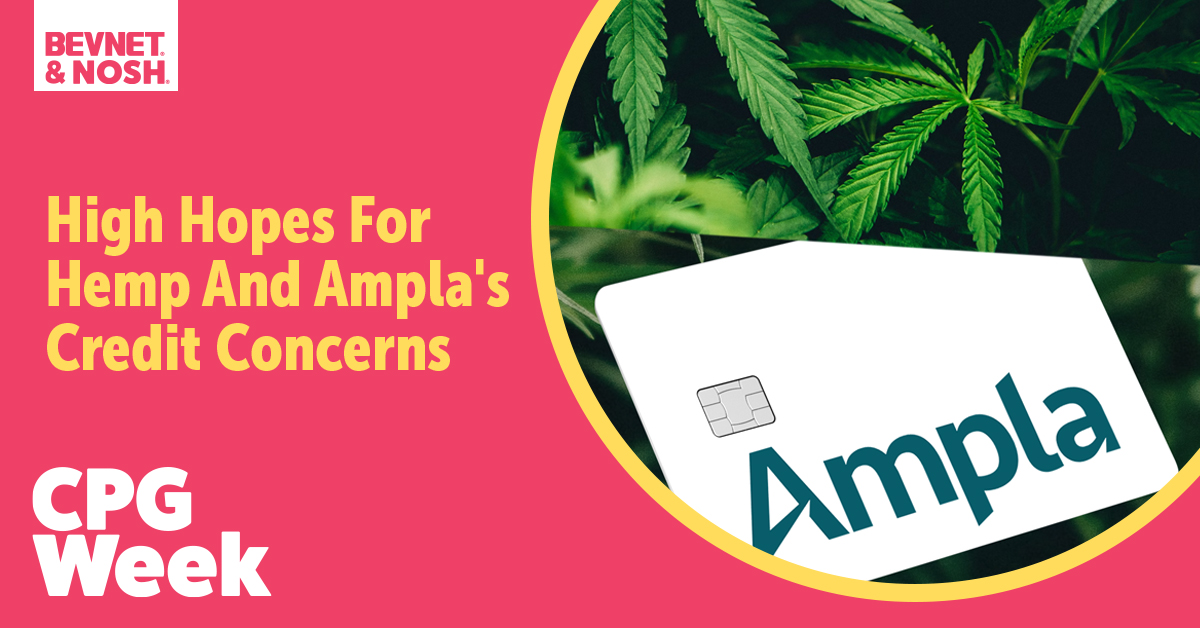
In this episode, the CPG Week team is joined by BevNET and Nosh Editor-in-Chief Jeff Klineman, who shares some insights from his trip with senior reporter Brad Avery to the Beverage Forum conference in Los Angeles this week. The two discuss celebrity beverage brands, why industry stakeholders are high on next-generation drinks and how big companies are diversifying.
The group moves on to discuss how the recent news that marijuana is expected to be rescheduled by the Department of Justice could impact the cannabis industry. Later, Jeff explains what is happening at CPG credit provider Ampla and how it is impacting brands large and small.
Show Highlights:
0:35 – Nosh managing editor Monica Watrous kicks off the show asking if the team would live in a Skittles-inspired micro-apartment for a year.
2:00 – Brad and Jeff share their insights on what happened at Beverage Forum this week highlighting how celebrity culture is evolving in drinks and “lessons learned” from one big producer-distributor.
6:00 – Senior reporter Lukas Southard explains the latest news out of the federal government that marijuana will be downgraded to a Schedule III drug. The team debates what this could mean for the cannabis industry in terms of regulation and opportunity.
13:15 – Jeff shares his most recent story on the troubling signals coming out of fintech consumer brand lender Ampla and his thoughts on the repercussions throughout the CPG world.
About the CPG Week
CPG Week is the podcast that explores the latest happenings in the consumer packaged goods industry. Join our seasoned reporting team as they dish out the week’s stories in quick, easy-to-digest episodes. Catch up on the top headlines of the week, dive into exclusive insights with the BevNET and Nosh teams, and set yourself up to make more informed business decisions. Tune in to stay up-to-date on the latest developments in the dynamic world of packaged food and beverage.
New episodes are released every week. Send us comments and suggestions anytime to podcast@nosh.com.
Show Highlights:
In this episode, the CPG Week team talks Beverage Forum insights, the state of the cannabis industry after the news that marijuana will be rescheduled to a Class III drug and the troubling signs coming out of the fintech consumer brand lender Ampla.
Episode Transcript
Note: Transcripts are automatically generated and may contain inaccuracies and spelling errors.
[00:00:05] Monica Watrous: Welcome to the CPG Week podcast by BevNET and Nosh, your source for the latest food and beverage industry news. I'm Monica Watrous, Managing Editor of Nosh, here with my co-hosts, Brad Avery, Lukas Southard, and Jeffrey Klineman. If you're enjoying the show, please subscribe on your listening platform of choice. On the podcast today, we're discussing credit concerns in the wake of lender Ampla's woes, high hopes for hemp, and what happened at the Beverage Forum. But first, Lucas, would you live in a Skittles inspired micro apartment for a year?
[00:00:38] Brad Avery: Well, considering that I did live in a micro apartment in New York for many years, Skittles would be an upgrade, I guess.
[00:00:48] Monica Watrous: To celebrate the launch of Skittles Littles miniature candies, Mars has partnered with a prominent interior decorator to create a colorful 353 square foot unit in New York City and is offering rent-free living for a year to one lucky winner.
[00:01:05] Brad Avery: Yeah, you left out the rent-free part of New York micro apartment. That's the sell right there.
[00:01:12] Lukas Southard: Yeah, Lucas, how much you pay for yours?
[00:01:15] Brad Avery: Ah, god, too much.
[00:01:18] Lukas Southard: Yeah, exactly. More than I should have. I'm assuming this comes with free Skittles, too. I would hope. One would hope.
[00:01:24] Jeffrey Klineman: One would hope. I'm sorry, my wife and I shared a 575 square foot apartment in New York, and so we had 262.5 square feet a piece, and we came out just fine. And that was, yeah, that was about us. No Skittles, but at one point we did get a six foot sub in there.
[00:01:52] Brad Avery: Wall to wall sub.
[00:01:56] Monica Watrous: Okay, well, moving on, Brad and Jeff, you just returned hours ago from the Beverage Forum in LA. Can you tell us about that experience?
[00:02:05] Lukas Southard: Well, it opened up with the Pledge of Allegiance, which I thought was very patriotic from some local school children. And it ended with Poppy and Lance Collins on stage together for a discussion about, you know, the future of entrepreneurial brands.
[00:02:21] Jeffrey Klineman: Yeah, there was a lot of attention paid to the concept of the Creator brand. I think it being LA, it having, you know, some movie star appearances, like Robert Downey Jr. showed up in the morning to talk about Happy Coffee. There was a lot of discussion about this idea that celebrities can help accelerate the growth of brands. And it almost felt like we're entering a new era. It felt like the assumption in the room was that 2020 to 2040 is going to be a celebrity makeover. of every food beverage brand out there. So, you know, I hope you're ready to eat your Ric Flair soup.
[00:03:23] Lukas Southard: It is an interesting point because I think already we saw and heard some discussion that just having a celebrity brand is not going to be enough anymore. I think even during the Robert Downey Jr. session, he himself kind of admitted that he realized that as he got into this, that being Iron Man doesn't just make a brand successful. There's a lot that goes into it. And importantly, you know, Gavin Hattersley, the CEO of Molson Coors, in his session, they talked a bit about ZOA and having Dwayne Johnson behind the Brad Avery them the confidence to go huge at the start rather than build small and grow big. And they learned a few lessons on the way that they need to retool this. And just having The Rock was not enough to make the brand an instant smash hit.
[00:04:07] Jeffrey Klineman: Yeah, no, it was interesting because they really went big behind ZOA with The Rock and opened it. His reviews were mixed because he said it was the energy drink to reach $50 million in revenue the fastest. But he also called it quite a learning experience. And any time you have a multinational CEO describing something as a learning experience, an educational experience, you know there's been some tinkering in the back room. And I know they're, you know, they're rolling it back out for the summer. Obviously, my favorite part about that was Gavin Hattersley saying that he had to be educated on the term BDE. He did not know what it meant, but he does now.
[00:05:11] Lukas Southard: And I don't think he explained it to the audience, who doesn't know. And we're not going to either.
[00:05:16] Brad Avery: It's one of those, be careful when you Google that later.
[00:05:19] Jeffrey Klineman: Yeah, exactly. Exactly. Gavin, I'm sure, has people to Google it for him.
[00:05:26] Monica Watrous: From BDE to THC, did you see any hemp beverages at the event?
[00:05:32] Jeffrey Klineman: No, there was a lot of discussion about the sort of changing nature of alcohol, spirits, wine, beer, the role of distribution, the changing formats in store. But the one thing that did not really come up at all was no one passed the grass on beverages. In fact, while we were there, the news broke about the DOJ looking into rescheduling cannabis, which I know is something that Lucas has been looking into pretty deeply.
[00:06:15] Brad Avery: Reports came out on Tuesday that the DEA, through the federal government, will start to reschedule marijuana from being a Schedule 1 drug to a Schedule 3 drug. So that kind of bumps it down from being considered in the same line of thought as heroin or acid to Schedule 3, which is like Tylenol with codeine and steroids. This news was greeted by many as kind of a long time coming and a step forward in how marijuana policy is approached in the US. The news peg fit nicely with a feature I recently wrote for BevNET magazine titled Hemp Derived Satisfies Consumer Thirst for THC Beverages. as well as a separate feature I wrote for Nosh that came out this week on the website called High Hopes, THC Edibles Turn to Hemp. So both these stories report on how the introduction of hemp-derived THC has impacted the larger cannabis industry as a whole. both within the regulated states like Massachusetts, California or Colorado, as well as states without recreational marijuana laws, places like Texas or Tennessee.
[00:07:28] Jeffrey Klineman: I think it's interesting, Lucas, because you have a federal farm bill. that opens the gates to the growth of hemp-based THC that's been kicked back down to the states to deal with in terms of how they regulate these products. And then it's finally being kicked back up to the federal level to look at the way that we as a country handle cannabis.
[00:08:03] Lukas Southard: From my understanding the rescheduling because schedule 3 is largely prescription drugs and the like this isn't really gonna have too much of an impact on the legal recreational market or any impact at all on the hemp market. And so this is great as far as softening the laws around cannabis overall. It's going to be big, I think, for the social acceptance of cannabis broadening as people, if they're not already, come to accept it more as a regular part of daily life. And it's going to open the door for further regulations. But this act in itself does not instantly say, okay, it's a free-for-all.
[00:08:45] Jeffrey Klineman: Yeah, exactly, but it does allow something like banking to take place. Yes. It allows businesses to grow in the space, you know, whereas before the idea on its earlier schedule was that it has zero use from a medical standpoint or from a study standpoint and now it takes it back into the realm of something like a steroid.
[00:09:16] Lukas Southard: So this is great news if you run a dispensary and this is terrible news if you run a business selling bank vaults to dispensaries.
[00:09:24] Brad Avery: I don't know if it goes that far. I mean it's a win for sure and you guys bring up some valid points in terms of how this is more a nod towards decriminalization than it is towards really totally changing the diametrics of the cannabis business, shall we say. And it reminds me of something that was brought up to me in a conversation I had with Justin Singer, who's the co-founder of a powder THC drink called Ripple. And they're based out of Colorado. They've been operating since 2016. Singer said to me that the legalization of hemp-derived THC through the 2018 Farm Bill has shown what can happen to consumer safety, fraud, and product labeling when there isn't a regulatory framework to back it up. So the Farm Bill allowed hemp producers to make a THC product, but didn't have any sort of regulatory model from the federal government on the way down to states. And it is kind of allowed for a situation where there is really no dosing requirements on a federal level, and it's had states have to kind of react in the moment to how they're going to try to regulate this. And so what's happening with the DEA now in this decriminalization is great for normalizing THC use and the cannabis industry, but without a regulatory framework, it could even make things worse in terms of how states and law enforcement really are going to try to work around this.
[00:11:10] Jeffrey Klineman: Yeah, I think the point that Brad and I are making though is that it opens the door to creating a regulatory framework in all those areas. So you'll be able to study the effects of cannabis and THC regardless of its derivation. to determine what an appropriate dose is and what an appropriate tax rate is and what sort of exposure a bank that's handling these kinds of deposits should have.
[00:11:47] Lukas Southard: Even think back to CBD and a big thing that held up CBD getting cleared by the FDA was a lack of research around it. And then there was the issues that you couldn't really properly research it because of the scheduling issue and it gets into this whole mess. And so exactly. Untangling that, who knows? Maybe we even see some more word on CBD. That's totally spitballing. There's no guarantee. Because you can now do much more research and get into the effects.
[00:12:15] Jeffrey Klineman: It's going to have huge trickle-down effect on the industry Yeah, yeah, it does just open the gates a lot more to Building that that knowledge base that just hasn't been there and and from the knowledge you can derive Some form of regulation you can have debate whereas before It was you know Don't speak about it. Don't listen to it. Just say no.
[00:12:47] Monica Watrous: Insiders can read more at BevNET and Nosh about hemp-derived THC and emerging applications and brands in that space, as well as listen to an upcoming community call. Right, Lucas?
[00:13:00] Brad Avery: That's right. We have a community call coming out next week with Christy Palmer, who's the CEO of Kiva Confections, a legacy edibles company.
[00:13:13] Monica Watrous: Another big story that we reported on this week comes from Jeff, our editor-in-chief. Jeff, can you tell us more about what's going on with CPG lender Ampla and the consequences for emerging brands?
[00:13:26] Jeffrey Klineman: Ampla is one of a group of what they call FinTech lenders that are focusing on the CPG space. One of the big issues for many small brands and startup brands and even larger brands, 50 million, 100 million, is it's hard to have a good rhythm with your working capital. So you need to pay for products that you're going to sell, you need to pay your manufacturer, you need to pay your employees, but your capital cycle is such that you're waiting to get paid by the wholesalers and by the retailers who are buying your products. Ampla was really, you know, people really liked it. because it provided an easily accessible, reasonably inexpensive line of credit that a lot of brands could get to quickly without necessarily needing to sell equity in their brands to smooth out this cash flow cycle. Like a lot of companies in the FinTech community, they have faced a little bit of a downturn, and there was a series of disruptions in lines of credit for small brands over the past couple of months. We were hearing from them with a fair amount of regularity. When we started looking into it, what we found out is that, in fact, Ampla's financial position had eroded to the point where they were trying to sell the assets of Ampla to another buyer who could maintain that flow of capital for these smaller brands. You know, the basic headline is Ample has been in real trouble, and it's flowed downhill to the brands that depend on the money to pay the bills. If they're not able to sell, then it could get a lot worse. As of Monday, they were close to a deal. And since then, we have not heard from the company. And I think it would be great If we could, when I asked one of the investors at the Beverage Forum if I could get an update on the situation with Ampla, I got no comment.
[00:16:20] Lukas Southard: Have you heard anything from any of the brands about what their plans are?
[00:16:25] Jeffrey Klineman: What's plan B? Well, what's interesting is there are a lot of sort of low-cost lenders who are kind of swooping in. And in fact, some of the news came from the fact that some of the brands were wondering why they were getting these letters from other companies like ClearCo or Settle, who also offer these kinds of lending products. And it's just been, I think, very confusing for a lot of companies to see that the line of credit that they were going to draw on has been either reduced or zeroed out entirely. A lot of that has been due to the fact that Ampla wanted to clean up its accounts and ready them for a sale, but you don't want to see a letter that says, you know, we need you to repay this right now when you're already worried about paying off your manufacturer.
[00:17:31] Monica Watrous: And it has shades of Silicon Valley Bank collapse.
[00:17:36] Jeffrey Klineman: A little bit, yeah. You don't want to, when you're reporting this, when you're talking about it, you don't want to cause a run on the company. I think people are aware now of what's been going on and with any luck they'll find a soft landing. I know that investors and the CEO of Ampla, Anthony Santomo, were working on it and I'm sure that they'll be able to find a solution for this just simply based on the fact that Ampla is much smaller than Silicon Valley Bank and, you know, while I I am neither a banking regulator nor a principal of this company. I'm hopeful that they can work it out in some way, but it would be reassuring, I think, to those brands to hear where things are right now.
[00:18:40] Monica Watrous: We will continue to follow this story as it develops. And in the meantime, here are some other notable bits of news from the week. Walmart doubles down on private label with premium, accessible, better goods debut. The Simply Good Foods Company acquires Owen. And squaring the circle, as circular packaging systems evolve, are sustainable solutions getting closer? For these stories and more, become an insider on BevNET and Nosh. That wraps up this edition of CPG Week by BevNET and Nosh. Thank you to our audio engineer, Joshua Pratt, our director is Mike Schneider, and our designer is Aaron Willette. If you enjoyed the podcast, please subscribe on your listening platform of choice, and we will see you next time.
About CPG Week
CPG Week is the podcast that explores the latest happenings in the consumer packaged goods industry. Join our seasoned reporting team as they dish out the week’s stories in quick, easy-to-digest episodes. Catch up on the top headlines of the week, dive into exclusive insights with the BevNET and Nosh teams, and set yourself up to make more informed business decisions. Tune in to stay up-to-date on the latest developments in the dynamic world of packaged food and beverage.
New episodes are released every week. Send us comments and suggestions anytime to cpgweek@nosh.com.
Stay Informed, Stay Competitive
Unlock the articles, expert interviews, and data reports that power the food and beverage industry. Join our community and stay ahead with exclusive insights from BevNET and Nosh.