CPG Week: Gutsy Soda Moves, Financial Doldrums, and Much Ado About Mushrooms
Episode 62
In this episode:
In this episode:
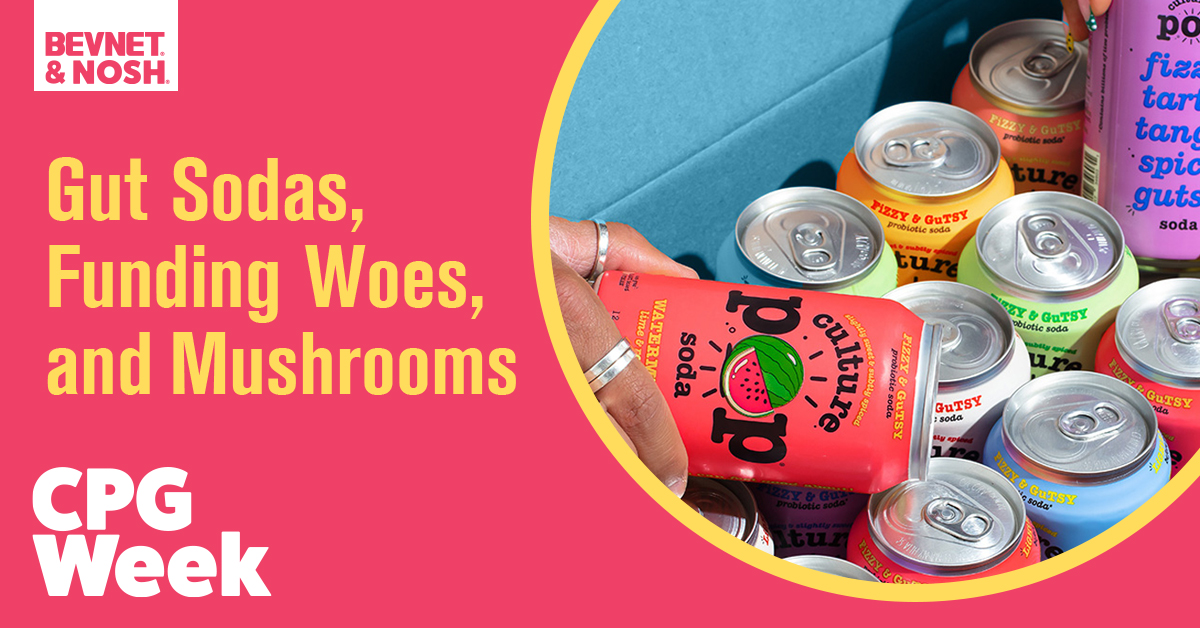
This week the BevNET and Nosh team discusses Poppi acquisition rumors, the investment landscape, and consumer adoption of functional mushrooms.
Show Highlights:
0:30 – Monica starts the episode challenging Jeff and Brad to a hypothetical pistachio cracking competition that devolves into a semantical discussion about “nut meat.”
3:25 – Brad highlights prebiotic soda brand Poppi’s big week, which included a highly-watched Super Bowl ad and a Bloomberg article speculating about a Coca-Cola takeover.
7:00 – Why haven’t any of the biggest soft drink companies created their own version of Olipop or Poppi? Jeff draws comparisons to Coke’s short-lived, stevia-sweetened cola, and points out why large players are wary of snapping up small brands today.
9:00 – Monica notes probiotic soda brand Culture Pop’s recent $21 million funding and points to other beverage brands raising capital recently. Jeff shares what investors are looking for in potential targets.
11:15 – The team considers whether consumers understand functional mushrooms and shares examples of brands entering the space. Brad asks whether psychedelic imagery on packaging confuses shoppers.
15:05 – Jeff poses the question that should be on every product developer’s mind: What’s the next big health grail consumers are seeking, a la the antioxidant? “Is it prebiotic, psychedelic or adaptogenic?”
About the CPG Week
CPG Week is the podcast that explores the latest happenings in the consumer packaged goods industry. Join our seasoned reporting team as they dish out the week’s stories in quick, easy-to-digest episodes. Catch up on the top headlines of the week, dive into exclusive insights with the BevNET and Nosh teams, and set yourself up to make more informed business decisions. Tune in to stay up-to-date on the latest developments in the dynamic world of packaged food and beverage.
New episodes are released every week. Send us comments and suggestions anytime to podcast@nosh.com.
Show Highlights:
This week the BevNET and Nosh team discusses Poppi acquisition rumors, the investment landscape, and consumer adoption of functional mushrooms.
Episode Transcript
Note: Transcripts are automatically generated and may contain inaccuracies and spelling errors.
[00:00:05] Monica Watrous: Welcome to the CPG Week podcast by BevNET and Nosh, your source for the latest food and beverage industry news. I'm Monica Watrous, Managing Editor of Nosh, here with my co-hosts, Brad Avery and Jeffrey Klineman. If you're enjoying the show, please subscribe on your listening platform of choice. On the podcast today, we're discussing gutsy soda moves, financial doldrums, and much ado about mushrooms. Hey Jeff, how many pistachios do you think you could crack open and eat in eight minutes?
[00:00:37] Jeffrey Klineman: I have fat fingers. I don't think I could do very many. Just ballpark it. A few hundred, but if I was super hungry and I had grown out my nails a lot.
[00:00:49] Brad Avery: If this was like the last food you had on earth and you needed those pistachios in order to survive and all you get in eight minutes is all you get and that's it.
[00:01:00] Jeffrey Klineman: I would buy the nut meat bags of pistachios and just go to town on them. But I have a feeling that that's not what you're looking for in this question.
[00:01:11] Monica Watrous: I want to hear more about nut meat bags. What's that?
[00:01:15] Jeffrey Klineman: You can buy the pistachio nut meats in their own bag. You know, it's their pre-shelled pistachios. Salted or unsalted. Great on salads. Why are we calling it meat?
[00:01:29] Monica Watrous: Yeah, that's what I want to know.
[00:01:31] Jeffrey Klineman: That's what they're called, is nut meats.
[00:01:32] Monica Watrous: I don't like it.
[00:01:32] Brad Avery: It's unsettling.
[00:01:34] Jeffrey Klineman: You know, we call everything meat in the food and beverage industry if it's made from soy, if it's made from peas. We're making meat out of everything. Can't we call the traditional nut meat, nut meat?
[00:01:53] Brad Avery: Yeah, but you have to spell it M-E-E-E-T.
[00:01:57] Jeffrey Klineman: No, you don't. We don't have extra vowels, Brad. We remove vowels in the CPG industry.
[00:02:06] Monica Watrous: Well, the reason I brought this up is because on February 26th, Wonderful Pistachios is hosting its second annual Get Kraken Eating Championship. And Los Angeles Chargers linebacker Joey Bosa is going to compete against the number one competitive eater in the world, Joey Chestnut. This Joey versus Joey showdown in which they have eight minutes to eat as many pistachios as possible. for $10,000 in total cash prizes.
[00:02:38] Jeffrey Klineman: So, I mean, I think the question for you, Monica, is if Joey Bosa had been playing alongside Nick Bosa, would you be celebrating a Chiefs Super Bowl win?
[00:02:51] Monica Watrous: I don't know enough about football to answer that question.
[00:02:55] Jeffrey Klineman: They're brothers. They both play D.
[00:02:58] Monica Watrous: The only brothers I know about in the NFL are- Are the Kelsies. Are the Kelsies, yeah.
[00:03:04] Jeffrey Klineman: See, that's what I would like to see, would be a Kelsey Boza pistachio shelling and eating contest. And the loser has to eat Joey Chestnut.
[00:03:17] Monica Watrous: Well, why don't we switch gears from talking about cracking pistachios to cracking a cold can of prebiotic soda?
[00:03:27] Brad Avery: Yeah, Poppy is having a huge media month. They had a big coming out at the Super Bowl, speaking of football, with a last minute ad buy that turned into one of, if not the most watched ads of the game, which when you consider that this is a startup brand still that has rapidly risen with triple digit growth, And I'm seeing them more and more places now. I don't know about you guys, but I go to any store and I feel like I see Poppy now, at least around Boston. And you have to consider the brand recognition that it's building. Almost immediately afterwards, Bloomberg runs a article speculating whether Coca-Cola is among the suitors, among the suitors for healthy soda brand Poppy. which we don't know exactly how that article got to press. We don't know who may have leaked the rumor to Bloomberg. Poppy itself denied it. Coke wouldn't comment. But it shows there's maybe some real interest among the big CPG companies to pick up one of these prebiotic brands that are fast rising.
[00:04:33] Jeffrey Klineman: A more cynical look at that Bloomberg story might say that someone was trying to test the waters to see how much of a process could go up around Poppy.
[00:04:48] Brad Avery: a classic trial balloon. We saw a bit of that with Olipop last year too. Axios had a special article floating whether or not there was a big demand to acquire Olipop. We don't know exactly where things are in the process. The Bloomberg article itself said there was no deal in the works, but there certainly is a drive to get Poppy or one of these brands over the finish line and probably quickly.
[00:05:17] Jeffrey Klineman: Well, the investors probably would like to see these brands get over the finish line. And it would be great to see a little bit of a jumpstart to M&A in the CSD space. But at the same time, there's still a ton of runway for these brands to grow. You're seeing more of them. They're both expanding distribution, as is CulturePop. There's been a big growth in the functional soda space. What I think is also kind of interesting is there's a little bit of a media backlash in the soda space. These are supposed to be prebiotic, healthy sodas, and so, of course, you get the follow-on stories of, well, how healthy are these sodas really? And they, you know, look, they're, they're lower in calorie than most CSDs and their, their questions starting to pop up around the inulin that they use as the prebiotic or even how much of a prebiotic fiber is, is going to be beneficial to the human biome.
[00:06:27] Monica Watrous: I don't think anybody is buying these drinks to meet their daily fiber intake requirement. What's appealing about Olipop and Poppy is they do have a lower sugar content. They're made with ingredients that are perceived as more natural than traditional CSDs.
[00:06:45] Brad Avery: And one of the most interesting pieces to me is that we've been talking about this space for years. And it's been a big opportunity for small startups to launch their own version of a prebiotic or a gut health friendly soda. But we've not seen the big CPG companies like Coke or Pepsi or KDP try and hop in with their own twist. They could innovate quickly if they want to, but they haven't. So do they want to acquire in order to get into this space? Or is there something that they're skeptical of and that's why they're not getting into it?
[00:07:14] Jeffrey Klineman: There's a big gap of something that's growing in the entrepreneurial space versus something that's going to move the needle for the big CPGs. And not that they don't like to play in it, and not that I'm not sure they're not watching these brands, but at the same time, I wonder how much the revenue of something like a Coca-Cola Life right, which was their stevia sweetened product, a sort of mid-cal. I wonder how much revenue it had at the time of its shutdown compared to the entire functional soda category. It's, and that's been one of the problems for these for these big companies is they see something starting to sprout and they could try and innovate their own concept and they have to do that much bigger. If they want to bring in this sprout, they have to be able to grow it. And that's why I think they're a lot warier about pulling the trigger on small brands these days, and they really do want to see proof of concept. A $200 million brand like Olipop is a small fraction of what they sell in Diet Coke or Coke Zero every year.
[00:08:44] Brad Avery: But investors are certainly interested.
[00:08:47] Monica Watrous: Well, that's right, Brad. CulturePop this past week announced its fundraising. Our colleague Lukas Southard wrote a story on BevNET.com called CulturePop Raises $21 Million in New Investment. CulturePop is one of several brands that has netted new investment in the past couple of months, Sanzo, Odyssey, Juneshine, and Rural Organics are other examples. So it seems like there's appetite to support these functional and better for you brands but Jeff you recently wrote about some quote carnage in consumer and and the challenges that we're seeing in the funding landscape.
[00:09:29] Jeffrey Klineman: Yeah and I think it speaks to what I'm hearing from investors which is those brands you named are all on a tight discipline growth path right now and that's what they're rewarding. A lot of brands have been going raise to raise and they haven't been able to come up with profitable or close to profitable approaches to their businesses and that's what investors have been unwilling to take a flyer on. It's part of a sort of spiral that involves a lack of investment in new consumer funds or a slowdown of investment in existing consumer funds, those funds not wanting to risk their money on brands that they don't see as having a path to exit, and that bigger part, which is that path to exit seemed to take a pause from all the big strategics and we're still waiting for a reset there. And the reason behind that is they've been able to reward shareholders by increasing prices on existing brands during the pandemic. So sooner or later that cycle is going to break. And we'll start to see brands get bought up again, but it's going to take a sort of consumer and investor demand for innovation on the part of big CPG.
[00:11:10] Monica Watrous: I think I could use some mushrooms to de-stress after hearing that news.
[00:11:15] Brad Avery: Well, I wrote about another new mushroom drink brand this week, Melting Forest, which comes to us from CBD Living. You can read the full article on BevNET, Stress Test. Melting Forest aims to grow mushroom-powered RTDs. They are offering energy and de-stress drinks. We've seen more activity from investors even coming into this mushroom drink space. Earlier this month, Odyssey closed a $6 million funding round. We're also seeing a lot more innovation like products like Space Tea. There's a brand called Immoral that is doing another mushroom drink. Mudwater, which has a lot of mushrooms in its coffee alternative formula, they opened up a cafe, brick and mortar, in California earlier this year. Are consumers jumping onto this mushroom trend? It seems like the health conscious ones are, but is it at the place of prebiotic soda? Not yet, it's very early.
[00:12:12] Jeffrey Klineman: Yeah, and it's an up and down trend too, right? So Odyssey pulled in this investment partially on the strength of their move more into the energy space and dialing back that mushroom power in those beverages. At the same time, we're seeing legalization of psychedelic mushrooms on a couple of ballots in this election cycle. We're decriminalized in Oregon and in the great municipality of Somerville, Massachusetts. The point is, there's a growing awareness of mushrooms as medicine.
[00:12:56] Brad Avery: We've seen for years in the natural channel brands trying to sell adaptogens. And that was always, I felt it was always a little bit of a vague term. I don't know if consumers necessarily understood or not what adaptogens were, but these mushrooms qualify. They are adaptogenic mushrooms. And I think couching it in an ingredient that is instantly understandable. It's like, I know what a mushroom is.
[00:13:17] Monica Watrous: I think people think mushrooms and they think umami, slimy, sometimes pizza topping. They're thinking shiitake. They're not thinking lion's mane or reishi or cordyceps. There's still some consumer education to be done there. I was at Sprouts a couple weekends ago. And they had an end cap on their innovation table dedicated to brands producing mushroom type products. Some of the examples that I saw there, Good Dirt beverage that I am drinking right now, as well as nutrition bar called Balanced Tiger that has 1500 milligrams of functional mushrooms. And then also Plant People, which is a brand that offers mushroom gummies. I bought some because I was curious. I know what they are, but I don't know that the average consumer will really understand, even if they are familiar with mushrooms.
[00:14:13] Brad Avery: A lot of brands, you know, Melting Forest, Popadelics, we've been joking a lot about shrooms, but these brands are leaning into that psychedelic adjacent element, even though these are not psychoactive ingredients. And I do have to wonder what that does for perception. It's certainly playing into those aesthetics. And that will definitely have appeal for a certain consumer. But is it going to be like CBD, where people were very interested in it because it came from marijuana? And so it had that adjacency, even though it didn't actually get you high? Is there going to be a reaction like that from consumers to these brands leaning into that? Or is it just some fun branding?
[00:14:57] Jeffrey Klineman: I think there's some really interesting themes that we've actually hit on here. I think we've found our quest for the new antioxidant. The question is, is it prebiotic, psychedelic, or adaptogenic?
[00:15:13] Brad Avery: It's a good question, and one I think we'll be exploring for a while.
[00:15:16] Monica Watrous: Well, that's a lot of philosophy and conjecture. And now for a few bits of hard news before we close out the episode. Oatly settled a greenwashing claims case from investors for around $10 million. Non-ALK beverage volumes rebounded in February. And Middle Eastern brands like Zesty Z, Better Sour, and Maza are gaining traction in mainstream retailers. For these stories and more, become an insider on BevNET and Nash. That wraps up this edition of CPG Week by BevNET and Nosh. Thank you to our audio engineer, Joshua Pratt, our director is Mike Schneider, and our designer is Aaron Willette. If you enjoyed the podcast, please subscribe on your listening platform of choice, and we will see you next time.
About CPG Week
CPG Week is the podcast that explores the latest happenings in the consumer packaged goods industry. Join our seasoned reporting team as they dish out the week’s stories in quick, easy-to-digest episodes. Catch up on the top headlines of the week, dive into exclusive insights with the BevNET and Nosh teams, and set yourself up to make more informed business decisions. Tune in to stay up-to-date on the latest developments in the dynamic world of packaged food and beverage.
New episodes are released every week. Send us comments and suggestions anytime to cpgweek@nosh.com.
Stay Informed, Stay Competitive
Unlock the articles, expert interviews, and data reports that power the food and beverage industry. Join our community and stay ahead with exclusive insights from BevNET and Nosh.