CPG Week: Eggs-istential Crisis At The Grocery Store
Episode 107
In this episode:
In this episode:
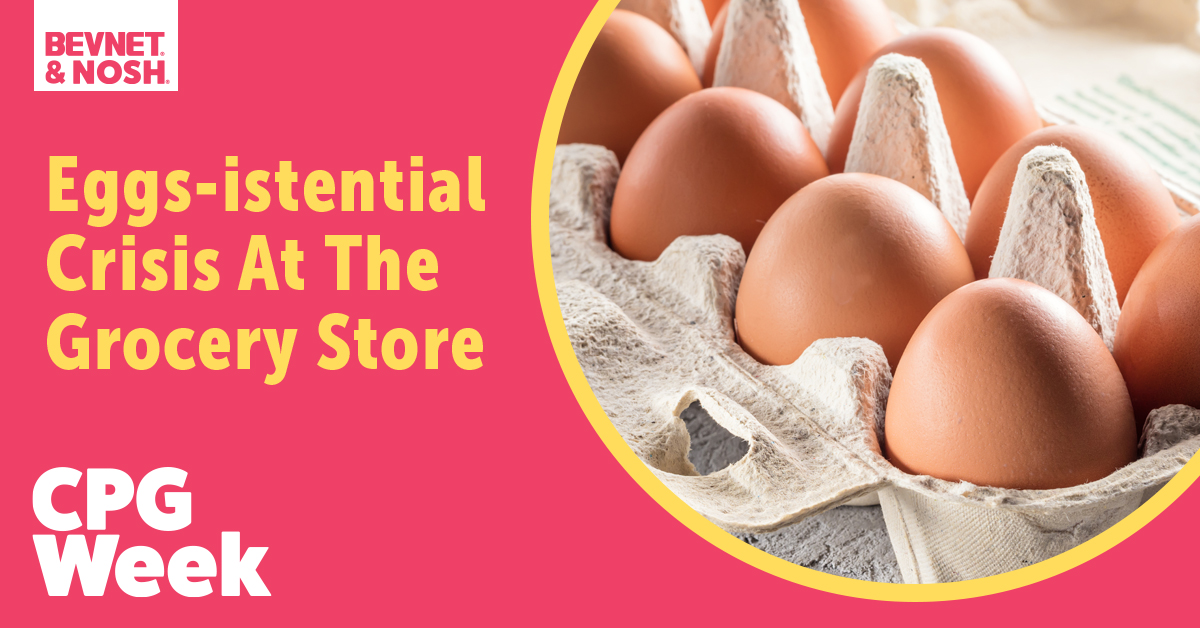
It’s likely not news to anyone who has bought groceries in the last two years that food costs are up. Due to environmental issues, supply chain challenges, tariffs and demand, eggs have become a quintessential example of why costs at the checkout will likely continue to be higher than most consumers would prefer. Household staples like eggs, cocoa and coffee are quickly turning into nonessentials for many grocery shoppers as inflation continues to plague the industry.
Show Highlights:
0:30 – Do sour candy and pickles mix? Monica asks the team if they would “chew or spew” Van Holten’s expanded LTO partnership with Warheads candy.
3:15 – Why are eggs so expensive these days and how is it reflective of the broader topic of grocery inflation? The team dives into why eggs might be expensive forever.
6:30 – How will the high cost of eggs and other household staples cause ripple effects throughout consumer buying behavior? The podcasters explain why prices won’t likely fall but might stabilize.
10:00 – It’s not just eggs that have been on an expensive rollercoaster ride. Coffee, cocoa and many other commodity shortages are impacting how CPG brands and consumers are adjusting to dynamic prices.
About CPG Week
CPG Week is the podcast that explores the latest happenings in the consumer packaged goods industry. Join our seasoned reporting team as they dish out the week’s stories in quick, easy-to-digest episodes. Catch up on the top headlines of the week, dive into exclusive insights with the BevNET and Nosh teams, and set yourself up to make more informed business decisions. Tune in to stay up-to-date on the latest developments in the dynamic world of packaged food and beverage.
New episodes are released every week. Send us comments and suggestions anytime to cpgweek@nosh.com.
Show Highlights:
The CPG Week podcast team discusses why eggs have become a quintessential example of why grocery prices remain high despite moderating inflation.
Episode Transcript
Note: Transcripts are automatically generated and may contain inaccuracies and spelling errors.
[00:00:05] Monica Watrous: Welcome to the CPG Week podcast by BevNET and Nosh, your source for the latest food and beverage industry news. I'm Monica Watrous, Managing Editor of Nosh, here with my co-hosts Brad Avery and Lukas Southard. If you're enjoying the show, please subscribe on your listening platform of choice. On the podcast today, we're discussing the price of eggs. But first, Van Holten is teaming up with Warheads Candy to create a sour blue raspberry pickle. Lucas, chew or spew?
[00:00:38] Brad Avery: You just mentioning Warheads makes my mouth water from childhood of knowing when you're unwrapping it that it's going to be so sour, you're going to get that pucker. I'll go with chew, why not? I loved Warheads as a kid. I can't say I have had one in 20 years. In pickle form? Yes, and I love pickles, so why not? It will probably be spew worthy, but I would at least chew first.
[00:01:05] Lukas Southard: Are warheads not as sour now as they were when we were kids or is it just my changing taste buds? Because I remember as a kid they were almost unbearable at times, but now I actually had some recently and they were manageable. They're still pretty sour. I don't know if they changed the formula or if it is just
[00:01:25] Brad Avery: I'm older now and so I can't take it but it was interesting that I was almost bracing myself for for pain well that's what I'm saying is like I can feel my mouth like the saliva building because I like the anticipation of what it is what what drove you to grab a warhead at you know in your in your 30s now
[00:01:45] Lukas Southard: My mom got some and was like, here, do you want warheads?
[00:01:48] Brad Avery: Which of your moms should have warheads in the house? Yes, it's Christmas. You have an answer. Are you chewing or spewing on this?
[00:01:56] Lukas Southard: I'm going to spew, but not for the sour because I do love a sour pickle, but more for what I imagine is the candy artificial flavoring that's probably in this pickle. That doesn't sound very appealing to me.
[00:02:09] Brad Avery: It is a weird mix.
[00:02:10] Monica Watrous: My hot take is that pickles should taste like pickles and no one can convince me otherwise, so I'm spewing.
[00:02:18] Brad Avery: How do you feel about spicy pickles though? Because that's not really a pickle, it's like a spicy pickle.
[00:02:25] Monica Watrous: Pass.
[00:02:26] Brad Avery: Grylls makes a great spicy pickle. Yes, I'm all about the spicy pickle.
[00:02:30] Monica Watrous: I'm just not a spicy person in general.
[00:02:32] Brad Avery: Spice me up. Okay, fair enough. The spice must flow. One for Chew and two for Spews on the Warheads pickles. Wow, I think this is a first that I am the one that is all for it. I'm the positivity here.
[00:02:44] Monica Watrous: I thought for sure you would be disgusted by it.
[00:02:48] Brad Avery: No, I don't know. Maybe it's just the idea of a pickle and fond memories of blowing out my taste buds with Warheads as a child. I don't know. It just seems like I'd give it a go. I'd probably hate it, but I'd give it a go. I just always say the opposite of what Lucas says.
[00:03:06] Monica Watrous: I've noticed that.
[00:03:07] Lukas Southard: Don't do what Donnie Don't does. Don't give away our strategy, Brad.
[00:03:12] Monica Watrous: Well, speaking of appalling things to see at a grocery store, I just bought eggs over the weekend, and I think I spent like seven bucks. Now, granted, I get bougie eggs, like I get the cage-free, organic, pasture-raised kind, but I think I'm gonna have to start maybe downgrading to just the normal eggs. What's going on with egg prices, Brad? They're too damn high.
[00:03:34] Brad Avery: Tell us more. This isn't news to anyone who goes grocery shopping anytime in the last couple months, but you know.
[00:03:39] Lukas Southard: No, the price of eggs is continuing to rise after a sharp spike during the inflation wave of 2022, which if you remember, the price of eggs was a big topic during the presidential election and has long been a point of contention for consumers. It's continuing to rise. This time, one of the lead causes is avian flu, that is attacking chicken populations. According to the Bureau of Labor Statistics, the cost of a dozen grade A large eggs hit an average of $4.15 in December. That's up from $2.51 the year before, so a pretty big spike. Business Insider actually ran an article recently with an alarming headline. Eggs may be expensive forever.
[00:04:25] Monica Watrous: Eggs-pensive?
[00:04:28] Brad Avery: Yeah. The egg puns can just abound. I mean, I wrote about how bird flu was impacting egg prices in May, 2022. So it was actually one of the first stories I did here at Nosh. It was called egg-celerated pricing in the poultry market, causing problems for CBG companies. And at the time, the average price of a dozen eggs was hovering around $2.60 per dozen. how far we've come, right? It's definitely not gone down, and if anything, it's gone significantly up since then.
[00:04:59] Monica Watrous: Well, and grocery stores are paying even more than what you see on the shelf tag for, you know, the consumer facing price because eggs are considered loss leaders. It's what gets consumers in the store. And ideally, they spend more money on other higher margin products. But grocery stores are definitely feeling it as are restaurants and certainly any manufacturers are using eggs in their formulations.
[00:05:24] Lukas Southard: So the Business Insider piece 2 also cited some data from Cercana. The cost of large eggs among smaller retailers was $5.31 a dozen. And although they may be cheaper in certain retailers, the prices are unlikely to come back down anytime soon. Here's a quote here. The acute causes of this price spike, a drop in supply, a jump in demand, point to long-term structural issues that might stick around.
[00:05:50] Brad Avery: When I was reporting on this, uh, back in May, 2022, I talked to a couple of different brands that. Don't sell eggs directly, but use eggs in their formulations. And I learned that it was, it's pretty common to hedge as with anything and buy a lot of stock when you know, prices are going up, but it doesn't seem like there's any idea that these prices are going to come back down. So hedging for CPG brands that use eggs in their production or have that be, you know, one of the. pillars of their brands and their products are really just going to have to eat these costs, and that will eventually flow downhill to consumers at the grocery store.
[00:06:29] Monica Watrous: Another factor that is making eggs more expensive are cage-free requirements that are in certain states like California and Massachusetts.
[00:06:38] Lukas Southard: You also have to consider what the knock-on effect is going to be. You know, once again, consumers are feeling their wallets tighten. And what do they cut in turn? You know, eggs are a household staple for most people. And whether people stop buying eggs and change their diets, or they cut something else from their baskets, there's going to be ripple effects. And we can probably see this inflation impact other areas of the store as a result.
[00:07:06] Monica Watrous: Grocery inflation is something we've been tracking for the last couple of years. And while it has seemingly moderated, this is a topic that we checked in with a number of industry experts at the beginning of the year to get their take on whether prices were going to continue to climb, especially in light of some of the policies and actions that we're anticipating under the Trump administration.
[00:07:32] Brad Avery: Yeah, many people I had talked to or reached out to for our trend report said basically just that, that grocery prices for standard items are probably going to stabilize, but they're not going to go down. So one of the co-founders of key chain, Jordan Wentz said, quote, it's unlikely that grocery prices will be lower in January, 2026 than at the start of 2025. While overall inflation has slowed, grocery prices remain elevated due to factors like supply chain challenges, rising labor costs, and volatile commodity prices.
[00:08:06] Monica Watrous: We saw avian influenza or highly pathogenic avian influenza, HPAI, taking over the egg market back in 2015, but that was over the course of one season and the market bounced back. Within a few years, this time around, the bird flu has consumed a larger portion of the egg-laying population. Just in the last three months, 30 million chickens were culled. That's 10% of the nation's supply. There's really no end in sight. I know the industry is talking about vaccines for chickens to mitigate the spread of bird flu, but that's not a perfect solution.
[00:08:53] Brad Avery: So in that Business Insider piece that you referenced, Brad, there was a quote that kind of stood out to me about vaccines, because that's usually what we think of when we're having a pandemic or an epidemic of any sort. And the quote said, quote, sometimes vaccines can actually mask things and make things worse down the road, as opposed to identifying which animals are diseased, depopulating them, and preventing further disease transmission. And then a separate expert said, quote, we have a lot of trade agreements that can be impacted if a country can't differentiate between infected from vaccinated animals. So in theory, vaccinating chickens doesn't necessarily solve the problem and isn't an easy solution, but it could create further problems and increase the pain at the grocery store in terms of how this all shakes down to consumer pricing.
[00:09:45] Lukas Southard: I will say in the long run, I find it hard to see how the Trump administration's policies don't worsen inflation. If we consider the impact on farm workers of deportations, if we consider the impact on trade of tariffs, we just saw this flare up, potential coffee tariffs effectively with the Columbia spat over the weekend.
[00:10:13] Brad Avery: You can take my eggs, but not my coffee.
[00:10:16] Lukas Southard: Oh, I was thinking about, do I need to go drop $500 on bad coffee now to hoard before it gets- Just a cabinet full of Folgers for you.
[00:10:26] Monica Watrous: Just raid the BevNET supply. I'm sure there's a lot of coffee there.
[00:10:29] Lukas Southard: But yeah, it feels Like, these policies are not going to be conducive to lowering prices. I can't predict the future, so I don't want to go on a limb there, but given what we know about how tariffs tend to work, the likely outcome is if these go into effect, grocery prices will simply continue to rise, eggs included.
[00:10:51] Brad Avery: Yeah, and there's also an aspect that it's just not something that can be easily resolved by a president or a leader saying like, hey, we need to lower grocery prices. I mean, it reminds me also not just of the coffee comparison, but something else that's been happening in commodity prices with cocoa. And this is the cocoa high prices that we've been reporting on all year, all of last year. It's based on a lot of environmental factors. It's a supply chain issues. There's something that is kind of inherently part of how some of these products and these ingredients get to market. And it can't just be easily resolved. It's something that we're going to have to find ways to either get used to or deal with or not use as much.
[00:11:39] Monica Watrous: And the industry is reacting. I have talked to brands that have had to discontinue product lines that contain cocoa because the prices were just too high. It was it was impossible to have a path to profitability with those product lines. And we've seen some investments in alternatives. The venture capital landscape seems to have an appetite for alt-cocoa products. I haven't really seen a whole lot around alt-egg at this point, but I know that there are alternatives out there that are going to help reduce costs for a lot of formulators. The question is, are consumers going to balk at some kind of egg replacement when they've come to expect actual eggs in their baked foods?
[00:12:25] Brad Avery: And those alternatives aren't necessarily cheaper at this point. There's a lot of scale that's needed to go into Altcoco or an egg replacement that's going to make it price comparable to the everyday product that people are used to. Yes, long-term having a cocoa free cocoa, shall we say, or an egg replacement that doesn't come from a chicken is, is great. And food tech is working really hard on that, but those solutions aren't quite there yet. And they are definitely not at the same price level. And so to have that at scale, that, that will make a difference in consumer wallets is, is not really reasonable to think in the short term.
[00:13:10] Monica Watrous: Just curious, how often do you guys buy eggs?
[00:13:13] Lukas Southard: Not that much, actually. They're not really something that I use all the time. I'm not a big, like, egg-for-breakfast person. We don't bake a ton.
[00:13:22] Brad Avery: Yeah. A lot in my house. We are, I mean, it is, I would say, at least a dozen a week, if not more likely, like, 18 to 24 a week. But that's, you know, it's a family of four, and one of my kids eats an egg sandwich for basically every day breakfast.
[00:13:41] Monica Watrous: Oh yeah, I eat eggs every morning for breakfast. So, I mean, it's, there's an appeal there. It's a familiar ingredient. It's a high protein, nutrient dense ingredient that has been relatively affordable compared to animal protein. And it will be really interesting to see what shakes out. It is certainly an existential crisis. Nothing? Come on, that was good stuff.
[00:14:08] Brad Avery: I was letting it breathe.
[00:14:10] Monica Watrous: Yeah, like a fine line.
[00:14:11] Brad Avery: I was letting your joke just, you know, breathe the fresh air a little bit.
[00:14:15] Monica Watrous: I thought it would crack you up. Oh, there we go. All right. On that note, I think we should wrap it up. Here are some other notable bits of news from the week. Riding the RTD wave, Hayo secures nearly $20 million in funding, Inside Supergot's targeted sampling strategy, and Ferrero bulks up snacking portfolio with acquisition of Power Crunch. For these stories and more, become an insider at BevNET and Nosh. That wraps up this edition of CPG Week by BevNET and Nosh. Thank you to our audio engineer, Joshua Pratt, our director is Mike Schneider, and our designer is Aaron Willette. If you enjoyed the podcast, please subscribe on your listening platform of choice, and we will see you next time.
About CPG Week
CPG Week is the podcast that explores the latest happenings in the consumer packaged goods industry. Join our seasoned reporting team as they dish out the week’s stories in quick, easy-to-digest episodes. Catch up on the top headlines of the week, dive into exclusive insights with the BevNET and Nosh teams, and set yourself up to make more informed business decisions. Tune in to stay up-to-date on the latest developments in the dynamic world of packaged food and beverage.
New episodes are released every week. Send us comments and suggestions anytime to cpgweek@nosh.com.
Stay Informed, Stay Competitive
Unlock the articles, expert interviews, and data reports that power the food and beverage industry. Join our community and stay ahead with exclusive insights from BevNET and Nosh.