CPG Week: Decoding David & Unpacking Lunchly
Episode 90
In this episode:
In this episode:
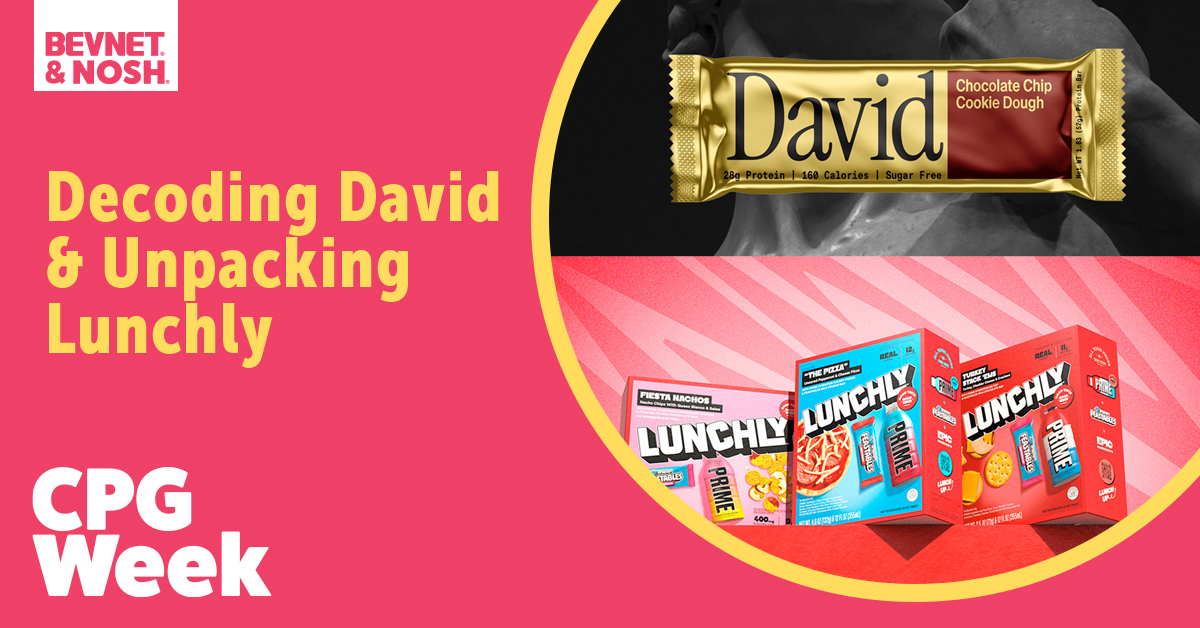
On CPG Week, the podcast team talks about Peter Rahal’s newest protein bar release, the PRIME and Feastables kid-focused Lunchly partnership, and how these two products relate to consumers’ differentiated value demands from ingredients and nutrition.
Nosh managing editor Monica Watrous kicks off the podcast asking if senior reporters Brad Avery and Lukas Southard would try one of Peter Rahal’s new products: Hormbles Chormbles. Next, the group talks about Rahal’s other new brand, high-protein snack bar David. The team goes through some of the debate surrounding David’s ingredient list and how Rahal is taking a different approach to snack bars from his previous brand RXBAR. The podcast goes on to talk about a new entrant in kids lunch kits, Lunchly, which has paired influencer-led brands PRIME with MrBeast’s Feastables.
Show Highlights:
0:30 – What’s a Hormbles Chormbles, and how is it connected to the recently launched David protein bar?
3:15 – After teasing the well-publicized launch of RXBAR founder Peter Rahal’s return to the bar category with its 28-gram option David, the team talks about the conversation happening around the brand’s ingredients.
6:15 – The group goes on to discuss how this product seems to be focused on a target consumer who is prioritizing macronutrients like protein over clean label ingredient decks.
12:00 – Brad explains a new co-branded product entering kids lunch products, Lunchly. The group debates how influencer marketing is impacting this category and whether this is a release valve for brands needing a new product to drive growth.
About the CPG Week
CPG Week is the podcast that explores the latest happenings in the consumer packaged goods industry. Join our seasoned reporting team as they dish out the week’s stories in quick, easy-to-digest episodes. Catch up on the top headlines of the week, dive into exclusive insights with the BevNET and Nosh teams, and set yourself up to make more informed business decisions. Tune in to stay up-to-date on the latest developments in the dynamic world of packaged food and beverage.
New episodes are released every week. Send us comments and suggestions anytime to cpgweek@nosh.com.
Show Highlights:
The CPG Week podcast team talks about Peter Rahal’s newest protein bar release, the co-branded Lunchly product from PRIME and Feastables, and how these two products relate to consumers’ differentiated value demands from ingredients and nutrition.
Episode Transcript
Note: Transcripts are automatically generated and may contain inaccuracies and spelling errors.
[00:00:05] Monica Watrous: Welcome to the CPG Week podcast by BevNET and Nosh, your source for the latest food and beverage industry news. I'm Monica Watrous, Managing Editor of Nosh, here with my co-hosts, Brad Avery and Lukas Southard. If you're enjoying the show, please subscribe on your listening platform of choice. On the podcast today, we're discussing industry reactions to two of the biggest product launches of the year. But first, what do you think a Hornbull's Chornbull's is, Brad?
[00:00:36] Brad Avery: You know, I don't know what it is. I could go for a Chornbull, I think. I assume. Like, I hope I want to go for a Chornbull.
[00:00:47] Lukas Southard: But why? What about Chormble makes you want it, is my question.
[00:00:52] Brad Avery: So, Monica, what is Chormble's Chormbles as far as you're aware?
[00:00:56] Monica Watrous: Well, it is a new disruptive candy brand being launched by the founders of RX Bar, Peter Rahal and Jared Smith. And it was hinted at earlier this year. This week, Jared Smith officially announced it on LinkedIn, Hornbills Chornbills. It's coming in Q1 of 2025. And it is, I believe, a protein, high protein candy. The name, I think, is getting a lot of people talking. I've seen some funny reactions on LinkedIn as well as Instagram. The whole branding was designed by DayJob, who has worked with the likes of FlyByJing, GlowNuts, and David, Peter Rahal's recent project, which we will be talks about today on the podcast. But unclear what a Hornble or a Chornble is. And is Hornble possessive or is it... Yeah, are they Hornble's Chornbles?
[00:01:46] Brad Avery: Like, do the Chornbles belong to Hornble? And then who is Hornble? Right.
[00:01:50] Lukas Southard: And the other thing is when you read it, when you look at Hornble's Chormbles, your brain kind of just says horrible crumbles, or at least mine does. And I'm not even dyslexic as far as I know, but like when I first look at it, I'm like, oh, horrible crumbles. So like, is that how you want some people to read your brand? Is this is a horrible thing? Hornble, here's a Chormble.
[00:02:10] Monica Watrous: It sounds like a Dr. Seuss candy.
[00:02:13] Brad Avery: Oh, that's actually a decent play. See, I didn't read Horrible Crumbles, I read Horrible Chormbles. I read it directly, now it's in my brain.
[00:02:21] Monica Watrous: Are we even saying it right? How do we know it's not like... Hormblaze.
[00:02:25] Brad Avery: Hormblaze Chormblaze.
[00:02:26] Monica Watrous: Oh, fancy.
[00:02:27] Lukas Southard: The CH is silent, so it's Hormblaze Ormbles, maybe?
[00:02:32] Brad Avery: Oh, gosh, yeah. This is sort of the brilliance of it is now that we're talks about it, we're like, what is it? And if you go to, they have an Instagram page up, there's not much on there. They're very much just getting going, but it definitely seems to lean into what is it?
[00:02:50] Monica Watrous: A lot of mystery, but also definitely getting us talking. I'm sure a lot of other folks are going to be talks about it too. So more to come on Hornbull's Chornbulls.
[00:02:59] Lukas Southard: I look forward to learning about the wide world of Chornbulls.
[00:03:02] Brad Avery: Read Nosh.com for all your chormble news and chormble needs.
[00:03:08] Monica Watrous: Well, I alluded to this a few moments ago. David Protein is the new product from Peter Rahal and a little background on Peter. As I mentioned earlier, he is the co-founder of our X bar, which within five years of launching sold to Kellogg, now Kellanova for $600 million. And five years later, or maybe a few more years than that, his non-compete expired and he's able to launch another protein bar. He first hinted at David the week before Expo West, which got a lot of folks talks about it in Anaheim. It was a calculated move on his part. He admitted to as much. And there was a lot of mystery for the past six months and a lot of lead up onto what is David? What is Peter Rahal's next move? And I think a lot of folks were expecting something along the lines of RxBAR, which is known for its radical transparency, the front of PAC saying six almonds, three dates, two egg whites, no BS. David marks quite a departure from RxBAR in terms of the ingredient deck. Instead of having ingredients that you can find in your pantry like almonds and dates, it has things like milk protein isolate, allulose, polydextrose, glycerin, modified plant fat, And it's got a lot of folks kind of scratching their heads thinking, I thought this was going to be RxBAR 2.0. Now, the nutritionals are the big part of this. It has 28 grams of protein, 150 calories, and zero grams of sugar per bar, which is really impressive to the fitness community. They don't care about the ingredients. They just want those macros. So you have to take a step back and consider the target audience for this product.
[00:05:02] Brad Avery: Yeah, on LinkedIn, we've been seeing a number of people responding negatively to the product launch, in particular over the ingredient panel. And I believe one of the issues is that some of these ingredients are things that you can't get into Whole Foods with. There's a very big backlash from the clean label organic community against this product. And it's a mixed bag because on one hand, they are correct that these ingredients are not clean label as we have come to understand it. However, as you alluded to, Monica, does this matter to the consumer that David the brand is targeting? And does this fitness community that regularly purchases supplements and, I mean, a lot of these people are drinking Bang and other types of energy drinks, do they care so much about whether something's organic or genetically modified? I don't know if the plant fat is genetically modified, but it's modified. Do they care or not? Or will this, in some cases, even be a selling point?
[00:06:09] Monica Watrous: Well, I will say on the bar, because I received some bars prior to the launch, the label does say contains a bioengineered ingredient. But to your point, I think that the fitness community has really moved away from this idea of clean label. And I think David recognizes and capitalizes on that. So to your point about Bang, as well as other products that have artificial flavors and sweeteners, it doesn't matter. They just want high protein, low sugar, low carb.
[00:06:37] Lukas Southard: it definitely feels like he knows who his target audience is, and he knows the kind of consumers that are gonna come to this product, and that's what he's going after. The fact that there's 28 grams of protein, as opposed to RX-Bar was like 12 grams of protein, I think, traditionally, that's a big jump, and he's going after these protein-seeking consumers that are probably in gyms and fitness-focused, the same kind of consumers that are, yeah, bank consumers or Celsius consumers that, you know, want an energy drink that might be lower in sugar, but also still has, like we talks about last week, like candy flavors and still tastes good. And it doesn't matter where those flavors are coming from, even if they're artificial. So it does feel like he knows his play here, and you got to give it to him on that front.
[00:07:27] Brad Avery: Now, to play devil's advocate for a moment, I do understand the criticisms, however, because someone with Peter Rahal's stature in this industry, with the ability to rapidly launch a product like this at, I'm assuming, a fairly large scale, You could say that he has the responsibility to be putting out a good product that's healthy or a cleaner label or forwarding the clean label movement into the mainstream with something like this. So I understand why people are a little upset about that part of it. But again, I don't know if these criticisms are feeding back into the brand's social media or if it's just a insular LinkedIn industry issue. I think there's fair points on both sides here.
[00:08:14] Monica Watrous: I can tell you that folks who are posting on the Instagram page for David and the kinds of posts that are being reposted on David's Instagram page are very favorable. And they are coming from a lot of fitness and wellness oriented folks who are super excited that a product like this exists. The main thing I keep seeing is, oh my gosh, the protein is so high. The macros are so great. And again, the ingredient deck isn't as big of an issue for those consumers.
[00:08:44] Lukas Southard: This relates also back to some of the data we're seeing in the bar category. So looking at the most recent exclusive BevNET and Nosh Insights Report prepared by Spins, what's new in the bar category, a lot of this category is not growing as quickly or is even declining in terms of sales compared to prior years. But the one area that is increasing is protein bars. So according to the report, bars with between 25 grams and 30 grams of protein, 28 grams for David, is the fastest growing subcategory with a dollar percent change of 315%. Now, granted, this is the smallest category in terms of the dollar share, but it's also tracking with 242% growth in unit sales in that same 52-week period ending in mid-August. So whereas other protein bar ranges are either flat in terms of growth or have a declining unit sales growth, the high protein 25 to 30 grams is the sweet spot it seems like right now. And to go along with that, products that have less than 15 grams of protein are declining at a much slower rate with lower amounts of protein. So in that kind of. 12 or below grams of protein, there's a lot of decline. And so people are looking, you know, as we've said many times, people are looking for high protein products and. David is, is going to deliver that with a really high protein, zero sugar, low calorie bar. So as long as you're not looking at the ingredient deck for, you know, those natural clean label shoppers, you're going to be happy with what you have.
[00:10:23] Brad Avery: You know, I do just want to note that between Chormbles and the rollout of David, Peter Rahal's marketing strategy really does seem to be like that Simpsons episode where it's Gabbo is coming. Gabbo, Gabbo, Gabbo.
[00:10:41] Lukas Southard: I do remember that Simpsons episode. Now, keep in mind, I mean, going back to Peter Rahal, like this is coming from someone who's who's a trusted founder in the space. And so even people who are not in the world of CPG as we are and know him by name as the founder of RXBAR. many consumers do recognize RxBar. And if they do find out through socials, through influencers, that this product is, you know, from the founder of RxBar, or from the same people who did RxBar, they're probably gonna be interested in that as opposed to some of the other options on the shelf. And Peter Rahal is no dummy. He knows that his name carries a lot of weight in this category, and he's been using it, as any influencer would, to build up his business and sell bars. He might be getting some pushback from certain people on socials and on LinkedIn, but he's wielding his clout as a business person should. And he's selling or he's trying to sell more product using his name.
[00:11:41] Monica Watrous: Speaking of influencers using their names to sell products, the other big product launch that we saw this week comes from two influencer-backed brands, Prime from KSI and Logan Paul, and Feastables from Mr. Beast. Brad, can you tell us more?
[00:12:02] Brad Avery: Yes, so lunchly is pitched as a somewhat better for you alternative to Lunchables But largely this is again showing the power of strong influencer brands because we have prime which Rocketed to fame last year on the back of Logan Paul and KSI and we have feastables You know coming from mr. Beast who is I believe at the time of recording still the number one youtuber on in the world and has a veritable business empire at this point. So similar to David, this is also facing a bit of ingredient debt controversy from some in the industry, particularly those who are looking at this and saying it might only be marginally better than Lunchables when it comes to health. And in this case, you're talks about products marketed to children. Now, there are some notable differences between the products' health and nutrition panels. Lunchly is significantly lower calorie and lower sugar than Lunchables. However, the products are not necessarily clean label either, especially the Prime that is included with the drinks has never pitched itself as a clean label product and contains sucralose. You also have two highly influential figures in Logan Paul and Mr. Beast who particularly speak to children. but have garnered a lot of controversy, a lot of heavy controversy. Mr. Beast recently has been sued by contestants on one of his game show videos. He's been the target of allegations of fostering a workplace rife with sexual harassment. And Logan Paul, of course, has also garnered plenty of controversy. There are questions about the ethics of some of these influencers. Now, there's also a question of You know, what is the truth to these allegations that are being levied against them? And also, how much does that filter down to the end consumer? It's no doubt that Lunchly is going to be coming out with a strong premiere based on pretty strong branding and strong marketing and names that instantly can sell products, at least for this current moment.
[00:14:16] Monica Watrous: Lucas, you have two young children. Would you send them to school with Lunchly?
[00:14:21] Lukas Southard: Possibly begrudgingly, luckily my kids are young enough that they are not watching Mr. Beast YouTube videos or watching YouTube in general, nor will I have them watch anything from Logan Paul. But that being said, I do understand this balancing act that happens as a parent with what your kids eat. Because a lot of times I sit down with my children and they don't even eat what's on the table. And so something is better than nothing. And something healthier is better than not healthy, but if you can get them to eat anything, you know, calories are calories, sustenance is sustenance at the young age. And I think, you know, there is a play here for that. That being said, you know, I did see in a separate LinkedIn post related to a separate news piece, a little interesting bit of insight from the president of Launchpad, Jeremy Smith. He called this category the healthier than the other crap, but still not healthy category. And there is a lot of that out there. And yeah, it's marginally better in terms of the calories and the sugar content and a little bit on the protein, it seems like. But, you know, if marginally better is better than nothing, then yeah, I might I might feed it to my kids. Saying all that, the whole thing, this collaboration between Mr. Beast and the Prime team, does seem like a play for relevance, as it was quoted in the story we wrote on Nosh. Kendall Dickinson, founder of Flexible Creative and writer of No Filter, said that, and she also said this once again seems like a, quote, save us moment for Prime. And there is a lot to be said there that Prime hasn't been doing as well as it was in the recent past. And Mr. Beast is facing some issues. There has been some reformulation of his Feastables product. So maybe with their powers combined, they can put these products into a new format that will drive some sales and will drive the relevance of these brands in other channels.
[00:16:21] Brad Avery: Right, and meal kits is an interesting category to go after, children's meal kits specifically, because Lunchables is a Kraft Heinz product. It's still easily the dominant player in that space, and it's a small space. There's not strong competition from what I can gather. Greenfield has lunch kits. There's the Good & Gather lunch kits at Target. There's a few other competing products that, again, are marginally to some degree healthier. Lunchly is coming out strong with branding and seems very aggressive in its approach to capture that Prime and Feasible's imagery that really can, you know, particularly get a kid saying, Mom, I want that. And you mentioned Prime has lost its growth curve. It's facing declines for several months now and has also been facing lawsuits and threats of lawsuits from several business collaborators. So is it a play for relevance? I'm not sure. I don't know if it's a, we need this to save us play, but it definitely strengthens the brands at a time where they both need a little boost for sure.
[00:17:28] Monica Watrous: I think with both of these product examples, Lunchly and David, it shows how insular our world is and how much closer we are to health and wellness trends than the mass market really cares about.
[00:17:39] Brad Avery: Right. And it's not that these trends aren't important. It's not that these trends won't be more important in the future. But for now, we got to remember that, you know, someone sees Lunchly, they're probably buying it because they saw Logan Paul and Mr. Beast more than looking at the panel.
[00:17:54] Monica Watrous: Here are some other notable bits of news from the week. Three Wishes bets on cereal-adjacent categories to fuel growth. Low-ABV brands aim to prove they're more than diet wine. And Mars appoints new CEO for kind. For these stories and more, become an insider at BevNET and Nosh. That wraps up this edition of CPG Week by BevNET and Nosh. Thank you to our audio engineer, Joshua Pratt, our director is Mike Schneider, and our designer is Aaron Willette. If you enjoyed the podcast, please subscribe on your listening platform of choice, and we will see you next time.
About CPG Week
CPG Week is the podcast that explores the latest happenings in the consumer packaged goods industry. Join our seasoned reporting team as they dish out the week’s stories in quick, easy-to-digest episodes. Catch up on the top headlines of the week, dive into exclusive insights with the BevNET and Nosh teams, and set yourself up to make more informed business decisions. Tune in to stay up-to-date on the latest developments in the dynamic world of packaged food and beverage.
New episodes are released every week. Send us comments and suggestions anytime to cpgweek@nosh.com.
Stay Informed, Stay Competitive
Unlock the articles, expert interviews, and data reports that power the food and beverage industry. Join our community and stay ahead with exclusive insights from BevNET and Nosh.