CPG Week: Celsius Goes Vertical And M&A Trends
Episode 96
In this episode:
In this episode:
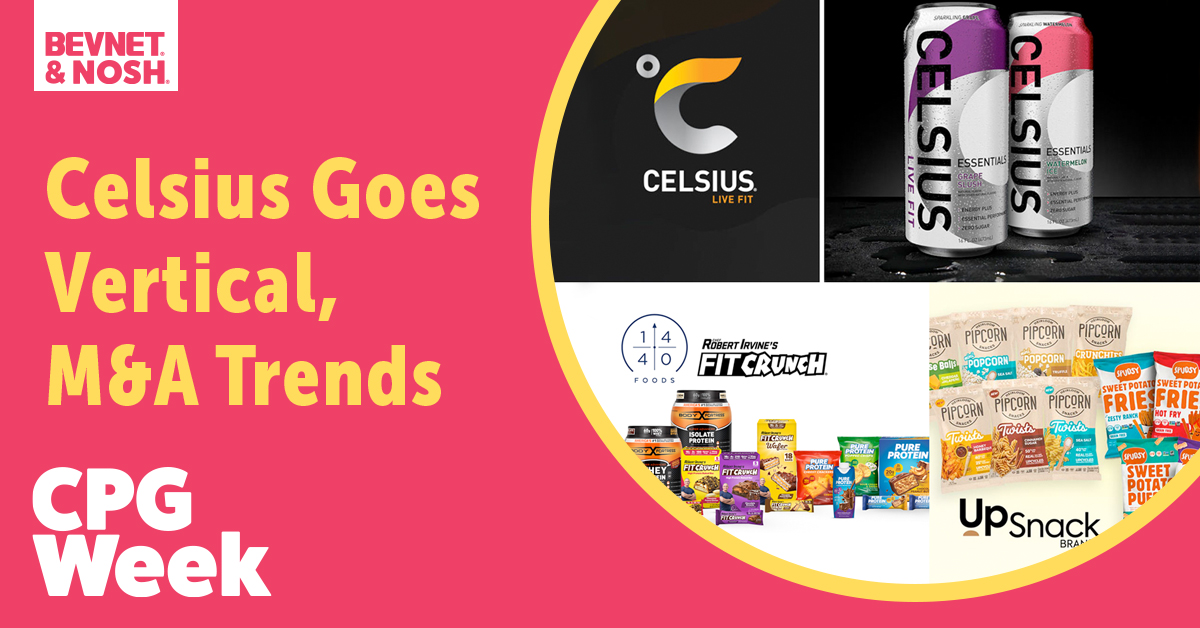
On CPG Week, the podcast team talks about Celsius’ aspirations to go vertical and a variety of smaller acquisitions across food that nod to trends in M&A markets.
The group starts by discussing Celsius’ acquisition of the brand’s manufacturing partner Big Beverage’s production facility. Then, the group goes on to dive into acquisitions across various food categories, from protein bars to pizza dough. They discuss why these deals represent a growing trend of scaling through consolidation.
Show Highlights:
0:30 – The team discussed beverage samples from House of Cha, Bear n’ Beaver and Magic Cactus.
4:30 – How do energy brands compete in an increasingly crowded category? Senior reporter Brad Avery explains why Celsius’ answer is vertical integration with the acquisition of Big Beverage’s North Carolina manufacturing facility.
7:30 – In the past week, senior reporter Lukas Southard wrote about two acquisition deals: FITCRUNCH was added to 1440 Foods’ portfolio and Pipcorn and Spudsy came together in a new entity called UpSnack Brands.
11:15 – Nosh managing editor Monica Watrous and Brad go over two other deals involving Del Real Foods and DeIorio Foods, respectively.
13:00 – The group discusses why these various deals show a trend in M&A markets. Monica shares how that relates to insight given in a recent CoBank report.
About the CPG Week
CPG Week is the podcast that explores the latest happenings in the consumer packaged goods industry. Join our seasoned reporting team as they dish out the week’s stories in quick, easy-to-digest episodes. Catch up on the top headlines of the week, dive into exclusive insights with the BevNET and Nosh teams, and set yourself up to make more informed business decisions. Tune in to stay up-to-date on the latest developments in the dynamic world of packaged food and beverage.
New episodes are released every week. Send us comments and suggestions anytime to cpgweek@nosh.com.
Show Highlights:
On CPG Week, the podcast team talks about Celsius’ aspirations to go vertical and a variety of smaller acquisitions across food that nod to trends in M&A markets.
Episode Transcript
Note: Transcripts are automatically generated and may contain inaccuracies and spelling errors.
[00:00:05] Monica Watrous: Welcome to the CPG Week podcast by BevNET and Nosh, your source for the latest food and beverage industry news. I'm Monica Watrous, Managing Editor of Nosh, here with my co-hosts Brad Avery and Lukas Southard. If you're enjoying the show, please subscribe on your listening platform of choice. On the podcast today, we're discussing M&A trends and an energy drink maker's investment in vertical integration. But first, I see that you guys have each picked up some beverages from the sample fridge. What do you have over there?
[00:00:36] Brad Avery: Well, I'm trying a new tea brand called House of Cha, and it clarifies on the can, it's not chai, it's cha. They don't really explain what the difference is, so that is one concern I have. But I will say, this is an oat milk masala cha. It is canned in America, and it drinks pretty well. I'd say it's smooth. I liked it. Lucas, you had it.
[00:01:01] Lukas Southard: Yeah, I thought it was tasty. I mean, I don't know if I would, say it's a direct comparison to like a you know chai latte you'd get like it's a hot chai latte you'd get at a coffee shop but it was good i mean it was drinkable and i i was confused also by the brand name on the front it has like some numbers that don't really relate to anything that they explain
[00:01:21] Brad Avery: I was on their website and they do explain in their logo here it says Masala Cha and then there's a little sign that says 100 kilometers and H44 and so the story they explain on the website is that in the treacherous mountain roads of India, drivers and travelers drink chai to help them go the distance. The chai was the perfect boost that it could give them the energy to drive another 100 kilometers until the next chai stand. So that's kind of what it's taking. As far as it goes, you know, thank, if they're listening, thank you for sending in the samples and it tastes quite smooth.
[00:01:53] Lukas Southard: Yeah, I'm trying a bear and beaver. That's just an N in there. It's a ginger beer. They also had like a root beer and I guess like an orange creamsicle that I haven't tried yet. It's really good. I think it's super tasty. I like ginger beer. I'm not much of a soda drinker, but when I do it is like a ginger ale or ginger beer. It's good, I do sometimes have issues when a soda is in a tall can. A 16 ounce can of soda is a lot of soda. And it's full sugar. It's full sugar, it's like real cane sugar, which makes it taste good, but I don't know if I'll make it through the whole thing, because that's just a little overload for me.
[00:02:29] Brad Avery: I've tried a few other flavors though, it is really tasty, but I don't think I've been able to finish a can because of that. Monica, what's your take on full sugar soda these days?
[00:02:39] Monica Watrous: just I don't see a lot of people doing it. And so there needs to be a reason that that differentiates it from like a traditional CSD. And if that's if it's like an imported sort of old soda shoppy shop with a P at the end that that style. Double P's with an E. If it's an old soda shop style of beverage, or meant to be nostalgic, or it's made with organic ingredients, I can see the reason for full sugar beverages. But it just seems like so many new products coming out are those mid-sugar, mid-calorie.
[00:03:16] Brad Avery: Yeah, this one in particular, Bear and Beaver, is a Canadian brand in British Columbia. They don't use dyes. They do use real ingredients, real cane sugar. That ginger beer has real ginger. The cream soda that I tried from them is with pure vanilla. So they do have some real strong flavor there. It definitely just sort of seems like a very indulgent occasion, like it is a true treat. Are you drinking anything today?
[00:03:43] Monica Watrous: I am. So I'll be, I'm actually going through a sober curious moment currently. So I've stocked up on magic cactus, low dose THC beverages. So, uh, I've got some in the fridge, uh, spiced peach variety to drink because we were recording this on election day. And I think, uh, something that'll help me take the edge off is, is very much needed.
[00:04:09] Lukas Southard: Yeah, shout out to my boy Johnny. I love that brand. That's my go-to drink at home, especially on a day like today. So I will probably be cracking on when I get home as well. So cheers to that.
[00:04:19] Monica Watrous: Yeah, all three of their SKUs are great, but Spiced Peach is my favorite. It's really, really good. Speaking of beverages, Brad, you wrote recently about Celsius and its investment in vertical integration. Can you tell us more?
[00:04:33] Brad Avery: Last week, Celsius paid $75 million to acquire one of its co-packing partners, Big Beverages Contract Manufacturing, a North Carolina-based manufacturer that has been a partner of Celsius for a while. Celsius, which is based in Florida, is getting their 170,000 square foot manufacturing warehouse facility, which is located in North Carolina. And this really is a move towards vertical integration for the company. And this is a brand that only just recently became a $2 billion enterprise. This is definitely a move for a major player now in energy drinks to streamline its production and its supply chain capabilities, especially as they continue trying to expand. I spoke with CEO John Fieldley not too long ago, before this acquisition was made, but around the NAC show. And at the time, he told me about how they are going for food service in particular. They are looking at ways to continue expanding in retail. Alternative channels are very important for them. So they want to be able to increase production, and they also want to be able to work on R&D. They are going hard on LTOs. which a lot of brands are doing these days, you know, limited time, original, exclusive flavors. This is a strong strategy. So I can see how having your own facility and vertical integration gives you all the more control and ability to experiment or try different product lines, even just for a limited time.
[00:06:07] Monica Watrous: I feel like this move really underscores a continued conversation we've been having about energy beverages and just all of the growth in that category as well as all of the capital flowing into that category lately.
[00:06:21] Brad Avery: Yeah, and remember that energy drinks are seeing some slowdown in growth, but that's also because they are lapping a period of very high triple-digit growth for a lot of these merging brands and strong double-digit growth for the category that's now slowed down a bit, but that's to be expected. You can't keep that hockey stick going forever. So I think we're now seeing a transition into what's next. So we saw KDP acquired Ghost and they already have a stake in C4. We are watching to see what happens with Alani New, which is another major player in the category, and we've been watching forever the monsters and Red Bulls of the space and how they're responding to all this new competition. With Celsius, remember as well that they are seeing their orders from PepsiCo being cut this year. But again, that's because they're lapping some pretty strong numbers from the previous year. So they're fairly confident about what the future holds. And I think this is just another sign that they want to fortify this business for the long term.
[00:07:25] Monica Watrous: Insiders can read more at BevNET.com. The story is called Celsius Moves Toward Vertical Integration with $75 Million Copacker Acquisition. Moving on to a couple of snack deals that transpired this past week. Lucas, you wrote about 1440's acquisition of Fit Crunch as well as the formation of UpSnack Brands. Can you tell us more about both of those deals?
[00:07:48] Lukas Southard: Of course, this week, Fit Crunch, which is the brand of celebrity chef Robert Irvine, it's his protein bar and powder brand, was acquired by 1440 Foods. So 1440 Foods has a pretty robust portfolio of this kind of active nutrition brands, so they operate MetRx, Pure Protein, and Body Fortress. 1440 Foods, it was set up to operate these three brands, and now The Fit Crunch, and it was set up by 4x4 Capital, a private equity firm based in in New York, and last year it received significant investment from Bain Capital, and according to my sources, they kind of equally are invested in 1440 Foods, but 4x4 Capital will kind of be overseeing the management of 1440 Foods. And what this does, even though it seems like these are all. Kind of protein bar brands that would kind of cannibalize each other in the market. There, there does seem to be brand loyalty when it comes to this category and what people are looking for in this active nutrition. And so this provides a whole new subset of consumers that are, you know, fit crunch consumers and fit crunch has been around since 2012. So it's a, it's a pretty entrenched brand. MetRx and Pure Protein as well are very entrenched in this market, so it just kind of adds a new consumer to them. In terms of Fit Crunch, it provides a needed scale in both their production stream as well as the distribution muscle of 1440 Foods, which is as I said, pretty entrenched in this active nutrition category and has a lot of contacts with new retailers that Fit Crunch could utilize. The other deal that I recently covered is basically a merger between two snack brands. It took the form of a brand new entity called Upsnack Brands, and it is essentially the merger of Pipcorn Heirloom and Spudsy. They basically are going to be controlled under Upsnack Brands, and Upsnack Brands is run primarily by Factory, which has been the primary stakeholder in Pipcorn since 2019, and with investment and a board seat for Carp Riley, who has been operating the Spudsy brand since 2020. So it's a way to kind of put these two middle tier, better for you snacking brands that have expanded into different formats under one organization and be a little bit more efficient in terms of their go-to-market strategy, as well as optimizing the co-manufacturers that they use. And, and putting all their wholesale into one location to just really try to scale up these brands, especially in light of what we're seeing in snacking, where there is some consolidation going on with Kelinova being acquired by Mars. And as we've talks about in the past. The growing suite of better for you snack brands from our home. So it's becoming harder for some of these middle tier snack brands to really operate and to carve out places. And so for them to, you know, with their powers combined, they can make a snack empire of their own.
[00:11:21] Monica Watrous: A different deal that we reported on this week involves Ready to Heat Hispanic food brand Del Real Foods, which is now a majority owned by multilatina corporation, Corporacion Multi Inversiones. I'm pretty sure I nailed that.
[00:11:36] Lukas Southard: Your Spanish is decent. It's bueno.
[00:11:41] Monica Watrous: Gracias. Palladium will remain a minority shareholder alongside the Cardenas family who founded Del Real Foods. With the acquisition, CMI Foods will expand its U.S. footprint and Del Real Foods, which was founded in 1957, will have more production and distribution muscle behind it.
[00:12:05] Brad Avery: There was one more food deal last week. Private equity firm Encore Consumer Capital finalized an acquisition of New York pizza dough producer Diorio's Foods. This is a 100-year-old brand that is known for making pizza dough balls. halls, flats, breadsticks, a big supplier for restaurants in the state and the area. And it's a deal that sees the company moving from one private equity owner to another. It came to Encore from LaSalle Capital, previously was owned by Rudolph Capital. So this is a legacy company that's been under private equity ownership for a long time. But it is interesting to see it move hands again and where it goes from there. Not too sure, but it's certainly a brand that has continued to reinvent itself and focus on innovation to stay relevant and stay on top of the industry.
[00:13:00] Monica Watrous: We've previously talks about the big deals that have transpired over the past few months, including Mars acquisition of Kelinova and cured Dr. Pepper's acquisition of Ghost. And we had speculated that maybe this would grease the wheels for some smaller deals. And it really appears as if that's what's happening.
[00:13:20] Brad Avery: Right, exactly. All the deals that we just talks about, seem to be part of a trend of, you know, some, some movement in this space, which is, again, nice to see, even if many will tell you in industry that it's still tough out there, which I fully believe it is a hard environment, and that these deals are being heavily scrutinized before they go through. But there's certainly a lot of smaller mergers that are happening.
[00:13:45] Monica Watrous: And that's consistent with a report that we just saw from CoBank, which is a national cooperative bank. An analyst is reporting that the pace of food and beverage acquisitions, though, while it has slowed from previous years, is about to pick up. And that would be on the back of some interest rate cuts that are expected to come down the line, as well as Companies that are strategically assessing and reshaping their portfolios. We've seen several major manufacturers divesting non-core businesses to focus on the core of their portfolio. A quote from Billy Roberts, food and beverage economist with CoBank says that food and beverage manufacturers are increasingly applying the 80-20 rule and devoting more attention to the 20% of their core brands and categories that account for the lion's share of the company revenue. We're seeing that with General Mills, which earlier this year divested its Yoplait, GoGurt, and WeYogurt brands to focus more on cereal, snacks, and pet food. In addition to this portfolio reshaping, we're seeing deals that are driven by increased demand in snacking and grab-and-go convenience. Some of the deals that we discussed earlier today, like Our Homes, Mammoth, shopping spree over the past year, as well as PepsiCo's acquisition of Siete Foods, which deepens its presence in natural snacks and better-for-you snacks.
[00:15:17] Brad Avery: We're even seeing some brands be defensive. This week, Lifeway, after getting a pretty large offer for acquisition by Danone, rejected it. feeling that they undervalued the company at $25 per share. And they've even made some moves to prevent a takeover by Danone to stop them from acquiring outstanding shares to become the majority owner. So this is a company that's been growing pretty significantly and now had an opportunity to exit and go private and doesn't want it. They feel that their growth is continually apace.
[00:15:53] Lukas Southard: Yeah, and it definitely does represent what we've been talks about for the last two years with inflation going up and bring new investors to a brand. This is sometimes what happens is you see some consolidation, both big and small deals. You see the bigger brands, the bigger companies looking for these. high growth brands like Siete and picking them up for, you know, a pretty nice price tag. But you also see the consolidation of some of the smaller middle tier brands because it's harder to get that capital runway to grow yourself. But with scale and, you know, with some extra support and reinvestment from your, you know, your cap table, it can really help to survive when things are still a little uncertain out there.
[00:16:40] Monica Watrous: Another signal that's supporting the idea that M&A activity is going to pick up in the year ahead are the tone, the Polish tone of executives during earnings updates and investor conferences this year. We've heard from the leaders of Mondelēz, General Mills, and Flowers Foods, all indicating that acquisitions remain a strategic priority and that they are evaluating dozens of potential bolt-ons. So the takeaway from the CoBank report is that we should expect more deals on the smaller end of the spectrum. While CoBank didn't specify the size of businesses or even purchase prices that represent smaller end of the spectrum, I think we'll see a lot of interest in brands that will help these strategics return to volume-led growth. after a period of relying on price inflation to raise their top line over the past couple of years. Here are some other notable bits of news from the week. Better Sour inks deal with Disney, launching Moana 2-inspired passion fruit gummies. Leveling up, Final Boss Sour secures $3 million. And non-alcoholic drinkers searching for novelty, flavor, and ease, say analysts. For these stories and more, become an insider at BevNET and Nosh. That wraps up this edition of CPG Week by Bevhna and Nosh. Thank you to our audio engineer, Joshua Pratt, our director is Mike Schneider, and our designer is Aaron Willette. If you enjoyed the podcast, please subscribe on your listening platform of choice, and we will see you next time.
About CPG Week
CPG Week is the podcast that explores the latest happenings in the consumer packaged goods industry. Join our seasoned reporting team as they dish out the week’s stories in quick, easy-to-digest episodes. Catch up on the top headlines of the week, dive into exclusive insights with the BevNET and Nosh teams, and set yourself up to make more informed business decisions. Tune in to stay up-to-date on the latest developments in the dynamic world of packaged food and beverage.
New episodes are released every week. Send us comments and suggestions anytime to cpgweek@nosh.com.
Stay Informed, Stay Competitive
Unlock the articles, expert interviews, and data reports that power the food and beverage industry. Join our community and stay ahead with exclusive insights from BevNET and Nosh.