CPG Week: Brand Revivals, Ultra-Processed Ban & A Distressed Co-Man
Episode 104
In this episode:
In this episode:
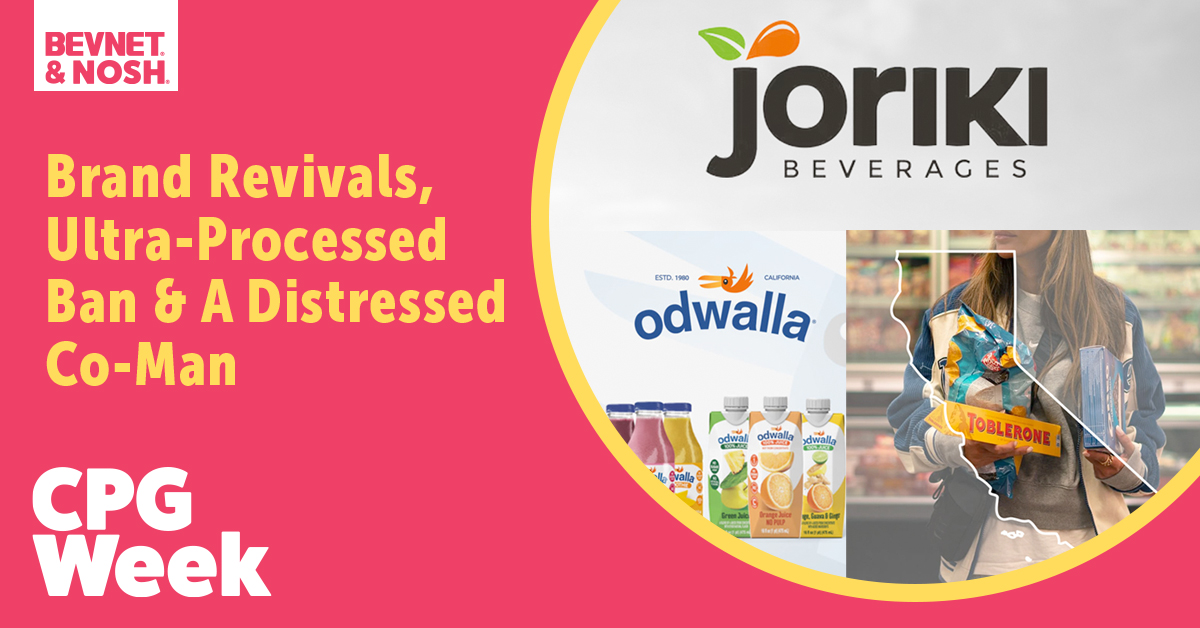
On this episode of CPG Week, the podcast dives into the revival of nostalgic beverage brands, the implications of California’s fight against ultra-processed foods and one beverage co-packer’s abrupt plant closure.
Odwalla is the latest beverage brand getting a reunion tour thanks to a legacy beverage maker. Nosh managing editor Monica Watrous and senior reporters Lukas Southard and Brad Avery discuss the strategy behind resurrecting failed brands with new value propositions. The team goes on to discuss what it means that California will be investigating the adverse health impacts of ultra-processed foods and synthetic dyes. The podcast wraps up with a briefing on what is known about the closure of Joriki Beverages’ Pennsylvania production facility.
Show Highlights:
0:30 – Slice, Jolt Cola and, most recently, Odwalla are all getting a chance to return to shelves after being discontinued. Brad explains Mexican beverage producer Grupo Jumex’s plan to bring back the former Coca-Cola-owned juice and smoothie brand.
5:30 – Do brands need to be revived or did they fail for a reason? The group discusses if nostalgia is enough to create lasting success and why there is momentum behind this resurrection trend.
9:00 – Lukas explains the recent executive order from California’s governor targeting ultra-processed foods. The CPG Week team discusses how the directive calling for state agencies to investigate ultra-processed products and synthetic food dyes will impact the larger CPG industry.
15:45 – Brad tells the team what he has learned so far about the sudden closure of a Pennsylvania co-packing facility owned by Canada-based Joricki Beverages.
About CPG Week
CPG Week is the podcast that explores the latest happenings in the consumer packaged goods industry. Join our seasoned reporting team as they dish out the week’s stories in quick, easy-to-digest episodes. Catch up on the top headlines of the week, dive into exclusive insights with the BevNET and Nosh teams, and set yourself up to make more informed business decisions. Tune in to stay up-to-date on the latest developments in the dynamic world of packaged food and beverage.
New episodes are released every week. Send us comments and suggestions anytime to cpgweek@nosh.com.
Show Highlights:
On this episode of CPG Week, the podcast dives into the revival of nostalgic beverage brands, the implications of California’s fight against ultra-processed foods and one beverage co-packer’s abrupt plant closure.
Episode Transcript
Note: Transcripts are automatically generated and may contain inaccuracies and spelling errors.
[00:00:05] Monica Watrous: Welcome to the CPG Week Podcast by BevNET and Nosh, your source for the latest food and beverage industry news. I'm Monica Watrous, Managing Editor of Nosh, here with my co-hosts Brad Avery and Lukas Southard. If you're enjoying the show, please subscribe on your listening platform of choice. On the podcast today, we are discussing California's ban of ultra processed foods and a beverage co-packers abrupt facility closure. But first, Odwalla is back. And so is Slice and Jolt Cola, too.
[00:00:38] Brad Avery: Somehow Odwalla has returned.
[00:00:41] Monica Watrous: Well, tell us more about that, Brad.
[00:00:43] Brad Avery: So Odwalla will be relaunching this year under the leadership of Grupo Jumex, a Mexican juice manufacturer that's been around for 60 something years. And they are working in partnership with Full Sail IP Partners, which had purchased the Odwalla brand from Coca-Cola in 2021 after Coke decided to discontinue it. Odwalla, of course, is a legacy brand. It's been around since 1980. It was co-founded by a group of jazz musicians, including the late Greg Steltenpol, who went on to found Calafia Farms. And so this relaunch is focusing on bringing it back to its origins. They're going clean label, minimal ingredients, and they told me that they really want to lean into the jazz angle. There's going to be a lot of jazz associated with the brand, apparently. This is still early stages, but their plan is to plug Odwalla into their existing distribution network. They're going to run it as a separate independent brand, but it's going to have the full benefit of the Groupohomex system as they roll out to stores and meet with potential buyers to get this seeded into the market.
[00:01:50] Monica Watrous: I imagine there's a lot of nostalgia for that brand.
[00:01:53] Brad Avery: Well I'm curious because it's been off shelves for about four years now and that's a big gap. You have to rebuild distribution from start. You have to let people know that it's back. On the other hand, I told my wife last night, like, oh, Odwalla is coming back. And her response was, Odwalla was gone. So there's definitely going to be plenty of people who won't even notice that it was missing at any point. But there's definitely going to be some consumers who were fans of the brand and will be happy to see it back. There's others who may have moved on. It's a big challenge when you have a brand gone from market, especially for as long as four years, which we all know is an eternity in this business.
[00:02:31] Monica Watrous: Clearly, your wife doesn't read BevNET.
[00:02:33] Brad Avery: No, she doesn't work in the industry. It's fine.
[00:02:36] Monica Watrous: Well, Slice has been gone for a long time as well. And last May, we reported on that soda brand's return via an acquisition by Suja Life. Now, Sujulife at the time said it planned to bring improved ingredients and create a new healthy soda option in its portfolio, and hinted at advantages for gut health and superior nutrition function and taste. We've now seen images of the new cans on shelf, and sure enough, callouts include prebiotics and probiotics, and four to five grams of sugar, depending on the SKU. And it appears flavors include ginger ale, orange, lemon-lime, and grapefruit spritz.
[00:03:19] Brad Avery: Is this maybe the third time in 10 years Slice has been relaunched or attempted to relaunch? And definitely seems like it's maybe going the furthest with suja behind it.
[00:03:29] Monica Watrous: Well, it remains to be seen. My question is, does the market really need another gut health focused soda? I was watching the Golden Globes this past weekend and I saw commercials for both Ollipop and Poppy during the show. And it's possible we'll see a reprisal of Poppy's Super Bowl commercial first aired last year during the big game. These companies are both going really hard at aiming to retain or grow share of this segment of the healthy soda category. And I wonder if there's room for slice in the mix.
[00:04:04] Brad Avery: It's a real question too of just how much nostalgia is there for the Slice brand. Obviously this new product is going with the classic branding style and trying to invoke the original. I remember the first iteration of a relaunch tried to position it as a sparkling water and the can looked nothing like Slice. And then there was a middle buyer at some point that did try to bring it back in its original format and now we have this version. The ultimate question, though, is there a big pent up demand for Slice or is this totally new audience? And I think you also raise a great point is does the market have room for another gut health soda? It's pretty crowded as is.
[00:04:47] Monica Watrous: And we know that Coke and Pepsi are making their own plays in that category this year.
[00:04:52] Lukas Southard: You could argue that it has become oversaturated, but there does seem to be, in my opinion, it seems to be a lot of momentum. And so I don't know why there wouldn't be an effort to try a recognizable brand with this better for you credentials to, to really kind of carve off some territory in prebiotic sodas. I don't really see any signs of that slowing down from a demand perspective. So why not?
[00:05:20] Brad Avery: It's a recognizable brand, but at the same time, people probably recognize it as a full sugar soda. So you already got to get over that hump if people do know what Slice is. And if people care what Slice is, you're going to have to also tell them that this is a different product than it was before. It just comes in a similar can. So that is a big challenge.
[00:05:40] Monica Watrous: It's a question of whether these brands need to be revived and whether these new attributes make sense for those brand equities.
[00:05:50] Brad Avery: Right. Did they fail for a reason in the first place? And I think with Odwalla, it's an interesting case where it was a Coke portfolio brand. It was a Coke portfolio brand for almost 20 years, which was the big shock when it was discontinued. But was it given a chance to succeed or did it just get hit on the chopping block in the middle of the pandemic when they were cutting a lot of other brands as well? It is a question, and how much affinity do consumers have for Odwalla is the thing that we're gonna have to see. Why does this brand stand out, especially when juice is in decline at the moment? Obviously, that could change, and there's attempts to turn it around. It's also coming in at a time where the juice category across multiple segments is in decline. There was a bump during the pandemic because people wanted immunity and were returning to old habits, but it's back down again. So this is coming at a moment where juice needs a kickstart.
[00:06:47] Lukas Southard: And I think there's something to be said about consumer demand for nostalgic products. Although Odwalla has only been off the shelves for four years, it is something that I think about in terms of a nineties beverage. Like one of the first better for you beverages that you could pick up was an RTD smoothie in a grocery store. I mean, you mentioned Jolt Cola, Monica, at the beginning, and that's another one that's playing into this nostalgia. It's being licensed by an energy and fitness supplement brand, Redcon1. And they're kind of banking on the fact that people like remember Jolt Cola and remember it as this like high caffeine cola that was big in the eighties and nineties and was trying to kind of carve out territory between Coke and Pepsi. And they want to bring it back in a newish kind of form, but with the recognizable name value of, hey, this was, as they call it, the first energy drink.
[00:07:43] Monica Watrous: just seems like a big risk to bring back product that people know in a certain way with new attributes and potentially ruin or change that brand.
[00:07:54] Brad Avery: If you want a model of where it's worked, clearly Canadian has apparently been doing pretty well for itself coming back with both a product that mirrors the old version and a healthier, better for you version. On the other hand, we've seen revivals of products like original New York seltzer that seem to have come and gone as far as I can tell, or at the very least have yet to make a major splash. And it's a question of, is this something that's better remembered, or is it something that people really were missing and wanted back? I don't know for sure. We can also look at the challenges that come when a brand disappears from market and has to come back. Look at Zico Rising, which has been on the market for longer, despite co-killing Zico around the same time. And they've had a slow roll of it, trying to get it going. And I know they're working pretty hard on charging that up and expanding it. It was a little slow going there for a while to get Zico back in the market, even roughly a year or so after it was gone. With Odwalla, it's about four or five years. So it's an even larger gap.
[00:08:58] Monica Watrous: What I want to know is whether we can drink any of these products in California in light of the new challenge, I guess, that Governor Newsom is presenting with an executive order last week. Lucas, can you tell us more?
[00:09:15] Lukas Southard: You're right, Monica. California's governor, Gavin Newsom, has started the year off with picking up a continual fight with ultra processed foods and his ongoing campaign to try and clean up public school lunches or meals provided at public schools. So the directive calls on state agencies to provide recommendations to limit the harms of what is listed as ultra processed foods. and food ingredients that pose a potential health risk. Much of those food ingredients relate to synthetic dyes. This new executive order comes on the back of California's legislature banning many food dyes from school lunches in September. And then in October 2023, the state also passed a bill called the California Food Safety Act that effectively banned various common food additives, including red dye three and potassium bromide. among others. This aligns with a potential shake-up in food regulations under President-elect Donald Trump's incoming administration. He picked Robert F. Kennedy to be the Secretary of the Department of Health and Human Services, and Kennedy has been an outspoken critic of processed foods and coined the term, Make America Healthy, again. Piling onto this, the FDA has gotten closer to finalizing its definition of the term healthy on packages. It said that nutrient-dense foods like fruits, vegetables, low-fat dairy, and whole grains are part of a healthy dietary pattern, but they also added nuts, seeds, higher fat fish like salmon, certain oils, and my personal favorite, water, to the list of what can be called healthy.
[00:11:05] Brad Avery: I'd love that. That's insane that it wasn't there before.
[00:11:10] Lukas Southard: Oh, I love it. I mean, I guess if you were calling bottling pond water and saying, this is healthy, you might run into some trouble.
[00:11:18] Justin Kendall: I suppose that's fair. Remember the raw water thing? That's true.
[00:11:21] Monica Watrous: I was going to say, pond water, it reeks of raw milk. I'm sure that there's some group of people out there who think that there's all of these really difficult to find nutrients and minerals in pond water. So that might actually be a superfood for some people.
[00:11:35] Lukas Southard: There's some algae in there. Everyone likes algae in their drinks. Be that as it may, California's move is definitely a part of an ongoing campaign that Newsom has had to try to kind of clean up the food system in California and institute regulations to try to provide more access to nutritious foods, especially to children, but also try to kind of help the issue of food deserts throughout the state.
[00:12:05] Monica Watrous: What implication does this have for brands? Because to have a patchwork of regulations state by state really complicates production and food labeling and distribution for a lot of small businesses that can't really afford to make these sweeping changes.
[00:12:22] Lukas Southard: Yeah, I mean, it is important to note that this executive order is not banning ultra processed foods, because that would be pretty difficult to do, considering that the definition of what an ultra processed food is fairly nebulous. The executive order called out packaged snacks, chips, crackers, Cookies, which I guess aren't snacks according to California. Sugary beverages and highly processed meats like hot dogs and lunch meat as ultra processed foods. But there isn't a FDA definition of ultra processed foods as far as I know.
[00:13:00] Monica Watrous: No, it's not a defined term by anybody.
[00:13:04] Lukas Southard: Yeah, so this law isn't banning them, but it is calling for state agencies to investigate how to find alternatives to some of these products that they're calling ultra-processed foods within the food system and within food that is delivered through the state.
[00:13:24] Brad Avery: What we do also find sometimes, especially with California in particular, is if they implement some sort of regulation, that usually de facto becomes regulation for the country, because for most manufacturers, it's not going to be economical to produce two different versions of the product. So you see that with, say, BPA lining in cans, a lot of Brands just, you know, ignore the BPA lining because they're not gonna be able to sell in California and it'd be ridiculous to try and produce a separate product just for California when you could just produce it all that way. So this is, whatever effect it has, going to have a ripple effect on the rest of the country.
[00:14:03] Monica Watrous: Man, you can't have any fun in California. They came for our weed drinks. They're coming for our Oreos. What's next?
[00:14:11] Lukas Southard: Well, it's funny you bring up the weed drinks because that, you know, happened last year and it was a big shock to the industry. But in talking to a lot of THC beverage producers and, and stakeholders, a lot of them are just moving to a different market and they say, okay, like, yeah, it's unfortunate. We can't sell these products in grocery stores in California, but there's a huge market for these products in Florida, in Georgia, in Texas, in. Tennessee and in places that don't have a regulated THC market. So we're just going to go there. And besides the fact that a lot of them are still sending THC drinks through the mail. Personally, I had some sent to my parents' house over the holidays and the brand I ordered from did not seem to have a problem sending THC drinks in the mail.
[00:14:55] Monica Watrous: Don't name that brand. We don't want to get them in trouble.
[00:14:57] Lukas Southard: I'm not going to name any names. I'm just going to say I enjoyed a couple of THC drinks, hemp-derived THC drinks over the holidays in a D to C fashion.
[00:15:07] Brad Avery: Feds are going to be knocking on your door, Lucas. They want the names. Name the names.
[00:15:11] Monica Watrous: No, they're coming for the brand. They don't care about Lucas.
[00:15:16] Lukas Southard: I hope they don't come for me. I've got a whole cellar full of them. And technically, in Massachusetts, we're not supposed to have them either. But you know.
[00:15:23] Justin Kendall: What? Lucas is just out here admitting the crimes on the podcast. What can I say? You know, I live life on the edge. Criminal mastermind.
[00:15:31] Monica Watrous: And speaking of beverages, Brad, you reported on a beverage co-packer in Canada abruptly shutting one of its sites this past week. Can you tell us more?
[00:15:42] Brad Avery: Yes. So Joe Ricci Beverage, a Canadian co-packer, abruptly decided to shut down its only U.S. facility in Pittson, Pennsylvania on New Year's Eve. Employees at the plant were treated to emails telling them that they wouldn't be returning to work after the holiday last Wednesday. And since then, there's been a lot of questions about what is going on. This was a fully functioning plant that, according to local news reports, produced products for Welches and Coca-Cola. And in Canada, they have three facilities that produce for Danone and Walmart, or at least they did until last summer when there was a listeria outbreak in some of the plant-based milks that they produced at one of their facilities. So last week, Joureki reportedly filed a notice of creditor protection with the Office of the Superintendent of Bankruptcy in Canada. They declare that they are not bankrupt but, quote, Now, I tried to get in touch with Joe Ricci last week, but phones went unanswered. We're not really sure exactly what's going on. I was able to talk to a few employees at the plant who asked that they not be named, but they did say that it was pretty abrupt, and they clarified that it was hearsay, but they thought that it might be related to the Listeria outbreak and some destabilization that happened with the company afterwards. However, we cannot confirm that, and that is just what a couple of now jobless former employees told me. So this is, of course, a developing story, and it's a bit odd. There's over 220 people that were put out of work without notice. There's talks that they might want to file a lawsuit, assuming that a Pennsylvania state regulation investigation finds that there was wrongdoing in violating the Warren Act and requirements of notice. Reportedly, a potential acquisition had fallen through around Christmas that led to this closure. But otherwise, there's still a lot of questions that we're trying to answer here, and we can't confirm much of anything other than that this Pennsylvania facility is no longer open.
[00:18:00] Monica Watrous: As we've seen with Boar's Head recently, it's really hard to come back after a foodborne illness event. And I wouldn't be surprised if that was the issue causing that closure.
[00:18:12] Brad Avery: I can say for sure that the plant that had that issue was shuttered for months, and I'm not sure whether or not it's opened again yet. So certainly there was lost revenue.
[00:18:22] Monica Watrous: Well, Brad, we're counting on you to continue to report on this developing story. And here are some other notable bits of news from the week. Danone sues Lifeway CEO Smoliansky for value-destroying share move. How the real cereal company is strategizing around simplicity. And Advent International to acquire Duke's mayo maker Sour Brands. For these stories and more, become an insider at BevNET and Nosh. That wraps up this edition of CPG Week by BevNET and Nosh. Thank you to our audio engineer, Joshua Pratt, our director is Mike Schneider, and our designer is Aaron Willette. If you enjoyed the podcast, please subscribe on your listening platform of choice, and we will see you next time.
About CPG Week
CPG Week is the podcast that explores the latest happenings in the consumer packaged goods industry. Join our seasoned reporting team as they dish out the week’s stories in quick, easy-to-digest episodes. Catch up on the top headlines of the week, dive into exclusive insights with the BevNET and Nosh teams, and set yourself up to make more informed business decisions. Tune in to stay up-to-date on the latest developments in the dynamic world of packaged food and beverage.
New episodes are released every week. Send us comments and suggestions anytime to cpgweek@nosh.com.
Stay Informed. Stay Competitive.
Become an Insider to unlock exclusive CPG insights, data, education, and industry exposure for food & beverage leaders.

Industry Analysis
Context behind the headlines

Data & Reports
Category performance & trends

On-Demand Education
Expert-led video courses