CPG Week: Artificial Intelligence and Slice Resurrected…Again
Episode 76
In this episode:
In this episode:
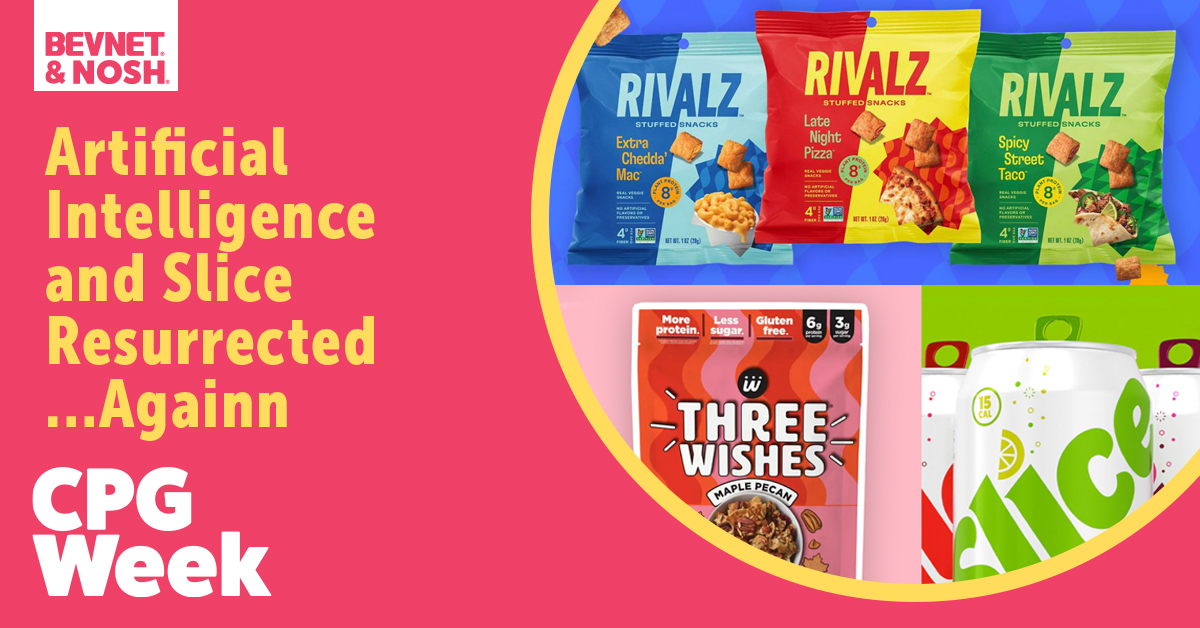
How does artificial intelligence fit into the CPG industry? Senior reporter Brad Avery walks the podcast team through A.I.’s impact on everything in food and beverage from product ideation and formulation to streamlining operations. Nosh managing editor Monica Watrous shares data on the granola segment and the CPG Week group discusses how recent product launches speak to enlivening a staple category. Lastly, the team examines the news that Suja Life has acquired the trademark for former Pepsi soda brand Slice.
Show Highlights:
0:30 – After reminiscing about the ‘90s era game show “Supermarket Sweep,” Monica quizzes Brad and Lukas on CPG trivia from the show (with a little help from BevNET CMO Mike Schneider).
5:20 – Brad talks A.I. machine-learning, how it is being implemented in CPG food and beverage, and why having a human touch is still important to brand-building.
10:30 – Monica shares what she found when looking more closely at the granola category.
15:00 – The team discusses the news that Suja Life has acquired soft drink brand Slice and might be relaunching it as a new functional, gut-health soda. The group goes on to throw out some other nostalgic beverage brands they would like to see resurrected.
About the CPG Week
CPG Week is the podcast that explores the latest happenings in the consumer packaged goods industry. Join our seasoned reporting team as they dish out the week’s stories in quick, easy-to-digest episodes. Catch up on the top headlines of the week, dive into exclusive insights with the BevNET and Nosh teams, and set yourself up to make more informed business decisions. Tune in to stay up-to-date on the latest developments in the dynamic world of packaged food and beverage.
New episodes are released every week. Send us comments and suggestions anytime to podcast@nosh.com.
Show Highlights:
The CPG Week podcast team talks about how artificial intelligence is creeping further into all aspects of food and beverage, why granola is having a moment, and the resurrection of soda brand Slice.
Episode Transcript
Note: Transcripts are automatically generated and may contain inaccuracies and spelling errors.
[00:00:05] Monica Watrous: Welcome to the CPG Week podcast by BevNET and Nosh, your source for the latest food and beverage industry news. I'm Monica Watrous, Managing Editor of Nosh, here with my co-hosts, Brad Avery and Lukas Southard. If you're enjoying the show, please subscribe on your listening platform of choice. On the podcast today, we're discussing AI, granola, and the reinvention of a cult classic soda brand. But first, Before we started recording, we were talks about the classic game show Supermarket Sweep. Lucas, you started watching some reruns of that this weekend?
[00:00:40] Brad Avery: Yeah, I somehow stumbled on a channel. I was staying at a little hotel and they had, it was Supermarket Sweep 24-7. So I watched like three episodes and it really brought me back. The 90s era of game shows was great, but also that specifically was a show that I was for some reason obsessed with as a kid. I just loved the idea of it.
[00:00:58] Monica Watrous: So Brad has never seen it. How would you describe it to someone who isn't familiar?
[00:01:04] Brad Avery: So it was a game show with almost like Price is Right. They would choose three two-person teams were chosen from the crowd and they were asked supermarket trivia or CPG trivia throughout the first two-thirds of the show and then the big finale was the the groups would go out into this staged supermarket and grab as much stuff as they could basically but it was it was very strategic about like what stuff you grabbed was high value and then they tallied it all up at the end of the game and whoever had the most stuff, one. But the joy of it for me was watching them run with reckless abandon through a supermarket and grab as much stuff as they could. I just thought that was a great idea.
[00:01:53] Lukas Southard: So you get to keep your groceries.
[00:01:56] Brad Avery: Yeah, I get the feeling that all the groceries there did not actually have anything in it. Everything seemed really light. Like they always like go for the turkeys or the hams and they're just like throwing these things into their cart. So I imagine they were styrofoam turkeys maybe? It was all a lie. I can't believe that. They can just lie to you on TV like that?
[00:02:15] Lukas Southard: That's horrible.
[00:02:16] Brad Avery: As a 10 year old kid though, I was just like, oh, look at all those turkeys. That's great. I'm into it.
[00:02:22] Monica Watrous: Well, I have grabbed some questions from an old episode of Supermarket Sweep to test your 90s CPG knowledge. Are you guys ready?
[00:02:31] Brad Avery: We are going to fail this, but go for it. I'm interested. Maybe not.
[00:02:36] Monica Watrous: Maybe not. OK, here's the first one. You have to name this. This is a slogan question. Regardless of all the other brands on the market, when it comes to their product, this company claims, quote, it's the real thing.
[00:02:52] Lukas Southard: It's like a mayonnaise brand.
[00:02:55] Brad Avery: No, it's on the tip of my tongue.
[00:02:59] Lukas Southard: It's the real thing.
[00:03:02] Brad Avery: I know it's not right. Pepsi.
[00:03:06] Monica Watrous: You're close, Lucas. It's Coca-Cola.
[00:03:09] Brad Avery: I knew it was a soda. I knew it was a drink.
[00:03:11] Monica Watrous: So close. Oh, this is hard. I've got two more questions. After the Thanksgiving turkey, the kids may fight over who gets this brand of salad dressing.
[00:03:24] Lukas Southard: Newman's Own.
[00:03:26] Monica Watrous: I don't think that brand existed.
[00:03:28] Brad Avery: I think it was earlier than that. I'm trying to think of salad dressings from then. Ranch?
[00:03:34] Monica Watrous: Well, think about the context of the question. After the Thanksgiving turkey, the kids may fight over who gets this.
[00:03:45] Brad Avery: I told you I wasn't going to be good at this. I know.
[00:03:47] Lukas Southard: I was five years old when this show came out.
[00:03:54] Brad Avery: I don't know. Hidden Valley Ranch. I know it's not right. It's Wishbone. Wishbone. Wishbone. That was a brand? Okay. Yeah, that makes sense. That makes sense.
[00:04:07] Monica Watrous: Okay. Well, we've got one more and I'm really hoping you guys get this one. Pressure's on. If not, our director and chief marketing and revenue officer, Mike Schneider, will come in with the assist. OK. Naming their product after an employee's hometown in Massachusetts, the Kennedy Biscuit Company began producing these in 1892.
[00:04:35] Brad Avery: Boston baked beans?
[00:04:39] Monica Watrous: Think about where you are.
[00:04:41] Brad Avery: Cape Cod chips?
[00:04:42] Monica Watrous: or I don't know, Brad, where are you right now in this moment?
[00:04:46] Lukas Southard: I'm in Newton, Massachusetts. Fig Newtons. Yes. Oh my God. Oh, okay. Finally got one. All right.
[00:04:55] Monica Watrous: Yes. Okay. Well done or I don't even know if I can call what just happened well done, but nice try and thank you for playing.
[00:05:05] Monica Watrous: That's more like it. Yes.
[00:05:08] Monica Watrous: Moving on to the first topic of today's episode, Brad, you've been writing about artificial intelligence and all of its applications in packaged food and beverage. Can you tell us more about how brands are using this for their businesses?
[00:05:22] Lukas Southard: Yeah, so it's been pretty inescapable for several months now. The AI is everywhere. It's being integrated into all sorts of platforms online, and CPG in the food and beverage business is no different. Last month, I wrote a pretty large feature on Nosh about that. They're here. Nothing spooky about these real-world AI uses in CPG. I wish I could take credit for that headline. Credit goes to Editor-in-Chief Jeffrey Klineman. Absolutely. One thing that we're seeing is brands that are using AI for formulation. So snack brand Rivals is one example of putting a lot of investment into an AI platform for ingredient formulation. Before them was NotCo with their plant-based milks and plant-based meat alternatives. They are based in Latin America and they've also had a proprietary AI system for identifying ingredients. This is one of the key ways that we're already seeing AI used in food and beverage. More recently this month, we've started to see some other updates from other parts of the industry. Progressive Grocer reported just a week ago that Erawan has been improving its labor efficiency with an AI-powered workforce management program that is going to help them with scheduling, with payments. There's an app involved with it for the employees to use. So we're seeing this technology very quickly find its way into all manner of the back end. I think sometimes though where people get a little confused is you see the chat GPTs, you see the image generation, and then you have to ask the question of how is this being used in a way that's practical.
[00:07:07] Monica Watrous: Well, and you talks about using it to identify ingredients in recipes. Another example that you wrote about in your feature comes from Preem, which makes a low FODMAP pudding. And the founder of that brand was able to identify a key ingredient in the formulation. But then sometimes AI suggests putting glue in cheese. So it's not a perfect science, is it?
[00:07:33] Lukas Southard: That's a great point, though, because what we're seeing right now is Google has kind of rushed out an AI-powered search response, and it's been giving people a lot of wrong answers, a lot of very absurd answers, and the one you alluded to was something that someone really got, which is, how do I make the cheese stickier in my pizza? And it suggested putting some Elmer's glue, some non-toxic school glue, to get the cheese to stick. And these are the kind of issues that come up with generative AI, particularly with chat GPT and chatbot style programs. The engineers sometimes call it hallucinations, but it's more or less a mistake. I think someone traced that glue fact to a Reddit post and it just seemed to have drawn from there. And so that's something when we're talks about this higher end where it's your company on the line, you should be a little cautious of.
[00:08:31] Monica Watrous: Well, followers of BevNET and Nosh social media platforms also have seen how AI can contribute to product concepting. Our chief marketing and revenue officer and the director of this podcast, Mike Schneider, has had a lot of fun coming up with creative collaborations and flavor innovations for a lot of the brands that we write about and support in our community.
[00:08:59] Lukas Southard: I do think that's a good point, though, about envisioning products. And I do think some designers and some brands, particularly startup brands, are using, say, that image generation as just a way to test out ideas. I don't think anything that it produces is necessarily going to be ready to ship, although some platforms are saying that they can do that. But I do think it's an interesting sounding board. The Preem example, the founder there, she was trying to find a preservative that met all her needs about natural and health, and she couldn't get that answer from anywhere. And so she asked ChatGPT, and ChatGPT gave her, in this case, a correct answer. And it was one that she then went out and verified, and it was the perfect solution for her product. So those are little ways that if you don't have the investment to get a whole AI system up and running with big data sets, you can use some of these free programs in creative ways and scrappy ways that can give you vital information or just allow you to think through problems.
[00:10:07] Monica Watrous: But you still need a human touch because it's not perfect.
[00:10:11] Lukas Southard: I think so. I think there's a lot of optimists who see AI eventually not needing that human touch, but I still think, at the moment, you absolutely need that human touch.
[00:10:22] Monica Watrous: Insiders can learn more by reading your feature, Brad, at BevNET and Nosh, and tuning into the Community Call on the same topic. Moving on from a very high-tech concept to something that is quite low-tech, granola. So we've been noticing a lot of notable launches in this category recently, some elevated flavor profiles, chef-crafted recipes, high-protein, grain-free, low-carb, superfood ingredients. And that prompted me to look into the category and see what was going on. I wrote a story on Nosh called Category Close-Up, What's Up With Granola? What we learned by looking at SPIN's data is the shelf-stable granola and muesli segment generated just over $1 billion in sales, and that was an increase in unit sales of 4.5% year-over-year in natural and multi-outlet retail channels. We've seen a lot of dollar sales growth across a number of categories, but to see unit sales growth is saying something. We also saw social chatter about granola has increased nearly 24% over the past year according to TasteWise. So I'm just wondering why are we seeing so much activity in the granola category lately?
[00:11:46] Brad Avery: Well, I think granola is just something that everyone loves. I personally love granola as the cereal maven of the, of the team. I put granola in my cereal mixes, as you know, but there's been a lot of new, new brands kind of getting into that. So Three Wishes is a cereal brand that launched its first ever granola in a line extension. It's a grain-free granola and it comes in three varieties. We also saw direct to consumer wellness brand chroma debuted a super granola. This is coming off the back of their super ramen. So they're adding in all these functional benefits to. these products that people have grown to love and seem to be a pantry staple. And then also we saw Rhine Snacks, which is not really getting into breakfast so much, but they did acquire a Vermont-based granola producer, Small Batch Organics, and they've been integrating granola into their remixed snacks with their dried fruits. So they had a, uh, cherry cashew crunch remix that has little granola clusters in there, um, as, as their new kind of snack variety. And, and I know that they have more innovation coming out this year now that they've taken over this, uh, granola manufacturing as, as their, their own manufacturing plant.
[00:13:12] Lukas Southard: Yeah, Monica, your story points out something at the end there that I think is interesting that we're seeing across pretty much all CPG is a lot more flavor innovation and kind of, I don't know, funky flavors is the right word. You know, smoky pineapple, sweet curry, magical. mystical matcha, salted chocolate tahini. I mean, these are interesting creative flavors and consumers are trying out different things. I mean, we see that as a limited edition offering in plenty of categories, strange flavors, new flavors, international flavors. So granola seems to be embracing that just as every other category is.
[00:13:49] Monica Watrous: Right. And we're also seeing some interesting new ingredients that are starring in some of these formulations. One startup has a buckwheat based granola and another uses tiger nuts as its hero ingredient. And purely Elizabeth, which has been a leader in this segment, the top selling granola brand in the natural category for over seven years. In January, it unveiled its cookie granola, which is an indulgent fusion of breakfast And actually Purely Elizabeth just this week launched its first ever large scale advertising campaign on the heels of that successful launch. That brand achieved 56% year over year growth in the past quarter. So something's going on with granola.
[00:14:33] Lukas Southard: One thing I'd love to find out is the consumer demographics now. I mean, we think about granola as shorthand for that kind of earthy, crunchy person. Like Lucas. Yeah, like Lucas. So who are the people that are buying his new product?
[00:14:48] Brad Avery: I mean, hey, I did go to school at Santa Cruz and grew up in California, so I guess I just have to live into that.
[00:14:54] Lukas Southard: He's hugged many a tree.
[00:14:57] Brad Avery: We used to climb trees at Santa Cruz, actually.
[00:15:01] Monica Watrous: Another development that we reported on this week involves the acquisition and reinvention of a classic soda brand. What happened with that, Lucas?
[00:15:12] Brad Avery: Slice is back, again. It was announced this week that Suja Life, the parent company to both cold press juice brand Suja Organics and shopmaker Vive Organic, has acquired the trademark for the former Pepsi soda brand Slice. Suja Life announced in the press release that, quote, the relaunch of Slice will not just be an all-natural low-calorie soda, but one that delivers advantages of gut health. with superior nutrition. So it seems to be a nod to the trend towards pre and postbiotic soft drinks. And Suja appears to be getting into the gut friendly soda game. So slice pop, I guess would be maybe, maybe what we might see in coming months.
[00:16:03] Lukas Southard: It's worth noting that this is now the third time in six years that someone has announced a relaunching slice. In 2018, a VC group tried to relaunch it as a zero calorie sparkling water, kind of a spindrift variant with organic juice. And the branding was totally different. It was called Slice, but it looked like something totally different. And then we didn't hear too much about that. And then three years later in 2021, a different group announced they were relaunching it as like a classic style with branding that looked much more like the old 90s cans. and it was a real soda and then we didn't hear so much about that and then now it comes out that Suja has bought them. So I think it's interesting that people keep relaunching this brand. I mean it's worth remembering that Slice began in 1984 and was discontinued by Pepsi in 2005. So they're gonna be relaunching a brand that for, there's legal adults who have never lived in a world with original Slice.
[00:17:05] Monica Watrous: So what is it about this brand and why do consumers want to embrace this, you know, an 80s soda brand in a new format and a new, you know, with new liquid and new branding?
[00:17:18] Lukas Southard: Well, I think you've got to reverse the question is not why do consumers, it's do consumers want to embrace this brand? Sure. I mean, we all remember this product from the 90s, the 80s.
[00:17:28] Monica Watrous: You don't Brad, but Lucas and I do.
[00:17:30] Lukas Southard: I remember Slice. He's not that much younger than us.
[00:17:36] Monica Watrous: You never saw a supermarket sweep, I don't know.
[00:17:41] Lukas Southard: But I think the other interesting point is this is also Suja's second acquisition. Remember in 2022 they bought Vive and that gave them a real controlling share of the juice shot category. This is them now innovating through acquisition into soda. And they've had success with their first acquisition. Let's see how their second acquisition goes.
[00:18:04] Brad Avery: Yeah, according to Suja, they control about 50% of the cold press juice shot category. So they're not an insignificant player in the beverage, better for you beverage industry. And they launched a three SKU line of plant-based protein at the beginning of the year.
[00:18:24] Monica Watrous: I just wonder if we need another gut health soda. We just saw from Bloomberg this week that Ollipop has $500 million in sales. They're pretty much owning the category alongside Poppy. Why bring in another player?
[00:18:39] Brad Avery: And with Ollipop announcing they had $500 million in sales this year, It seems like it's overcrowded, but I think that means that there is a lot of demand for these products. And that's not to say that there couldn't be another player that could find a way into the gut health soda category and have success.
[00:19:04] Monica Watrous: I wonder if we'll see any other. reinventions of brands similar to Slice that will be taking on modern attributes that are relevant to today's consumer.
[00:19:19] Lukas Southard: You know, I never got to try Orbitz. I've always wanted to try it. Someone should buy that and make it because I want to drink a lava lamp.
[00:19:28] Monica Watrous: Do you though? I do. I'm curious.
[00:19:31] Brad Avery: One brand that I would love to see come back in a healthier version. Now this might be before your time, Brad, but do you all remember Squeeze-Its?
[00:19:41] Monica Watrous: Yes.
[00:19:42] Brad Avery: The little, they were like kids drinks and they were in a molded like plastic, almost like a, like a soda pop glass bottle, but it was plastic. And it had like a figure on it. I've had these. I know what you're talks about. It was basically just sugar water. It brightly colored. But I remember as a kid, I wanted them so bad and my parents would never allow me to have them. But I wonder if someone could bring that back in a, in a healthy version, like a kid's version.
[00:20:08] Monica Watrous: I don't even know what that would be, but I had those in my fridge growing up. Yeah, maybe like I don't know. I actually would like to see like a alcohol application for that. Like put some, like a squeeze it with like tequila.
[00:20:22] Lukas Southard: Yes. Oh, wow. Now we're talking. Oh man, we got it. Cut this up. Cut this up. These ideas are gold. We can't just be putting these out there.
[00:20:31] Monica Watrous: No, we want somebody to make this for us, Brad.
[00:20:33] Brad Avery: Yeah. Yeah. We all know that getting into the beverage game is very difficult. So we're just throwing ideas out there and whoever wants to take them, they can take them. Just send us samples of the boozy squeeze-its, please.
[00:20:45] Monica Watrous: Boozy squeeze-its. Amazing. Here are some other notable bits of news from the week. How South 40 Snacks scaled through a unique sourcing model, inflation shifts consumer grocery sentiments and shopping habits, and a drink with Free AF founder Lisa King. For these stories and more, become an insider on BevNET and Nosh. That wraps up this edition of CPG Week by BevNET and Nosh. Thank you to our audio engineer, Joshua Pratt, our director is Mike Schneider, and our designer is Aaron Willette. If you enjoyed the podcast, please subscribe on your listening platform of choice, and we will see you next time.
About CPG Week
CPG Week is the podcast that explores the latest happenings in the consumer packaged goods industry. Join our seasoned reporting team as they dish out the week’s stories in quick, easy-to-digest episodes. Catch up on the top headlines of the week, dive into exclusive insights with the BevNET and Nosh teams, and set yourself up to make more informed business decisions. Tune in to stay up-to-date on the latest developments in the dynamic world of packaged food and beverage.
New episodes are released every week. Send us comments and suggestions anytime to cpgweek@nosh.com.
Stay Informed, Stay Competitive
Unlock the articles, expert interviews, and data reports that power the food and beverage industry. Join our community and stay ahead with exclusive insights from BevNET and Nosh.