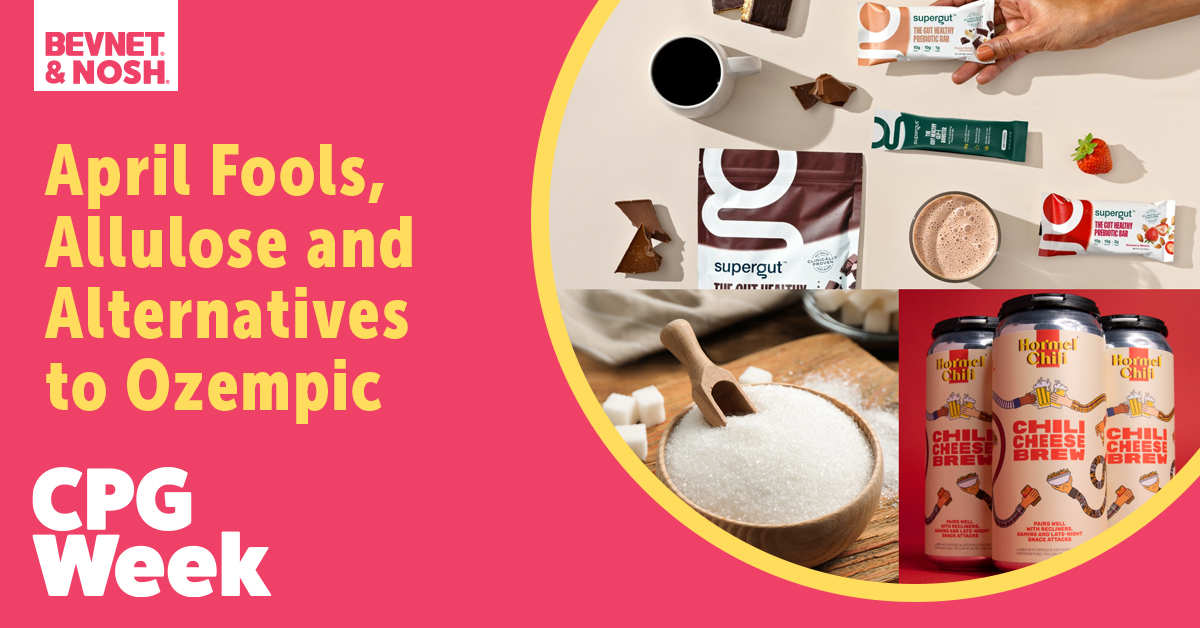
CPG Week: April Fools, Allulose and Alternatives to Ozempic
Episode 67
In this episode:
In this episode:
With April Fool’s Day fast approaching, Nosh managing editor Monica Watrous tests senior reporters Brad Avery and Lukas Southard to see if they can tell the difference between real CPG launches and prank products that have shown up in marketing campaigns over the years. After the Prank Product Pop Quiz, the team discusses how allulose is being talked about as “nature’s GLP-1” and the gray area around that assertion, leading to a bigger conversation on the state of sweeteners highlighted by a New York Times exposé about sugar cane harvesters in rural India.
Show Highlights:
0:30 – Senior reporters Brad Avery and Lukas Southard test their knowledge of April Fool’s Day CPG products with a pop quiz from Nosh managing editor Monica Watrous.
6:00 – Monica talks about how allulose has become a hot topic in food and beverage as some brands are positioning it as a natural alternative to GLP-1 weight loss drugs.
7:15 – Lukas explains what he has learned about alternative sweeteners and appetite suppression drugs after talking to Supergut founder and CEO Marc Washington at Expo West.
10:30 – The team discusses why there doesn’t seem to be the perfect sweetener for CPG brands with perceived downsides to all options in the category from stevia to erythritol to cane sugar.
About the CPG Week
CPG Week is the podcast that explores the latest happenings in the consumer packaged goods industry. Join our seasoned reporting team as they dish out the week’s stories in quick, easy-to-digest episodes. Catch up on the top headlines of the week, dive into exclusive insights with the BevNET and Nosh teams, and set yourself up to make more informed business decisions. Tune in to stay up-to-date on the latest developments in the dynamic world of packaged food and beverage.
New episodes are released every week. Send us comments and suggestions anytime to podcast@nosh.com.
Show Highlights:
In this episode, the team discusses industry pranks and the controversy surrounding various sweeteners, including allulose and erythritol.
Episode Transcript
Note: Transcripts are automatically generated and may contain inaccuracies and spelling errors.
[00:00:05] Monica Watrous: Welcome to the CPG Week podcast by BevNET and Nosh, your source for the latest food and beverage industry news. I'm Monica Watrous, Managing Editor of Nosh, here with my co-hosts, Brad Avery and Lukas Southard. If you're enjoying the show, please subscribe on your listening platform of choice. On the podcast today, we're discussing April Fools, Allulose and alternatives to Ozempic. So we're starting to see some early April Fool's marketing stunts coming through. And I've prepared a little pop quiz for you guys to test your knowledge of outlandish CPG items, whether they're actually real or April Fool's pranks. Are you ready, Lucas?
[00:00:45] Brad Avery: I will do my best. I'm very bad at these. I'm gullible.
[00:00:49] Monica Watrous: Are you ready, Brad?
[00:00:51] Lukas Southard: I'm as ready as I'm ever going to be.
[00:00:54] Monica Watrous: All right, let's go. Here's your first product. Chobani Skin is a line of Greek yogurt-based face masks enriched with real fruit. Offerings include a hydrating mask with coconut, an anti-aging mask with antioxidant-rich blueberries, and a brightening mask with banana, pineapple, and mango, real or fake.
[00:01:14] Lukas Southard: I'm going to go with that's an April Fool's joke. It's just the word skin does not go well with Chobani. And so I think I've got to just go with April Fool's for that reason.
[00:01:26] Brad Avery: I'm going to go with Brad. I think this is an April Fool's, but I kind of want it to be true because it kind of does sound refreshing to put on your face.
[00:01:35] Monica Watrous: OK, it is an April Fool's joke. But you probably still could put that on your face and maybe get some kind of hydrating skin benefits from it. Chobani skin.
[00:01:42] Brad Avery: Tonight I'm going to rub Chobani on my face just to see what happens.
[00:01:47] Monica Watrous: All right, product number two. Hormel Chili Cheese Brew is an American lager featuring a corn chip flavored base with a mix of savory spices and hints of cheddar cheese powder. Real or fake?
[00:02:00] Lukas Southard: I'm saying real on this. Nothing about that is unusual to me. That sounds totally real. Why would you not make that? It doesn't sound bad either. I'm totally going for real.
[00:02:12] Monica Watrous: All right, you guys are two for two. That is a real product. Came out last year around the Super Bowl. Okay, number three. Van Lewin joined forces with Kraft Heinz to develop Grey Poupon Dijon mustard ice cream with salted pretzels. Real or fake?
[00:02:29] Lukas Southard: Fake, but you could absolutely do that for real if you wanted to.
[00:02:33] Brad Avery: I'm gonna zag here. I'm gonna say real just because I feel, the pretzels throw me off, but I feel like people have tried this savory ice cream before and it has legs.
[00:02:47] Monica Watrous: Lucas is right. That is a real product. Damn, I'm so confident. And it should come as a surprise because if you think about some of the products from Van Leeuwen, they had pizza ice cream, ranch dressing ice cream, mac and cheese.
[00:02:58] Brad Avery: The ranch dressing, that was the one that was kind of in the back of my head, I think.
[00:03:02] Monica Watrous: The next product, Frito-Lay teamed up with IHOP to introduce Rooty Tooty Fresh and Fruity flavored Lay's potato chips, which have notes of strawberry topped pancakes with syrup and bacon. Real or fake?
[00:03:16] Brad Avery: Should be real. Oh, I was going to say should be fake. I hope it's fake. I'm going fake on this one. That sounds gross. Tooty Fruity chips? I don't know.
[00:03:26] Monica Watrous: Yeah, they're real. So, Brad, when you try them, you let us know what you think, because I don't think that Lucas and I are going to give those a shot.
[00:03:33] Lukas Southard: I'm going to have to track them down. That's a hard no for me.
[00:03:37] Monica Watrous: All right, here's our next product. Introducing for a limited time only, Del Tic Taco Packs. Del Taco has teamed up with Tic Tac Mints to create iconic flavors of Del Taco hot sauce in mint form. Real or fake?
[00:03:58] Brad Avery: I'm going fake. Yeah, I'm saying fake too. It defeats the purpose of having a mint if it's hot sauce, right?
[00:04:06] Monica Watrous: That's a good point. Yeah, that one's fake. Well done.
[00:04:10] Lukas Southard: I have to say, I always feel a little bit like the Grinch when April Fool's Day comes around for brands, because I know everyone gets very excited about it. But this is kind of a perfect example of if you do a fake April Fool's Day collaboration, I think you should be required to actually produce the product. because we live in a world where Doritos liquor exists. This is where the human experience has been building up to, to create Doritos liquor, and you're gonna come out here, and you're gonna say, oh, we're doing Tic Tac Del Taco. It's like, do it, you should have to do it, because someone will buy it. There's no joke that you can come up with anymore that someone will not buy.
[00:04:55] Monica Watrous: That is true, that's a really good point. Okay, I've got one more for you guys. Burt's Bees and Hidden Valley Ranch, ranch-flavored lip balm. Real or fake?
[00:05:05] Lukas Southard: We know it's real because you own it.
[00:05:07] Brad Avery: Yes, we all know you own this. This might be one of those, did it start as a prank and then they decided to go with it?
[00:05:16] Monica Watrous: That's exactly right. It's both. So it began as an April Fool's joke two years ago. And then earlier this year, it became a reality when parent company of both brands Clorox launched a limited edition on the Burt's Bees website, which I ordered, as you pointed out.
[00:05:32] Brad Avery: And do you use it regularly? Is it something you enjoy to have on your lips?
[00:05:36] Monica Watrous: I don't use it regularly, but I use it. All right, great job guys. I think you missed a couple in there, but you know, it was fun. And Brad got to deliver his decree about food and beverage brands faking out or creating real products.
[00:05:53] Lukas Southard: It should be the law. I will drink the sour cream and onion soda. It should be the law. I will not.
[00:06:02] Monica Watrous: OK, well, moving on. So I've noticed some recent LinkedIn posts about allulose, not a new ingredient, but one that has been in the spotlight for some reason lately. Proponents stand by its sensory and functional benefits as a sugar replacement, as well as the role it could play in reversing chronic illnesses, diabetes, and obesity. What's interesting about allulose is it is banned from the shelves of Whole Foods. It's not permitted for use in Canada or the European Union. But studies show that this rare sugar enhanced the GLP-1 activity in rodents, essentially functioning like Ozempic, Wigovi, or other popular GLP-1 meds prescribed for diabetes and weight loss. We know that those medications have downsides. They're very expensive. There are unpleasant side effects associated with their use. So could Allulose be a cheaper and more accessible option despite all of the regulatory and consumer perception issues it currently faces?
[00:07:07] Brad Avery: Monica, you and I have talked about this idea that Allulose could be nature's Ozempic, and it came up in a conversation I had at Expo West with Mark Washington, who's the founder and CEO of Supergut. Mark's brand, Supergut, is a meal replacement shake and snack bar. company that has leaned into the GLP-1 dietary trend. And the shift by some brands that we've seen is kind of utilizing maybe allulose in their formulations as a marketing tool to say that this is a GLP-1 alternative, that it controls appetite and can be used as a weight loss product. When I asked Mark about this at Expo West, he was skeptical. Now, full disclosure, his brand does use allulose as one of its sweeteners. It also has stevia and erythritol in the formulation. But he said that allulose is not what's driving the weight control benefits of his product. It's the prebiotic fibers. And though there is some science behind Allulose possibly being helpful in weight control, uh, and appetite control. It's not really a driving force. He did concede though, that he's not surprised that brands are using it as a marketing tool. Now call me a cynic, but it strikes me as a similar situation to what we saw a couple of years ago when CBD became the ingredient du jour for many food and beverage brands. Everyone was talking about how it was anti-inflammatory. It, you know, helped with appetite control or I don't know, you rub it on your scalp and you don't have dandruff anymore. This seems like one of those situations where there's an ingredient that is a bit controversial and is being adopted by many food and beverage brands as maybe being a little overblown about what the benefits of this ingredient are. Monica, you've looked at this more than I have. Does the science really back this up?
[00:09:32] Monica Watrous: Well, it has been found to have far fewer calories than sugar gram for gram. And it's not metabolized in the body in the same way that sugar is. But regarding the GLP-1 comparison, I've only seen a couple of studies. I haven't looked super in-depth into this. But the two studies that I referenced that simulated GLP-1 response in rodents, those studies were funded and conducted by employees of Matsutani Chemical Industry, which is a supplier of allulose. So I'd say keep that in mind. I'm not saying that the results are not to be believed, but there is a conflict of interest there.
[00:10:22] Lukas Southard: It really seems that there's no perfect sugar substitute or even a perfect sweetener when you consider sugar itself. Remember, we're just over a year from that study that showed erythritol leads to significant increase in heart attack and stroke. And this year at Expo West, I mean, I saw at least one brand, Lemon Perfect, said they've taken it out and they're now using Stevia because of the controversy around erythritol. Stevia itself though has issues just with flavor and there's a lot of consumers who are still sort of poisoned against stevia and I've seen other brands calling out no stevia on their cans. So there's no real silver bullet when it comes to finding a sweetener for food and beverage.
[00:11:07] Brad Avery: Yeah. And, and it's not just the health benefits also, as, as you alluded to in the beginning, Monica, some brands are taking different sweeteners out because they can't get into certain retailers, a whole foods being, you know, one of the primary ones that has a whole laundry list of ingredients that they don't allow, um, in the products they sell. I mean, uh, similar to what you just said, Brad, I talked to once upon a coconut at expo and they have. A pretty tasty, in my opinion, chocolate coconut beverage that is sweetened with sucralose, but they want to get into whole foods. And so they're reformulating and doing a whole new production of the product with cane sugar instead, because otherwise they won't be able to put that product on whole foods shelves.
[00:11:56] Monica Watrous: Yes, and Smart Sweets did a similar thing. They offer an allulose-free version at Whole Foods, which is sweetened with chicory root. All of their products on their website and in other retailers, though, do contain allulose. I talked to the founder of Good Journey Donuts, which is a low-sugar donut company. I think they're going to be launching some additional products beyond donuts eventually. But he was saying, no, we're standing by allulose because we like the way that it functions in our products, we think the eating experience is a lot better, and we don't need Whole Foods to be a success.
[00:12:33] Lukas Southard: So speaking of controversial sweeteners, there was also this weekend, the New York Times had a very large expose on sugarcane harvesting in India, specifically in the Indian state of Maharashtra, where workers, particularly women, are in a very dire situation where they are getting hysterectomies because they can't afford to take time off work to deal with their periods. and this is a place where Coke and Pepsi are sourcing their sugar from. So it's a very in-depth investigative story, and I highly recommend people go to the New York Times and check this out, but it speaks to the issues in the supply chain for sugar as well, not just the health concerns, but the moral concerns of how our sweeteners are being sourced and supplied. So it's just more food for thought when it comes to how we are sourcing our ingredients and what products we're putting in our formulations.
[00:13:38] Monica Watrous: We've seen an evolution in sweetener trends, what consumers are seeking in their food and beverage formulations, as well as what retailers allow on their shelves and what governments allow in their countries. So it'll be interesting to see if Allulose can overcome some of the barriers it currently faces. and whether food and beverage brands stand behind the science and the studies that suggest that it could be beneficial for weight loss and blood sugar management. Here are some other notable bits of news from the week. Semcap Food and Nutrition invests $68 million in plant-based protein bar brand Aloha. Believe It's Not Butter, premium brands and alternatives seek category breakthrough. And Guayaquil Yerba Mate announces Ben Mand as new CEO. For these stories and more, become an insider on BevNET and Nosh. That wraps up this edition of CPG Week by BevNET and Nosh. Thank you to our audio engineer, Joshua Pratt, our director is Mike Schneider, and our designer is Aaron Willette. If you enjoyed the podcast, please subscribe on your listening platform of choice, and we will see you next time.
About CPG Week
CPG Week is the podcast that explores the latest happenings in the consumer packaged goods industry. Join our seasoned reporting team as they dish out the week’s stories in quick, easy-to-digest episodes. Catch up on the top headlines of the week, dive into exclusive insights with the BevNET and Nosh teams, and set yourself up to make more informed business decisions. Tune in to stay up-to-date on the latest developments in the dynamic world of packaged food and beverage.
New episodes are released every week. Send us comments and suggestions anytime to cpgweek@nosh.com.
Stay Informed. Stay Competitive.
Become an Insider to unlock exclusive CPG insights, data, education, and industry exposure for food & beverage leaders.
Industry Analysis
Context behind the headlines
Data & Reports
Category performance & trends
On-Demand Education
Expert-led video courses