CPG Week: A Tale Of Two Comebacks
Episode 84
In this episode:
In this episode:
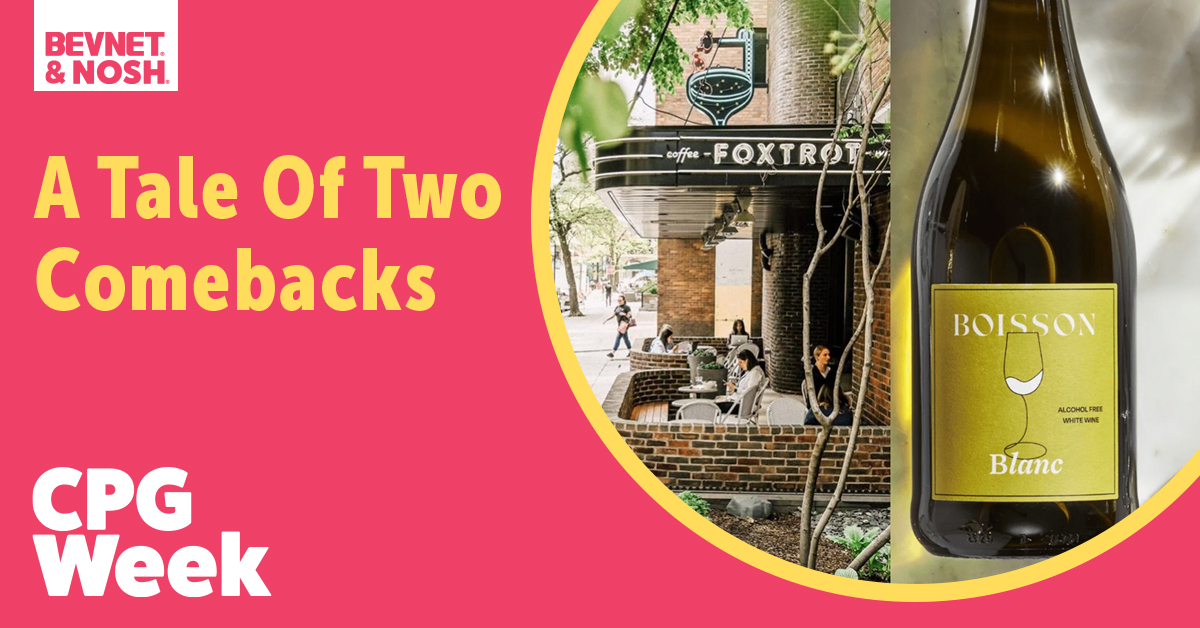
On this episode of CPG Week, Nosh managing editor Monica Watrous and senior reporters Lukas Southard and Brad Avery talk about two different retailers’ returns from bankruptcy.
The CPG Week podcasters discuss how there is a differing consensus about the expected returns of Foxtrot and Boisson. While some suppliers seem ready to return to Foxtrot shelves, there appears to be more hesitancy among brands who’ve formerly worked with NA retailer Boisson. In other news, a different low- and no-alcohol retailer gets an endorsement from bev-alc private equity firm in the form of a capital investment.
Show Highlights:
0:30 – Are truffles overrated? HuffPost thinks so; the CPG Week team responds.
1:45 – For Foxtrot founder Mike LaVitola, its return is not a comeback so much as a “totally new company.” The CPG Week group looks at what it means for the next-gen convenience store to return to business both from a brand perspective and from a macro-industry angle.
6:00 – Alternatively, there appears to be some trepidation surrounding the return of non-alcoholic beverage retailer Boisson. Lukas runs through a recent BevNET story that dissected suppliers’ opinions about Boisson’s return in light of the unfinished business and unpaid bills that haven’t been completely addressed.
12:30 – Not all non-alc retailers are struggling to win over brands. Charleston, S.C.-based Sèchey landed investment from InvestBev last week. Brad details how the new capital is an approval of one company’s approach to growing in NA beverages.
About the CPG Week
CPG Week is the podcast that explores the latest happenings in the consumer packaged goods industry. Join our seasoned reporting team as they dish out the week’s stories in quick, easy-to-digest episodes. Catch up on the top headlines of the week, dive into exclusive insights with the BevNET and Nosh teams, and set yourself up to make more informed business decisions. Tune in to stay up-to-date on the latest developments in the dynamic world of packaged food and beverage.
New episodes are released every week. Send us comments and suggestions anytime to cpgweek@nosh.com.
Show Highlights:
On this episode of CPG Week, the podcast team talk about the return from bankruptcy of two retailers, Boisson and Foxtrot, and how this is being interpreted by supplier brands.
Episode Transcript
Note: Transcripts are automatically generated and may contain inaccuracies and spelling errors.
[00:00:05] Monica Watrous: Welcome to the CPG Week podcast by BevNET and Nosh, your source for the latest food and beverage industry news. I'm Monica Watrous, Managing Editor of Nosh, here with my co-hosts Brad Avery and Lukas Southard. If you're enjoying the show, please subscribe on your listening platform of choice. On the podcast today, we are discussing a tale of two comebacks, Foxtrott and Boisson. But first, HuffPost just named this food as the culinary world's most overrated ingredient. What do you think it is, Brad?
[00:00:39] Brad Avery: OK, so anytime I watch Chopped, the thing that the judges hate the most is truffle oil. So that's going to be my guess just based on the culinary world part of the clue.
[00:00:50] Monica Watrous: Lucas, what do you think?
[00:00:52] Lukas Southard: Well, olive oil? I don't know. I'm just throwing it out there.
[00:01:01] Monica Watrous: OK, so Brad hit it. The answer is truffles. I guess that makes sense.
[00:01:04] Brad Avery: Yeah. This was a guess. I did not know the answer.
[00:01:07] Monica Watrous: So according to HuffPost, 40% of people are scientifically predisposed to hate the smell of a pheromone found in the fine dining fungus. Lucas, you're a recovering chef. Where do you stand on truffles?
[00:01:21] Lukas Southard: I don't know if I'd say the most overrated in the world, but they are overused. Don't tell a hot sauce maker truff, but I feel like we've been putting truffles in too many things and it's one of those ingredients that's great occasionally in very specific situations.
[00:01:41] Monica Watrous: I wonder if they sell truff at Foxtrott. Back in April, we reported on the sudden closure of Foxtrott, the modern convenience store retailer. And just three months later, they're ready to reopen their doors and rebuild relationships with former team members, supplier brands, and customers. The new owners who purchased the assets at auction, including the original founder, Mike Vitola, took to Instagram on July 30, and shared a post indicating that they're banding together to bring her back the original concept. The group proceeded to say the decision to shut down Foxtrott and to do so abruptly was not ours. And we believe the old Foxtrott lost its way in the unnecessary race to be the biggest it lost sight of why it started in the first place. Still, a number of questions remain. Some of the reactions on that post were mixed. A few brands were voicing their support for the reopening, while others were asking whether the retailer planned to make good on all of those unpaid invoices and severance checks that their employees missed out on. So what do we think about that, guys?
[00:03:01] Brad Avery: I think one of the lessons from this is about how little time has really passed when you think about it, what, three months since this happened? Yet how disastrous that can be for a brand to even have a blip like that. And obviously this new ownership team is aware of this and they're not responsible for the closing of the store. But how much trust do you have to rebuild? Like you said, with the unpaid vendors, consumers move on rapidly like that in an instant. And so, you know, telling people, hey, it's back, it's open again, it was closed before, it's open again. I think that's one of the more fascinating parts of this whole story is realizing this isn't just a blip. This company has to rebuild from a lot of lost ground. So I'm excited to see what they do next, but also interested to see how do they navigate this. This is a huge hurdle to overcome.
[00:03:58] Monica Watrous: It's a big crossroads for them at this point, because they're saying, we're not responsible for how things went down, but I feel like it is their responsibility to make it right. And according to a report in Crane's Chicago Business Journal back in June, Mike LaVitola was quoted as saying that, we're a totally new company starting from scratch, but we have the Foxtrott name and the intellectual property and a bunch of our locations. We're like a new startup again.
[00:04:25] Lukas Southard: I did talk to at least one brand at Fancy Food Show this past summer, who said they had received outreach from the former buyers of Foxtrott who are returning. So that company was Spring and Mulberry. They do. kind of premium, um, low sugar chocolate bars, um, really, really tasty date sweetened chocolate. And they were interested in returning to Foxtrott in whatever form. So. I do think that there was mixed consensus from suppliers about if they want to be back on shelf and Foxtrott, but I think for a lot of them, spring and Mulberry included Foxtrott was one of the first retailers to take them in and put them on shelf and. They think that there is an opportunity to return to those shelves in whatever form Foxtrott takes.
[00:05:15] Monica Watrous: The fact of the matter is, even if Foxtrott acted like a bad business partner in the past year or so under the previous ownership, a lot of brands view Foxtrott as a springboard. And Foxtrott itself says that they are known for saying yes to small makers and helping them get noticed and prosper. So it is a first retail account for a lot of emerging brands. And that's a hard fact to ignore.
[00:05:47] Brad Avery: Again, just to repeat my previous point, it's about trust. You have to regain trust of your partners in business, behind the scenes, and of the consumers. I think that's the key objective for this new ownership group.
[00:06:03] Monica Watrous: Now, also in April, we reported on the closure of Boisson, the non-ALC beverage purveyor. And just this past week, we wrote about its plans to return. Lucas, I know you've been in touch with Nick Bodkins, the founder and chief brand officer. Can you give us an update on what's going on with them?
[00:06:25] Lukas Southard: Our colleague Ferron Salniker, who's the spirits editor here at BevNET, wrote a story called, After an Ugly Breakup, Boisson and Its Former Partners Look for the Way Forward. In that story, Farron went back and talked to a lot of the suppliers and brands that she had talked to when she initially reported on Boisson quickly folding. So as a refresher, as you said, Monica, in April, Boisson filed for a chapter 11 bankruptcy using a subchapter five, which allows for small business owners to reorganize their debt and develop a plan to pay back its creditors. The non-ALC retailer officially announced in July that with the help of a new majority investor, the family office behind studio beverage group, Boisson would start its second life as a quote, e-commerce wholesale import. and distribution and category development within the non-alcoholic and functional beverage space. According to Farron's reporting, in 2023, Boisson generated a combined revenue of $10 million from its retail and e-commerce operations, along with another roughly $2 million from its own brands and its wholesale revenue. Boisson was unable to pay off its debts, mostly due to the fact that its nine brick-and-mortar retail operations had become too expensive. Those locations were in very expensive markets like New York, Los Angeles, San Francisco, and the most recent one was Miami. So when Boisson folded up or closed its retail doors, many non-out brands were left unpaid for product that they had already sent Boisson and Boisson was already holding in possession in warehouses or in their stores even. So if you go to the Boisson website, you can still order product from brands like Ritual Zero Proof or non-alco aperitivo, Figlia. What's interesting is that although some of the brands have received outreach from this new Boisson 2.0, shall we say, many of them have not. Figlia's founder told Farron that she hasn't heard anything from Boisson, but quote, they are still selling product of ours that they have yet to pay for on their website. Now this sentiment was heard from a couple of different suppliers, some of which I talked to in my reporting. And a couple of them were a little frustrated that they saw their product being sold, especially when they were sold sometimes on promo while they were still waiting to receive thousands of dollars in payment for that product that was never paid for. Boisson founder Nick Bodkin said he was unable to comment about the situation on the record as a result of bankruptcy proceedings. But he did say on stage with me at WebNetLive this summer that the company was going to, quote, work really hard to make it right with suppliers. So I don't know what really that means. Perhaps things are taking longer than he expected to talk to some suppliers, but a lot remains to be seen in terms of how this situation will pan out in the long run and what those relationships will be with Bosan and the, you know, relatively small non-out community.
[00:09:36] Monica Watrous: Another development in the non-ALC adult beverage space is a recent funding round for Sashay. Brad, you reported on this. Can you tell us more?
[00:09:46] Brad Avery: Yes. So in this instance, we have a non-ALC retailer that is now emerging for the first time. Sachet, who started in 2021 in South Carolina with a brick and mortar location in Charleston. And the online brick and mortar hybrid low and no ALC curator is now expanding. And then last week they raised a undisclosed investment from private equity firm InvestBev. InvestBev is, of course, a leading PE firm for the spirits and adult beverage space. Their investments include Sampray tequila as well as cannabis products like Cann. With Sashay, this has been a pretty great year for them so far. They started the year with a partnership with Target. As Emily Heintz said to me, Sashay and Target getting together. And Sashay curated the no-alk alternative set for Target stores across the country, picking brands like De Soi and Kineforix to go into that set. as well as expanding their own private label branded sachet line of de-alcoholized wines. So this week I was able to talk with Emily and with Brian Rosen, the general partner of InvestBev, to get a sense of what this funding is going to be going towards, and the big part of it is expanding that branded CPG arm of the business, and that includes now an expansion into New York. So, Sashay previously did a pop-up store when it was just a retailer in New York. Now it's going in as a CPG brand. Distribution through Proof No More, and they're rolling out probably in September, is what she said.
[00:11:35] Lukas Southard: In talking to Emily in the past, what I found incredibly enlightening about her strategy is this idea of building sachet as a brand in itself. It's not just a retailer. And although she has tried the pop-up in New York, I think she's seen a lot more traction in terms of using it as just a brand in itself, whether that's with its partnership with Target or bringing its private label or its branded products into other non-ALK retailers, I think is a great strategy. And it's less capital intensive. You know, I think one of the big problems we saw with Boisson was that they opened a lot of retail stores and in places that, yeah, there was more non-alcoholic drinkers, but also the leases on those storefronts and supplying those places became incredibly expensive and led to its downfall in retail. So I think Sachet's strategy has really been a little bit more pragmatic in terms of building in ways that are less capital intensive, but also increase the name value of what she's been doing.
[00:12:41] Brad Avery: Yeah, and when I asked Brian Rosen, you know, why did InvestBev want to invest in Sashay in particular when there's so many other similar businesses out there? And he said, they've gotten further on less than, you know, anyone else they looked at. He praised their scrappiness and their ingenuity as a small company. And at the same time, you have this category that is poised for very large growth of this low and no-alc sober, curious occasion. There's a quote in the story I wrote that is up on BevNET, but Brian said, there has to be a time when a brand and an audience are ready for each other. There's been non-alcohol before, but the audience was never ready. And there's been a non-drinking audience, but the brands were never great. And now is the time when those two things come together. So that's InvestBev's vision of what Sashay can be. And they very much see this as a dual track. They are going to continue operating as a retailer and a curator for this category and as a CPG brand of their own.
[00:13:40] Monica Watrous: Insiders can read more at BevNET.com. The story is dry drinks curator Sashay soaks up new funding from InvestBev. Here are some other notable bits of news from the week. Your big merger playbook. Hookups can have ramifications. Here's what they are. Laird, eye-popping e-commerce growth leads Q2 earnings. And King's Hawaiian owner adds Killer Brownie Company to portfolio. For these stories and more, become an insider at BevNET and Nosh. That wraps up this edition of CPG Week by BevNET and Nosh. Thank you to our audio engineer, Joshua Pratt, our director is Mike Schneider, and our designer is Aaron Willette. If you enjoyed the podcast, please subscribe on your listening platform of choice, and we will see you next time.
About CPG Week
CPG Week is the podcast that explores the latest happenings in the consumer packaged goods industry. Join our seasoned reporting team as they dish out the week’s stories in quick, easy-to-digest episodes. Catch up on the top headlines of the week, dive into exclusive insights with the BevNET and Nosh teams, and set yourself up to make more informed business decisions. Tune in to stay up-to-date on the latest developments in the dynamic world of packaged food and beverage.
New episodes are released every week. Send us comments and suggestions anytime to cpgweek@nosh.com.
Stay Informed, Stay Competitive
Unlock the articles, expert interviews, and data reports that power the food and beverage industry. Join our community and stay ahead with exclusive insights from BevNET and Nosh.