CPG Week: A Funding Double Feature And Vertical Farming Follies
Episode 118
In this episode:
In this episode:
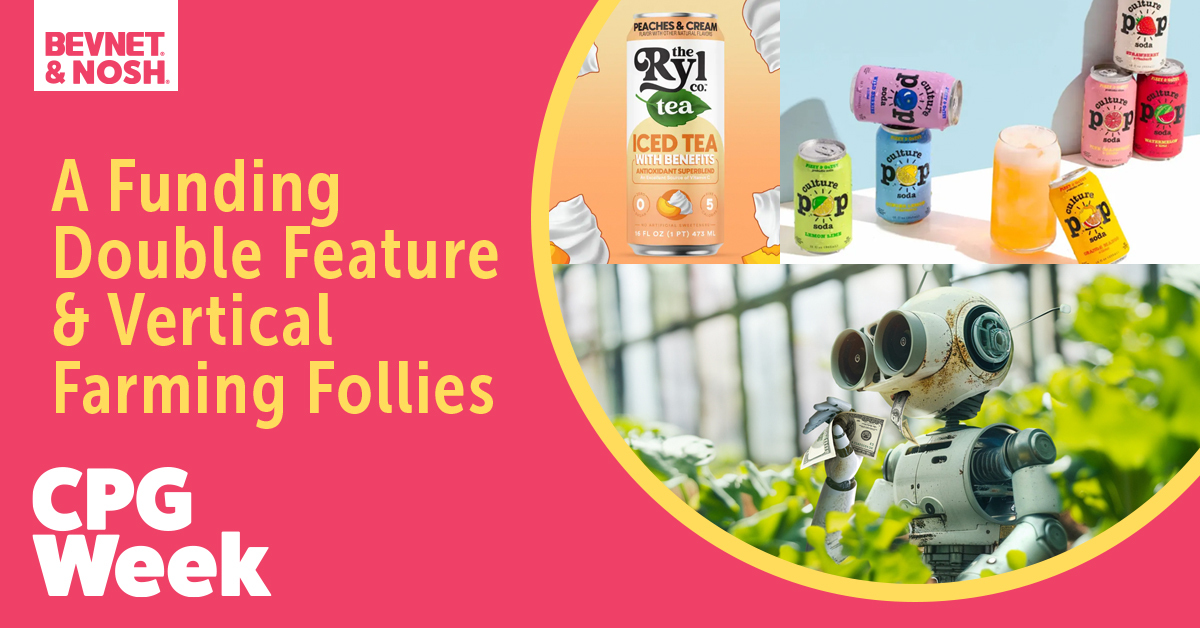
This week, the podcast team is discussing a pair of funding rounds recently announced by functional beverage brands Culture Pop and Ryl Tea, with highlights from conversations with the businesses’ respective leaders about expansion plans. Next, the CPG Week hosts tackle the topic of vertical farming and the challenges startups are facing as funding dries up.
Show Highlights:
0:30 – Nosh managing editor Monica Watrous points out that this weekend marks a once-in-a-lifetime occurrence: Easter falling on April 20, also known as the stoner’s holiday, 4/20. The team muses on how to celebrate appropriately.
2:50 – Senior reporter Lukas Southard shares insights from his conversation with Culture Pop founder Tom First on the probiotic beverage brand’s recent $15 million funding and its plans to compete in the modern soda set.
8:00 – Time for some Ryl news. Senior reporter Brad Avery explains how the maker of functional canned beverage brand Ryl Tea plans to use its new chunk of change.
13:55 – The team turns its attention to vertical farming, a concept that has struggled to live up to its own hype and the heaps of cash flowing into it early on. Lukas points to a pattern of overinvestment and underperformance across food technology in general.
About CPG Week
CPG Week is the podcast that explores the latest happenings in the consumer packaged goods industry. Join our seasoned reporting team as they dish out the week’s stories in quick, easy-to-digest episodes. Catch up on the top headlines of the week, dive into exclusive insights with the BevNET and Nosh teams, and set yourself up to make more informed business decisions. Tune in to stay up-to-date on the latest developments in the dynamic world of packaged food and beverage.
New episodes are released every week. Send us comments and suggestions anytime to cpgweek@nosh.com.
Show Highlights:
The CPG Week podcast team discusses a pair of funding rounds recently announced by functional beverage brands and the struggles of vertical farming businesses.
Episode Transcript
Note: Transcripts are automatically generated and may contain inaccuracies and spelling errors.
[00:00:05] Monica Watrous: Welcome to the CPG Week podcast by BevNET and Nosh, your source for the latest food and beverage industry news. I'm Monica Watrous, Managing Editor of Nosh, here with my co-hosts, Brad Avery and Lukas Southard. If you're enjoying the show, please subscribe on your listening platform of choice. On the podcast today, we are discussing a tale of two funding rounds and vertical farming's fumbles. But first, Guys, I don't think this has ever happened before, but did you realize that Easter is on 420 this year? I did. Yes. Everyone's been talking about it.
[00:00:42] Brad Avery: No, but I guess it just gives people an excuse to eat more chocolate eggs than they might normally do.
[00:00:48] Monica Watrous: Either of you planning to celebrate either occasion?
[00:00:51] Lukas Southard: I think you could mix weed chocolate with the chocolate eggs or the chocolate bunny and have in your Easter basket, start the morning off with- Or actual grass instead of the fake grass that people put in Easter. Well, yeah, there you go. That'd be very expensive. Yeah. But it would be for the occasion. It only comes once a year. Well, 420 Easter comes once a, who knows, decade? A lifetime.
[00:01:18] Monica Watrous: I've never seen it before. You have to think about it like the Gregorian calendar has to align with the moon cycle in order for the, actually, I have no idea how that works.
[00:01:31] Brad Avery: I mean, I will point out that you are talking to two Jewish men, so we probably are not... Personally, I will speak for myself.
[00:01:39] Monica Watrous: But at least one weed enthusiast.
[00:01:41] Brad Avery: Yeah. I mean, I will celebrate one of the two holidays, I'll let you decide which one, but it will actually probably be a nice holiday, because my family's going out of town and I will be home alone for the first time ever, so I will probably crack a... crack a nice THC beverage and maybe I'll shotgun and just see what kind of weird stuff happens that night.
[00:02:01] Lukas Southard: All right, the next time it will be Easter 420 again is in 2087. Yeah, we're all going to be dead.
[00:02:09] Monica Watrous: But I think, you know, I might be celebrating in the same way, Lucas, with I just got a shipment of Winx new 10 milligram THC lemonades. And they're delicious, but they are powerful.
[00:02:27] Brad Avery: They're strong, yeah. I have some of those too, and they're not to be trifled with for those of us who are not your everyday cannabis consumers.
[00:02:36] Monica Watrous: Which I am not. While not weed drinks, there were two canned beverage brands that started this week with some fresh cash. What happened and what does it mean for the category? Lucas, can you tell us about Culture Pop's funding round?
[00:02:51] Brad Avery: By most metrics, culture pop is kind of the third most popular of the gut health soda, modern soda set. And what they have done slightly differently than a lot of other brands is they've kind of kept a lower profile than the Ollie pops or poppies that we've talked about a lot on the show. That's not to say that they don't have a lot of. funding and a lot of support behind them. So last week they filed a SEC form D that announced that they'd raised a little over $15 million. And this is coming off the back of a separate funding round they did last February. So February, 2024, where they raised 21 million. What's interesting about culture pop is it, it does have a bit of a pedigree. Tom first is the founder and he is probably most well-known for being the co-founder of Nantucket Nectars. So he's been in the beverage game for a long time and Culture Pop is slightly different than Olipop or Poppy in that it is a probiotic soda. And they've taken a little bit more of like a fruit forward approach. They don't have a cola, they don't have a root beer yet, that is to say in their lineup, but they have a lot more of kind of fruit flavors that are part of their portfolio. And it's a New England-based, a Massachusetts-based brand. They've built out a really strong distribution network here in the Northeast and have been steadily spreading out. And just this week they announced they went nationwide in Target, and last year they went nationwide in Walmart. So they have some pretty good distribution. Not as flashy, maybe as, as Poppy or Olipop, but this new funding is, is definitely going to go towards increasing their marketing spend and, uh, investing more in sales team because they're moving deeper into, uh, DSD as their, their main avenue of distribution.
[00:04:53] Lukas Southard: But Lucas, did you know that there's only one traffic light on the Island of Nantucket?
[00:04:59] Brad Avery: I didn't know that.
[00:05:01] Lukas Southard: I learned that from a Nantucket Nectar's bottle cap.
[00:05:05] Brad Avery: Oh, there you go. I mean, I love Nantucket Nectar's.
[00:05:09] Lukas Southard: Then you should have known that.
[00:05:10] Brad Avery: I know, but it's like the Snapple, like all the little fun facts I used to have on the Snapple. You read it and you're like, oh my God, that's really interesting.
[00:05:20] Lukas Southard: Culture Pop's a really interesting brand though, and I think being in Boston, there's strong distribution locally. I see it sold in a lot of places around here. So they've done a very good job at penetrating both chains and independents in their own backyard. I'm not sure what the distribution looks like in the rest of the country, but it's worth remembering. This is a strong number three behind Poppy and Olipop in this functional, better for you soda set. Coming right off of Poppy's big exit to Pepsi and a lot of buzz around what's going to happen next with Ollipop, this is CulturePop's chance to start closing the gap, as they said and as they told you. So I think it's the right time for this brand to really be making a push and differentiating itself further from the now strategic-led competition.
[00:06:11] Brad Avery: they have a pretty strong footprint here in the Northeast. And that was something I brought up with, with Tom when I talked to him this week and he said. They've done a great job, especially in a place like New York City, they've partnered with Big Geyser. Yeah, and they've done, he said, an unbelievable job finding ways into that really complex grocery and independent C-store channels that exist there in New York City. But what they wanna do with this new funding is to really take that same approach to DSD into some of these other big metro areas and put some ad spend on you know, building up some brand awareness for culture pop in places that they, you know, they might be in a couple stores, but they want to be, they really want to be a competitor to Poppy and Hollypop.
[00:06:56] Lukas Southard: You know, there is an important question I've been meaning to ask Tom first, uh, that I forgot the last time I had a chance to talk to him. And I wonder if you asked him this, but is Derek White nice in real life?
[00:07:10] Brad Avery: You know, I didn't bring up the Derek White partnership, but I would guess, yeah, he seems nice.
[00:07:15] Lukas Southard: He seems like a really nice guy. This is, of course, Boston Celtics star Derek White, who is a brand ambassador now for Culture Pop for anyone listening who doesn't follow the NBA.
[00:07:25] Monica Watrous: And the person also in this podcast who had no clue what you were talking about.
[00:07:29] Brad Avery: We're entering NBA playoffs. So, you know, this is an important topic. You're going to hear a lot about NBA talk from me and Brad. You know, start studying up, Monica. There's a lot of, you got to bridge that gap.
[00:07:43] Monica Watrous: I got to do something when it's not football season.
[00:07:45] Brad Avery: Yeah. Yeah. Well, there you go.
[00:07:49] Monica Watrous: Well, moving on from CulturePop to The Real Company, Brad, you talked to the founder and CEO about its $15 million fundraise this week. Can you tell us more?
[00:07:59] Lukas Southard: Yes, time for some real news. So that's RYL, the maker of Real Tea. I spoke with Bloat and Ukela, who is the founder and CEO of the brand. It started in 2022, so it's entering now its third year in the market. And they also raised $15 million in a Series B round that they say is now going to accelerate the brand into hyper growth, which is their term. And they're looking to go from $10,000 at the end of 2024 to $40,000 by the end of this year. The brand, kind of like Culture Pop, also raised a little bit of money last year in a $7.5 million Series A that they were a little quiet about. And this is now really coming out the gate. If you'll remember, if you're aware of the brand, Reel has Morgan Wallen, the country music star, as an investor and partner and he re-upped as part of this round and is continuing to be pretty active in the brand and will be helping to open doors to get them onto the ground at festivals to do promotion. But really the big drive for why this brand is going To grow so says blow to Nukela is that they've really invested in their DSD network. They also have big geyser. They have some other key partners across the country polar beverage up here in the northeast. They have. And so they are looking to supercharge. They're going to be doing LTOs to try and build awareness. They're focusing a lot in digital marketing. And it's a lot about just getting into those accounts now, getting into stores and supporting it, hiring. They're looking to go from just under 40 employees to over 100 by, again, the end of the year. It's a pretty tight turnaround for what their ambitions are, but they think they can do it.
[00:09:47] Monica Watrous: Did you say 40,000 retail doors?
[00:09:50] Lukas Southard: Yes. 4-0-0-0-0. So the part about Reel that's interesting to me is it is part of this new class of emerging T startups that are looking to really upset the category with better for you products. We've seen a lot of attempts at that over the years. Tried and failed, but there's now some room being made with products like Liquid Death or even a longtime player like Yerba Mate brand Guayaquil charging growth in a category that has otherwise been a little sleepy, as a lot of people have called it. But, alongside Real, you've got Just Iced Tea, you've got Half Day, you've got St. James. There's a lot of brands now that are making a serious push to disrupt the set, get some fresh faces in there, get some better-for-you, organic, clean-label product in there. And that's what we're seeing and what I think this investment really shows is some strength for that.
[00:10:46] Brad Avery: Yeah, Brad, and you named a couple of brands that I've been following as well, and they've all kind of taken slightly different approaches, which is what's interesting about it. So most recently St. James just relaunched under a completely new packaging. They were using Tetra Pak cartons. Now they're doing aluminum resealable aluminum bottles for theirs. So really kind of leaning into that sustainability and organic ingredients. And then you named half day, which was a brand that also did a packaging refresh recently, and they tried to kind of update their look and revamp kind of their image. But also part of that was they're a prebiotic iced tea brand. So they're kind of leaning into that modern soda set a little bit too, saying like, hey, this has some functional benefits, or this is a good for you version, low sugar and has some inulin or other types of prebiotic elements to be good for your gut. So it's funny how this iced tea category has started to grow up in an interesting way, because there's a lot of different approaches that seem to be trying to hit on a lot of different trends in beverage.
[00:11:57] Monica Watrous: There's another brand that you didn't name called Viable Energy Tea, which infuses its iced tea, it's a bottled brand, but includes L-theanine and some other nootropics and adaptogens for mental clarity and cognitive benefits.
[00:12:16] Lukas Southard: It's funny you mention the connection, though, to the functional Better For You sodas, because that is something Bloated and I talked about briefly. When I asked him about all these other tea brands, he started talking about poppy and how that's validation that Better For You is still growing and still representing the future. Another interesting point you brought up lucas is saint james rebrand into aluminum bottles so real liquid death just half day 70s is another all of these brands have cans some of them are only in cans just has glass as well but. all these products are going into a canned or aluminum format, which I think also shows a bit of how the disruption is looking. Because otherwise, what, Arizona is the main canned tea brand, but you've got Pure Leaf and others in plastic and PET, that I think aluminum is really selling the convenience factor, but also selling the sustainability factor as well.
[00:13:22] Monica Watrous: Insiders can read more on BevNET about both of those deals. The stories are called Culture Pop Lands $15 Million to Close the Gap in Modern Soda and Real Tea Plans for 4X Hypergrowth Fueled by $15 Million Funding Round. Turning now to another well-capitalized sector, vertical farming. Lucas, you wrote about some of the struggles this industry has faced in recent years after raking in some significant capital. Can you tell us more?
[00:13:50] Brad Avery: It's been an uphill climb for food tech at large. So one of the main points of contention for the broader food tech category has been overinvestment and underperformance. So a lot of big claims about changing the broken food system or, you know, doing away with the meat industry and replacing it with alternatives that taste just the same and look just the same and cost the same. But for the most part, that really hasn't come to fruition. So I posted a feature last week using vertical and innovative indoor farming businesses as a case study for the struggle of scaling in food tech. And similar to, you know, what we have seen in alt meat innovations like cell cultured or precision fermentation based proteins. So agri-tech solutions to conventional, uh, agriculture have received a lot of early interest from VC and private equity groups in kind of the mid 2010s up through the pandemic. So total food tech investment peaked in 2021 at $61.2 billion. This is according to a report from Forward Fooding's Food Tech 500 report. Now over the last four years, however, food tech funding has declined severely dropping to about 16.1 billion in 2024. Now agri-tech or more specifically vertical farming was one of the hardest hit with this decline in investment. So among the many companies operating in this space, there are a number of startups that were heavily funded and have either since shuttered or had to restructure their businesses under chapter 11. One company, Plenty, is probably one of the most recent and glaring examples of this issue. So since launching in 2014, the vertical farming company, Plenty, raised nearly $1 billion. They announced last month that they were going to have to restructure under bankruptcy protections and close down a facility and kind of reframe how they're going to continue to do business. One reason many vertical farming startups like Plenty have haven't really met the initial expectations for growth and success is based on the fact that these are capital intensive technologies. One source I talked to described opening and operating an indoor growing facility was like playing whack-a-mole. Once you figured out one solution, there were a couple new issues that popped up and they were never the same issues. So even though you might've figured it out in your first facility, you open up your second or third and you're gonna have new problems because you're dealing with a living thing. You're dealing with an agricultural product. It's not something that can be reproduced as easily as you can other packaged food. Another big problem has been that most of these operations have kind of picked the lowest hanging fruit, or in this case, vegetable to grow. So many indoor operations have chosen to grow leafy greens and herbs, which are relatively easy to produce and grow indoors. But they also have to compete in a grocery store with commodity and conventionally grown options, which are. also very easy and cheap to produce and don't have the same scaling issues that a vertical farming operation has. So there is a lot of headwinds. And even though there was a lot of promises made and a lot of investment, it hasn't been as quick to scale as everyone would have hoped, I guess. That's not to say there haven't been some success stories. So Oishi is a vertically farmed berry company that started by making these kind of $50, like a 12 pack of strawberries. Now they've brought that price down significantly and they've been able to not only garner new investment, but also do some acquisitions of smaller food tech, mostly software companies and robotics companies to kind of streamline their automation and streamline their production to not only bring that price down, but also expand their distribution into different regions. And this is something that a lot of the sources talked about is that focusing on products like a strawberry or even, you know, some of these commodities that are facing pretty tough headwinds from climate change, like coffee or cocoa or vanilla beans are actually places where vertical farming or indoor farming could really do well because it's stuff that isn't easily produced year round, but they can also be grown and fit a demand and a need that that is a lot harder to meet. And so that's, that's where a lot of the sources I talked to kind of see the future of vertical farming, but they also hedged those expectations by saying, we're still a little bit of ways off. And so there's, there's still a long way to go for us to be growing even a majority or a portion of our agriculture indoors and in a vertical farming type of technology.
[00:19:16] Monica Watrous: Nosh insiders can read that special feature. It's called Vertical Farming's Fumbles, How Indoor Operations are Rebounding from Early Struggles. And here are some other notable bits of news from the week. Spring in Mulberry refines its omni-channel approach. How Fly-by-Jing is navigating staggering tariffs. And Molson Coors CEO Gavin Hattersley is set to retire. For these stories and more, become an insider at BevNET and Nosh. That wraps up this edition of CPG Week by BevNET and Nosh. Thank you to our audio engineer, Joshua Pratt, our director is Mike Schneider, and our designer is Aaron Willette. If you enjoyed the podcast, please subscribe on your listening platform of choice, and we will see you next time.
About CPG Week
CPG Week is the podcast that explores the latest happenings in the consumer packaged goods industry. Join our seasoned reporting team as they dish out the week’s stories in quick, easy-to-digest episodes. Catch up on the top headlines of the week, dive into exclusive insights with the BevNET and Nosh teams, and set yourself up to make more informed business decisions. Tune in to stay up-to-date on the latest developments in the dynamic world of packaged food and beverage.
New episodes are released every week. Send us comments and suggestions anytime to cpgweek@nosh.com.
Stay Informed. Stay Competitive.
Become an Insider to unlock exclusive CPG insights, data, education, and industry exposure for food & beverage leaders.

Industry Analysis
Context behind the headlines

Data & Reports
Category performance & trends

On-Demand Education
Expert-led video courses