Ultraprocessed Food: The Food Industry’s Approach

As the industry navigates emerging scientific, regulatory and industry-centric approaches to the Ultraprocessed Food debate, Nosh is diving into how each sector is addressing the challenge. Stay tuned for additional reporting.
Ultraprocessed foods (UPF) – the not yet defined, but increasingly controversial group of products that account for roughly 70% of the U.S. food supply – are under researchers’ microscopes, caught up in industry review and on the regulatory chopping block all at once.
Researchers are analyzing the alleged effects of UPF on human health – from potentially addictive qualities to how they’ve been designed for hyper-palatability. Those in the food industry are working to put parameters around what is, and what isn’t, UPF. And regulators are keeping a close eye on both arenas as legislation surrounding these foods, and their common attributes like chemical additives, begin to pop up in statehouses around the country.
In short, action against UPFs, in an array of forms, is coming from all directions.
“I’ve been around a long time, but I don’t think I’ve ever [seen] a presidential campaign where food and food policy was talked about nearly as much as this one, which is obviously, ironic as it’s a Republican administration,” said Beth Johnson, principal and founder of policy consultancy Food Directions, during a panel at the Consumer Federation of America’s National Food Policy last week. “It is an exciting time, and the whole processed food debate is obviously very interesting [since] there’s a lot we don’t know.”
Currently, the only working definition for UPF is the NOVA Food Classification System, developed by a group of researchers at the University of Sao Paulo, Brazil, in 2009. However, while that definition provides a starting point, industry experts, scientists and policymakers can agree on one thing: NOVA is not comprehensive enough to base legislation or industry guidance around.
A ‘Triage Moment’ For The Industry
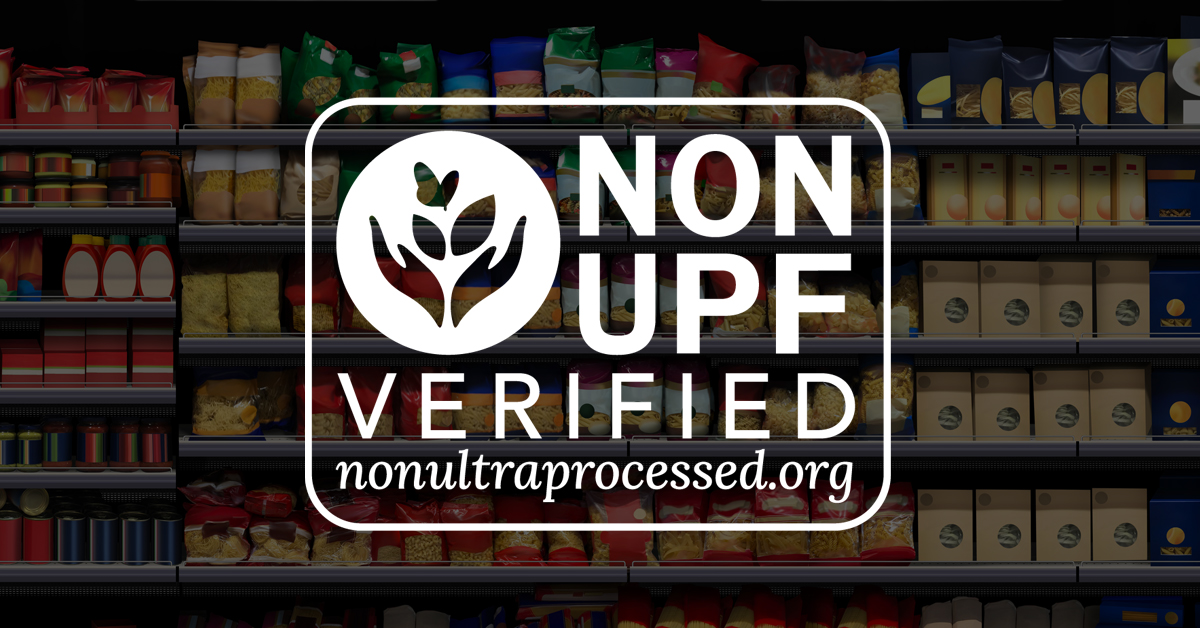
During Expo West 2025, we caught up with Megan Westgate, founder and CEO of the Non-GMO Project and the newly launched Food Integrity Collective (FIC) to learn more about how FIC is working to build industry guardrails around the designation of non-ultraprocessed food.
Westgate explained that originally the team believed the development of the non-UPF third-party verified claim would be largely based on NOVA. However, over the past few months she has come to realize that the framework could only get them about “85% of the way there.” NOVA scores foods based on inputs and manufacturing techniques used, but Westgate wants to take an approach that goes even deeper and promotes change.
“We want more packaged food to be metabolically nourishing,” she emphasized. “We want CPGs to change their formulations and their ingredients. And we want it to be easy for shoppers who are busy and on a budget, in a hurry, to easily find things that they know are going to be more nourishing for their families.”
The team is taking a wide array of factors into account including looking at product specs, what processing equipment is used and how the relationship and ratios of various inputs affect how the food is metabolized. They are also looking deeper into ingredient sourcing and aiming to address common concerns with UPF, like products’ hyper-palatability, and working on ways a standard could address those issues.
“It is still really unclear what this looks like for the industry and how to define these products to create the type of change that will effect progress among CPG formulations,” Westgate said. “What makes something hyper-palatable, and how in a standard and a certification program could we confirm that those formulating practices or types of processing haven’t been used? We’re trying… [but] we’re really wading into new territory here.”
The Non-UPF pilot program will debut later this spring with about 20 participating brands spanning all aisles of the grocery store. “If you have brand presence in every area of the store, then that’s what starts to create the leverage to get all of the brands to consider how they’re formulating and doing things,” Westgate said.
The program is engaging all food industry stakeholders, Westgate said, including researchers, doctors, dietitians, retailers, shoppers, brands and other healthcare practitioners, as it narrows in on its framework.
Industry demand for the program itself is unlike anything Westgate has seen before. She joked that in the early days of The Non-GMO Project “no one wanted to talk to us at shows like this.” But for the UPF pilot, the organization currently has a waitlist spanning more than 150 brands. That inbound interest has made putting the pilot together a lighter lift as FIC works to create the “MVP” version of the standard that is applicable to many product types through the upcoming pilot.
Representation across the store will not only create broader consumer awareness, but also give the organization grounding in a wide array of products, which all use different processes, ingredients and preservation techniques. As a “standard setting organization,” Westgate said her team is approaching UPFs by engaging all “co-creators of the food system,” but emphasized this is also a “triage moment” for the industry that has all of a sudden realized it needs to take action in this fairly uncharted area.
Aims Of The Food Integrity Collective
In order to cover all of the bases, The Non-GMO Project also introduced The Food Industry Collective alongside the Non-UPF certification debut. Ultraprocessed foods are just one-eighth of the equation that need to be solved in order for the food system to provide more nourishing food, Westgate explained.
The Food Integrity Collective has come up with eight “petals” it believes are central to creating healthier food. Those “petals” include: Minimal processing and additives, non-GMO, regenerative sourcing and biodiversity, healthy human communities, nutrient density and diversity, animal wellbeing, mindful packaging and “your unique contributions.”
According to Westgate, the nonprofit decided to tackle one of those petals – UPF – through this certification after it identified a lack of action or ability to act on behalf of the industry. Many of the other petals, she said, such as biodiversity efforts or regenerative agriculture already have notable support within the industry.
“There’s obviously a huge uproar about UPFs right now. We want to be a resource for helping them understand what they need to change and do to be on the right side of that concern,” Westgate added.
This combination of factors that FIC believes contributes to nutrient-dense food will be a difficult task for humans to consistently assess and score, particularly when it comes to weighing ratios of inputs like added sugars in relation to the combination of fats and oils used in an item – a common benchmark of UPFs.
While the pilot runs through the spring and summer, FIC will be pressure-testing its ideas and gathering more insight to refine the framework. Westgate believes it will continue to evolve long after the pilot as more is learned about UPFs and their effects. FIC aims to eventually lean into an integrated AI model so that it can simplify the process of assessing some of the nuances within UPF designations for brand partners.
“I think it is going to open up new opportunities in terms of the level of complexity of what we can run,” Westgate said while discussing ingredient relationships and formulation ratios. “That would be a probably untenably cumbersome effort for an individual human to evaluate those things, but possibly using AI, we can get there faster.”