Red Tomato Announces EcoCertified Rebrand; Expands Distribution to Include Mid-Atlantic, Midwest and Southeast Apple Growing Regions For 2024 Apple Season
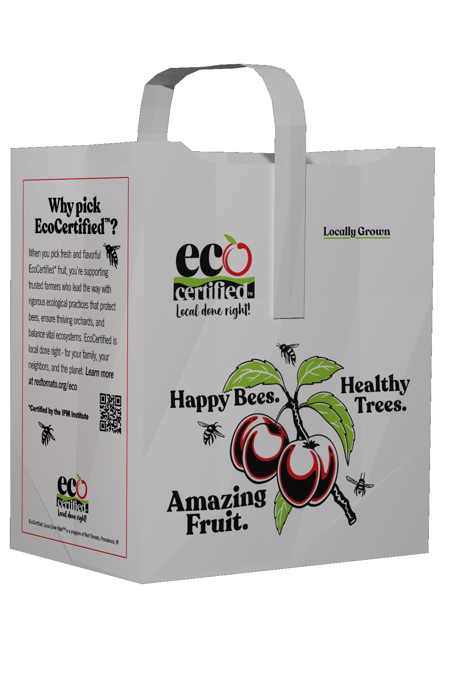
Providence, RI – Red Tomato, the pioneering force behind Eco Apple and Eco Peach, proudly announces the rebranding of its certification program to EcoCertified™ along with the redesign of EcoCertified fruit totes and pouches. This strategic shift broadens the scope of the certification to include a variety of fruits and value-added agricultural products, providing a more cohesive and impactful brand for consumers and growers alike.
The redesigned packaging is timed for the 2024 apple season and includes paper totes, pouches, poly bags, and master cases. The rebrand will help consumers choose EcoCertified fruit, which means they are investing in local and sustainable growing practices. EcoCertified is a promise of amazing fruit that is both local and ecologically grown.
Consumers who purchase EcoCertified produce support trusted local farmers dedicated to environmental stewardship who meet rigorous ecological practices, protect pollinators, ensure thriving orchards, and deliver delicious fruit. Enjoying EcoCertified apples means making a difference for family, neighbors, and the planet.
To plan the redesign, Red Tomato partnered with the Hartman Group, a renowned marketing research company specializing in the natural and organic grocery industry. Their expertise in consumer behavior, trends, and cultural shifts provided valuable insights through comprehensive focus groups conducted across the United States. These insights shaped the rebrand, leading to the emphasis on "picked at peak flavor," and the importance of local, sustainable farming practices.
Keywords such as "sustainable growing practices," "protect pollinators," "promote tree and soil health," and "growers care for the land, community, and earth" were instrumental in the design process. The packaging highlights the taste, ecological practices, and local sourcing that define EcoCertified. The front of the pouch proudly states, "Happy Bees. Healthy Trees. Amazing Apples." while the back emphasizes the rigorous ecological practices that protect bees, ensure thriving orchards, and balance vital ecosystems.
EcoCertified is designed to be a grower brand, an integral part of their marketing stories, and to build a stronger, more recognizable certification that stands for sustainable, ecologically responsible farming practices.
“It’s very hard for farmers to grow apples this way—I visit the farms. I have been designing for years and I know the challenge of communicating a complex idea dealing with sustainable growing practices with just a few words and a choice illustration or two,” says Diane Rast, Creative Director. “Which is why I’m excited with our final headline: Happy Bees. Healthy Trees. Amazing Apples. In one “bite”, in one three second glance, we can give consumers all the things they care about most.”
The updated packaging will be available in stores making it easier for consumers to identify and purchase EcoCertified products. Insights from consumer research indicate a strong preference for clear, concise labeling that highlights the product's sustainable attributes.
“EcoCertified orchards are a powerful, resilient force in our region’s food system, combining the most ecological growing practices with the best of local foods,” said Angel Mendez, Executive Director of Red Tomato.
Why EcoCertified?
The most ecological farming practices aren’t the same for every locale. Even though the cool nights of the eastern apple growing regions grow some of the best apples in the world, over 93% of certified organic apples sold in the U.S. come from eastern Washington. The climate in the eastern U.S. is very different––more rain, more diseases, and over 60 species of damaging insects––and the national organic standards do not offer viable treatments for eastern orchards
growing at a wholesale scale. For responsible growers and conscientious eaters in the eastern U.S., EcoCertified offers the best combination of local and ecologically grown fruit.
For more information about Red Tomato and the EcoCertified program, visit Red Tomato and EcoCertified™
About EcoCertified:
The EcoCertified program was launched in 2005, as a partnership of non-profit Red Tomato; the IPM Institute of North America; and a network of farmers, scientists, and fruit experts, to advance the most environmentally responsible growing practices for locally grown tree fruit in the Northeast. The goal, then and now, is to support growers in our region by bringing together the best of local and ecological growing practices, educating the public about their value, and building a market that keeps local orchards thriving and local apples abundant.
Since 2005, the program has certified over 30 Northeast orchards, representing more than 2,000 acres annually. EcoCertified is actively expanding to new regional chapters east of the Rockies, with a focus on the Midwest (Michigan, Wisconsin, Minnesota, and Illinois), Mid-Atlantic and Southeast, to further its mission of promoting sustainable, locally grown fruit.
About Red Tomato:
Red Tomato is a nonprofit food hub with over 25 years of experience helping to build a sustainable future for Northeast farms. Red Tomato is committed to bringing transparency, equity, and ecological responsibility to our food supply, by creating marketing, logistics and educational programs that support farm viability and make local food more accessible to all.
Red Tomato manages the EcoCertified program, working on behalf of the grower network to market and distribute ecologically grown fruit. The growing protocol, audits, and certification are overseen by a non-profit, the IPM Institute of Madison, WI, ensuring the highest standards of ecological farming.
Based in Rhode Island, Red Tomato works with partners throughout the US, including scientists and farmer networks, regional and national grocery stores, K-12 schools, community-based nonprofits, and other vendors. Red Tomato continues to develop new relationships across the region's food system to address market disruption and food equity for eaters.
Media Contact : [email protected]
For More Information:
Learn More

Stay Informed, Stay Competitive
Unlock the articles, expert interviews, and data reports that power the food and beverage industry. Join our community and stay ahead with exclusive insights from BevNET and Nosh.
Top news
- SPONSORED POST