CPG Week Podcast: Leadership Changes at Coke and Kraft Heinz. Plus, Thrive Market Goes Dry
Episode 153
In this episode:
In this episode:
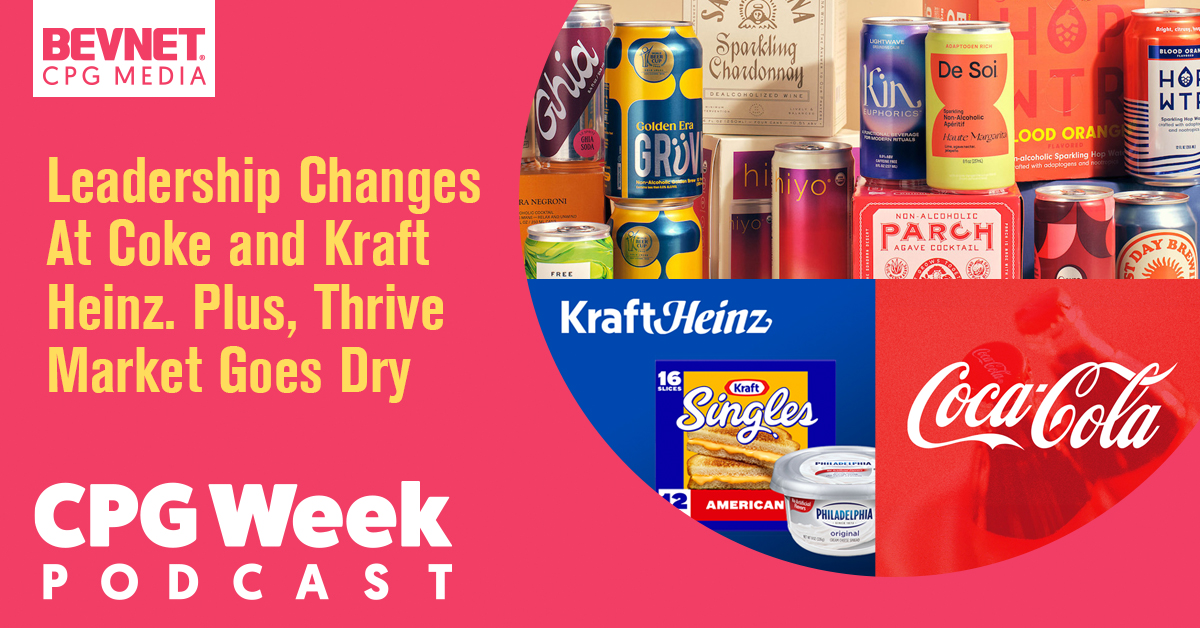
This week on the podcast, Nosh managing editor Monica Watrous and senior reporter Lukas Southard discuss leadership changes at Coca-Cola and Kraft Heinz, Thrive Market’s decision to drop alcohol, and what the apparent closure of Believer Meats means for the future of cultured protein.
Show Highlights:
0:15 – The Coca-Cola Company has announced a new leader to succeed James Quiney. Monica shares details of the succession plan.
1:20 – Kraft Heinz is also transforming its leadership team ahead of its planned spinoff. Lukas highlights the latest changes.
3:40 – Online grocer Thrive Market is eliminating its alcohol offerings and expanding its assortment of zero-proof options. Monica explains why.
6:50 – With the apparent shutdown of another cultured protein startup, the highly capitalized sector appears doomed. Lukas discusses the downfall of a previously promising player in the category.
9:15 – Brands are hopping on the advent calendar trend – and some really shouldn’t. Plus, Zero Sugar Oreos are set to launch. Will consumers bite?
About CPG Week
CPG Week is the podcast that explores the latest happenings in the consumer packaged goods industry. Join our seasoned reporting team as they dish out the week’s stories in quick, easy-to-digest episodes. Catch up on the top headlines of the week, dive into exclusive insights with the BevNET and Nosh teams, and set yourself up to make more informed business decisions. Tune in to stay up-to-date on the latest developments in the dynamic world of packaged food and beverage.
New episodes are released every week. Send us comments and suggestions anytime to cpgweek@nosh.com.
Show Highlights:
This week on the podcast, Nosh managing editor Monica Watrous and senior reporter Lukas Southard discuss leadership changes at Coca-Cola and Kraft Heinz, Thrive Market’s decision to drop alcohol, and what the apparent closure of Believer Meats means for the future of cultured protein.
Episode Transcript
Note: Transcripts are automatically generated and may contain inaccuracies and spelling errors.
[00:00:05] Monica Watrous: Welcome to the CPG Week podcast by BevNET and Nosh. I'm Monica Watrous, here with my co-host, Lukas Southard. Here is the latest in food and beverage industry news. James Quincy's nine-year run as chief executive of the Coca-Cola Company is coming to an end. The beverage giant revealed last week that Quincy is stepping down, effective March 31st, when he will be succeeded in the role by Chief Operating Officer Henrique Braun. Braun will be nominated by the company board at its 2026 annual meeting of share owners. Quincy, meanwhile, will continue at Coca-Cola as executive chairman. During his tenure, Quincy advocated for Coca-Cola's evolution from soft drink maker to, quote, total beverage company, and backed that mission with aggressive innovation and acquisition activity. Under his leadership, the company made headlines with big ticket acquisitions like Body Armor and Costa Coffee, while also swerving into beverage alcohol through partnerships with Molson Coors, Constellation Brands, and Brown Foreman. Braun has been with Coca-Cola for three decades, leading international divisions prior to overseeing all operating units as Executive Vice President and Chief Operating Officer since the beginning of this year.
[00:01:19] Lukas Southard: Kraft Heinz is also naming a new CEO as it plans to split its business into two separate publicly traded companies. As we've previously reported, Kraft Heinz is expecting to split into the Global Taste Elevation Company and the North American Grocery Company in the back half of 2026. While the two new entities have not finalized their names, at least one of these companies will be led by incoming Kraft Heinz CEO, Steve Kaheling. After the split, Cahalane will take over the Global Taste Elevation, which will house the larger half of the Kraft Heinz empire, and includes brands like Philadelphia Cream Cheese, Kraft Mac and Cheese, and Heinz Condiments. Cahalane is the former CEO of Kelanova, and before that, Kellogg's. Kelanova recently finalized its acquisition by Mars last week. In a somewhat surprising wrinkle to this leadership shuffle, Kraft Heinz current CEO Carlos Abrams Rivera will be stepping into a temporary advisory role as he hands off the reins. But Abrams Rivera will apparently not be taking over the helm of the other spinoff company, North American Grocery, as was previously reported when Kraft Heinz announced the spinoff initially in September.
[00:02:38] Monica Watrous: We have seen a lot of turnover in the big food C-suite this year. In September, Nestle named Philippe Navratil as its new CEO following the dismissal of Laurent Free following an investigation into an undisclosed romantic relationship he had with a direct subordinate, which breached the Nestle Code of Business Conduct. And then more recently, the Hain Celestial Group has named former Coke executive Allison Lewis as the permanent president and CEO of its U.S. food group, seven months after she assumed the role on an interim basis.
[00:03:12] Lukas Southard: Yeah, Monica. And also in beverage, a couple other brands have announced new C-Suite additions. Former Chief Sales Officer at Heineken and more recently Chief Commercial Officer at Olipop, Ray Faust is now the CCO at Lucky Energy. And Joan Sota also added a new Chief Operating Officer in Darcy Mackin and a new CMO with Eric Schneibel.
[00:03:36] Monica Watrous: As always, we will continue to report on personnel moves at BevNET and Nosh. Thrive Market is going completely dry. The online grocery retailer last week announced it is adding more than 100 products across 20 brands to its adult non-alcoholic beverage set, while simultaneously dropping all of its existing alcohol offerings. The expansion includes near beer, zero-proof wine, and mocktails from brands including Athletic Brewing Company, Mash Gang, Best Day, Groovy, Hi-Yo, Breeze, Recess, Des Soix, and Free AF. And while many retailers, including mainstream outlets such as Target, have been expanding their non-alcoholic sets to meet rising demand for alternatives, it's far more unusual for a company to drop an existing alcohol set entirely. Thrive Market had introduced wine to its offerings in 2018 and frequently touted its Better For You items among its alcohol selection in line with its health and wellness-minded brand mission. Thrive Market told BevNET that alcohol had never been a significant margin or growth driver for the business and noted the decision helps simplify logistics, as direct-to-consumer alcohol sales are complicated by restrictions in multiple states and strict regulations. The company also cited a recent Gallup survey to back its decision to drop alcohol brands, which found that since 1939, a record low 54% of US adults reported that they drink alcohol, down from 62% in 2023 and 58% in 2024.
[00:05:08] Lukas Southard: Yeah, Monica, and this is also coming right before the biggest sober month of the year, dry January, where I imagine there will be a Bunch of new data coming out showing how much sales are growing for this category. And I would also like to note that one of the brands that will be carried at Thrive, HYO, also just landed a pretty big multi-year partnership with Live Nation. Live Nation has been going deeper into the non-out category and seeing a lot of lift for having these alternatives as part of their offerings at live shows.
[00:05:49] Monica Watrous: We've been watching this segment for quite a while and it continues to evolve, but it's interesting to see who are emerging as the leaders. And it's clear that brands like Athletic and Recess are still holding their dominant positions.
[00:06:05] Lukas Southard: Agreed. And as you said, Recess is one of these functional brands, just like Hyo, that's done really well at live events where a lot of the alcohol consumption is being replaced by at least temperance or zebra striping, as it's sometimes called, by many consumers who are looking to not drink solely alcohol or alcohol at all while they're at live events.
[00:06:29] Monica Watrous: I prefer zebra caking where I just skip the alcohol and eat Little Debbie's zebra cakes.
[00:06:36] Lukas Southard: That's good, too. I mean, you know, you can't get drunk off of Little Debbie.
[00:06:40] Monica Watrous: Oh, yes, you can.
[00:06:43] Lukas Southard: One thing you cannot get drunk on is cell-cultured meat. Another well-funded cell-cultured meat company appears to be shutting down. Israel-based Believer Meats, formerly Future Meat Technologies, is reportedly ceasing operations. News began to leak out at the beginning of the month that things were not right at the food tech company when it was announced that a design firm was suing Believer Meats for $34 million in unpaid bills related to the construction of its North Carolina production facility. Believer Meats coming off announcing the completion of that full-scale production center and had recently received a regulatory green light from the FDA to begin producing and potentially selling its cell culture chicken to consumers. I will note that the news broke when former Believer Meats of HR, Ann Schubert, initially posted on LinkedIn that, quote, Believer Meats made the difficult decision last week to cease operations. Schubert has edited that post to read, quote, my journey with Believer Meats has come to an end. As of this recording, Believer Meats has yet to make a public statement on the future of its business. That caveat aside, Believer had raised over $360 million in funding from high-profile businesses like ADM Ventures, S2G Investments, and Tyson Ventures, among many others. Believer Meats is also the latest in a series of cell-cultured meat companies like Sci-Fi Foods and New Age Meats that have shut down in recent years. Another well-funded company in the cell-cultured meat space, Upside Foods, also pulled back on some of its plans for expansion when it decided to scrap the plan to move into a full-scale production facility in Illinois in February 2024. Upside Foods has also announced a series of layoffs as it has attempted to make itself more capital efficient.
[00:08:51] Monica Watrous: The seeming decline of cultured meat and its failed promise to deliver protein at scale is a subject that you've been writing about for quite some time, Lucas, and your latest piece on Nosh illustrates some of the more recent developments in this category. On a lighter note, is it just me or does it feel like there are more CPG advent calendars coming out?
[00:09:19] Lukas Southard: No, you're not alone. That definitely has become a trend, which I think is kind of fun. I have to say that it's been a tradition in my family that my mother gets me and my brother Advent calendars every year. And she has never gotten us one that has chocolates or any sort of goodies in it. It's always just the little pictures of Santa Claus and presents. What's the point? But now she buys them for my kids. And my kids are always asking, when do we get the ones with candy? What have you seen out on Thrive Market this year?
[00:09:52] Monica Watrous: Well, Kraft Natural Cheese has an advent calendar that, I mean, I don't actually think it's cheese. Do you have to keep it in the refrigerator? I don't know. The cold chain advent calendar? There's those shelf stable cheeses that, you know, people gift during the holidays. It might be that. I'm not even really sure. and delicious. The frozen cookie dough and gelato brand has a frozen advent calendar that it introduced this season. I think I also saw something fairly upsetting about a Malort advent calendar, but it's just like every day, it's just like another bottle of Malort.
[00:10:31] Lukas Southard: Yeah, and the press release that I got was something about like, nobody wants this, but we do it anyway. So, you know, go for it, my lord. I will not be enjoying your advent calendar, but, you know, more power to you.
[00:10:43] Monica Watrous: I feel like that's the kind of thing that somebody buys for like a white elephant gift exchange. And it's funny, but not practical. And the recipient is actually kind of, you know, doesn't really- Trying to find a way to re-gift it to somebody. Yeah, maybe. You know, I think I'd be down for an Oreo advent calendar. And speaking of Oreos, the brand just announced nine new innovations that are coming out in, I don't know, the coming months, coming year. And one of those is zero sugar Oreos, which I'm not sure who was asking for those, but they are free of aspartame, which it notes on the front of the pack, but made with maltitol and sucralose, which I don't think consumers are really excited about. I'm not really sure what the other options would have been. I guess stevia Oreo. I don't know. I don't know how that would have been, but.
[00:11:40] Lukas Southard: You know, this is one of those situations where like people go to Oreos because it is indulgence because they know it's not good for them, but it still tastes great. And we all love it.
[00:11:50] Monica Watrous: Don't mess with a good thing, guys. Just wait till they start putting protein in Oreos. Then we're all doomed.
[00:11:57] Lukas Southard: As long as it's full sugar with protein, then I might be on board. But don't give me a zero sugar high-protein Oreo, because then it just, what's the point?
[00:12:06] Monica Watrous: Here are some other notable bits of news from the week. PepsiCo allegedly created a soft drink price gap with Walmart, creating a system that allowed the world's largest retailer to obtain preferential promotional payments while those same payments were reduced for Walmart's competitors, according to court documents unsealed last week. Beverage packaging manufacturer Ball Corporation will acquire an 80% majority stake in Benapak's European can manufacturing businesses, including two production facilities in Belgium and Hungary. And finally, the U.S. Department of Agriculture unveiled the Regenerative Pilot Program, an initiative it claims will put $700 million towards assisting American farmers in the adoption of regenerative agricultural practices to improve soil and water quality, boost productivity, and strengthen the U.S. food and fiber supply. For these stories and more, become an insider at BevNET and Nosh. And if you're enjoying the show, please subscribe on your listening platform of choice. That wraps up this edition of CPG Week by BevNET and Nosh. Thank you to our audio engineer, Joshua Pratt, our director is Mike Schneider, and our designer is Aaron Willette. If you enjoyed the podcast, please subscribe on your listening platform of choice, and we will see you next time.
About CPG Week
CPG Week is the podcast that explores the latest happenings in the consumer packaged goods industry. Join our seasoned reporting team as they dish out the week’s stories in quick, easy-to-digest episodes. Catch up on the top headlines of the week, dive into exclusive insights with the BevNET and Nosh teams, and set yourself up to make more informed business decisions. Tune in to stay up-to-date on the latest developments in the dynamic world of packaged food and beverage.
New episodes are released every week. Send us comments and suggestions anytime to cpgweek@nosh.com.
Stay Informed, Stay Competitive
Unlock the articles, expert interviews, and data reports that power the food and beverage industry. Join our community and stay ahead with exclusive insights from BevNET and Nosh.