CPG Week: Meati and Beyond Meat Go From Sizzle to Fizzle. Plus, Danone’s Latest Deal
Episode 122
In this episode:

In this episode:
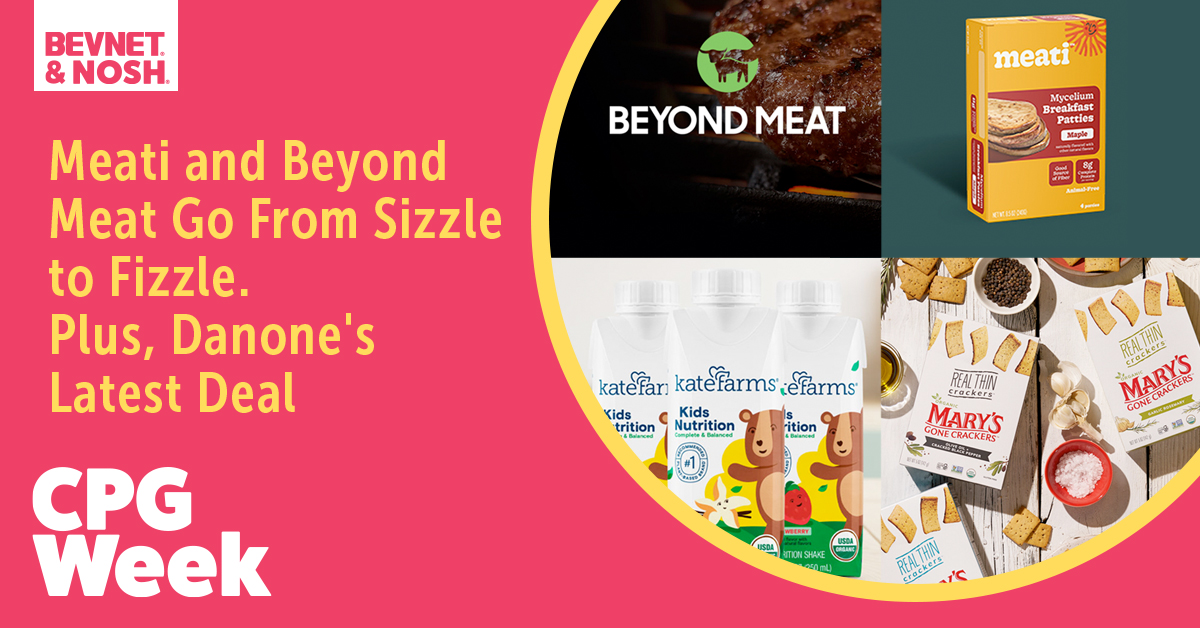
On this episode, the CPG Week podcast team digs into the declines of two prominent plant-based brands before discussing the acquisitions of Mary’s Gone Crackers and Kate Farms. Next, the hosts highlight the latest celebrity to launch a coffee brand. (Maybe a hot sauce would have been more appropriate?).
Show Highlights:
0:15 – The team kicks off the podcast discussing the downfall of mycelium meat maker Meati, who is reportedly selling for $4 million – after raising a total of $450 million during its lifespan. Nosh managing editor Monica Watrous provides a rundown of recent events that led to this point.
2:15 – Beyond Meat is also on the backburner. The plant-based patty purveyor recently secured $100 million in debt financing after a particularly brutal quarter that saw U.S. retail and foodservice sales declining by double digits.
5:00 – Senior reporter Brad Avery unpacks the sale of gluten-free pioneer Mary’s Gone Crackers to a Dare Foods subsidiary. What does it mean for the company going forward?
5:55 – Danone has struck a deal for Kate Farms, a maker of plant-based baby formula. The French dairy giant expands its reach into a new segment of the market. Brad discusses why the acquisition is consistent with Danone’s recently stated goals.
6:55 – Red Hot Chili Peppers frontman Anthony Kiedis is launching a coffee business (and speaking at BevNET Live!), Mid-Day Squares co-founder Jake Karls can finally eat his brand’s products, and Pepsi is playing dirty in Coke’s backyard.
About CPG Week
CPG Week is the podcast that explores the latest happenings in the consumer packaged goods industry. Join our seasoned reporting team as they dish out the week’s stories in quick, easy-to-digest episodes. Catch up on the top headlines of the week, dive into exclusive insights with the BevNET and Nosh teams, and set yourself up to make more informed business decisions. Tune in to stay up-to-date on the latest developments in the dynamic world of packaged food and beverage.
New episodes are released every week. Send us comments and suggestions anytime to cpgweek@nosh.com.
Show Highlights:
On this episode, the CPG Week podcast team digs into the declines of two prominent plant-based brands before discussing the acquisitions of Mary’s Gone Crackers and Kate Farms. Next, the hosts highlight the latest celebrity to launch a coffee brand. (Maybe a hot sauce would have been more appropriate?).
Episode Transcript
Note: Transcripts are automatically generated and may contain inaccuracies and spelling errors.
[00:00:05] Monica Watrous: Welcome to the CPG Week podcast by Bevna and Nosh. I'm Monica Watrous and I'm here with my co-host Brad Avery. Now let's get into the latest in food and beverage industry news. From the alt protein desk, Meaty's market cap, not mushroom cap, has imploded. The mycelium meat maker is reportedly slated to sell for $4 million. This is a company that has raised a total of $450 million during its lifespan, but its primary lender pulled nearly two thirds of its available cash. Back in March, Meaty filed a work adjustment and restraining notification act, also known as Warn Notice, telling its employees that if it could not secure alternate funding within 60 days, it would have to lay off its 150-person workforce and close its production facility in Colorado. Those 60 days were up in May, May 6th, and now CEO Phil Graves is assigning the food text company's assets to attorney Aaron Garber per recent court filings, and Garber is asking the judge to allow the buyer, listed as Meaty Holdings, Inc., to run the company before the completion of the sale?
[00:01:15] Brad Avery: Yeah, that's a brutal number. If you'll remember, Meaty faced some blowback in recent years from consumers who had digestive issues responding to the products. It definitely left a bad impression for a lot of people on the brand. And it's also a category that has been struggling tremendously lately. So not only do you have a set that is down, but you have a brand that a certain segment of consumers have been warned away from.
[00:01:41] Monica Watrous: This is a company that seemed to be succeeding while other plant-based alternatives were struggling. So last May, the company closed a $100 million investment round, and it increased its distribution footprint to 6,000 doors nationwide, including 2,000 Kroger doors. It was looking into expanding into the breakfast day part. To see this outcome for a company that once held a lot of promise is really rough. But that's not the only thing going on in the alt-meat world. We also saw this week that Beyond Meat secured a $100 million loan to pay down debt after a particularly brutal quarter during which US retail and food service sales experienced double-digit declines. The company reported a rough start to the year with first quarter net revenues slipping 9.1% to $68.7 million and volumes were down 11.2%. Founder and CEO Ethan Brown during an earnings call called it a particularly dark quarter and also cited weak consumer confidence and lost distribution at retailers as other factors contributing to the declines. The company has worked in recent quarters to reduce operating costs by consolidating its manufacturing footprint, cutting its workforce, and pulling out of some markets, most significantly China, and also trying to lean into consumer trends by adding avocado oil into many of its formulations, for example. Now this $100 million debt financing came from Unprocessed Foods, which is an affiliate of the nonprofit plant-based advocacy organization Ahimsa Foundation. And the loan comes in exchange for the right to purchase up to 12.5% of Beyond Meat's shares.
[00:03:24] Brad Avery: I'd be really curious to learn more about what Brown meant when he said weak consumer confidence. I can tell you that, anecdotally, I've heard from people who question the ingredients in these products. And it may not even be an issue with the ingredients, but there's a perception of them being overly processed. When you look at, say, the Maha movement and Clean Label, I hear from people in my life that they don't trust Beyond, or Impossible for that matter, because they look at the ingredient deck and they don't know what went into this.
[00:03:53] Monica Watrous: So these companies, Beyond Meat and Impossible Foods, were touted as revolutionary when they came on the scene. The question is, did the consumer really want this? And I think there was a lot of assumption that people would eat a more sustainably positioned product if it tasted and looked and cooked like real meat. But the fact of the matter is, consumers just don't care that much about the environment to make that trade-off. And these products were never at price parity with traditional meat, which made it an even tougher sell.
[00:04:21] Brad Avery: They also don't quite live up to real meat. They are a lot closer than your typical veggie burger, but there's a difference. And I think if you're appealing to the meat eater who wants to try to do better, it's not gonna hit the same spot.
[00:04:35] Monica Watrous: I do think the real winners of the plant-based movement are those who are creating products that are vegetable forward, minimally processed, like actual veggies and Abbott's Butcher. And I think we'll see more in favor of these types of products and brands versus the high-tech products that are seemingly on the way down.
[00:04:57] Brad Avery: Well, moving along from the alt-meat set to M&A, there was a couple of big deals this past week. First up, a pioneer in the gluten-free food set has been sold. Mary's Gone Crackers was acquired by Rousseau Incorporated, a U.S.-based subsidiary of Canadian foods conglomerate Dare Foods Ltd. Mary's prior owner was the legacy Japanese food business Kameda Saikako, which agreed to divest the brand in a debt-equity swap with the deal reached on April 29th. Kameda reported that Mary's had been, quote, facing challenging business conditions, including soaring raw materials prices, and that the company was trying to undergo reforms such as improving production efficiency and launching new products. Now, I reached out to Mary's last week when this was first reported, and the response I got back was a no comment, but a sense that the Mary's leadership is still looking to see what the future is going to be like and make sense of this deal itself. Next up, Daynone has agreed to acquire a majority stake in Kate Farms, the plant-based pediatric medical grade formula brand. Kate Farms has a very wide distribution footprint in the U.S. hospital industry and most recently expanded to mainstream retail with a line in Target. Danone, meanwhile, has been big on M&A and has been seeking to make acquisitions for over the past year. Most recently, they were shot down by Lifeway Foods, a kefir brand. But this Kate Farms deal now gives Danone a pretty sizable play in the medical area. They will be moving Kate Farms CEO Brett Matthews into a new role overseeing the Danone North American medical nutrition business. And going forward, Kate Farms has just been growing. It's raised a lot of money and this majority stake sale is a long awaited exit for a company that's been dominating an area with very little competition.
[00:06:51] Monica Watrous: On the lighter side, Red Hot Chili Peppers frontman Anthony Kiedis is getting into the coffee business. And my question is, will he sell the products or give it away, give it away, give it away now?
[00:07:03] Brad Avery: Well, that just seems like a bad business model. He's just going to give it away, give it away, give it away. So the product's called Jolene. No word whether or not Dolly Parton has involvement in the brand, but we'll see. But also apparently, big exciting news, Anthony Kiedis is going to be at BevNET Live next month in June in New York. Under the bridge. Very funny we don't have him for California, but I'll take New York and that's coming up sooner anyways.
[00:07:31] Monica Watrous: We're about four weeks out from the event, and folks can register at bevnetlive.com. Midday Square's co-founder and rainmaker, Jake Carls, can now eat his own product. After 13 years of believing that he was allergic to peanuts and tree nuts, he recently received some exposure therapy in a controlled environment and determined that he doesn't have an allergy and can participate in R&D efforts.
[00:08:00] Brad Avery: Did he say how he thought the product was? Did he live up to his own expectations?
[00:08:05] Monica Watrous: He didn't say, which is now that you mention it, kind of curious. Maybe he doesn't really like it.
[00:08:11] Brad Avery: Jake, you got to tell us. Follow up here. Give us a review of your own product.
[00:08:16] Monica Watrous: Congrats, Jake. We're excited for you.
[00:08:20] Brad Avery: And the Pepsi Coke beef is heating back up as Pepsi has revived the Pepsi Challenge. For those who might remember that from the 80s, they're doing a zero sugar version and they're going to Coke's backyard of Atlanta to set up some taste tests with Pepsi Zero Sugar and Coke Zero Sugar. This is also coming on the Coke Tales of May 8th, which was National Have a Coke Day. Did you say Coke Tales? I did not, but I should have.
[00:08:53] Monica Watrous: Here's Coke and Pepsi reminding everybody that they're still relevant in the age of Ollie Pop and Poppy. And here are some other notable bits of news from the week. The chocolate category is consolidating. Branded and private-labeled chocolate manufacturer, Chocolate Works, announced its acquisition of 150-year-old Thompson Chocolate, a producer of specialty and foil-wrapped chocolate novelties. Italian spirits group Campari America is launching Crodino, a zero-proof, ready-to-serve spritz to the US as its first stateside foray into the growing adult non-alcoholic category. And finally, weak alcohol sales dragged on Monster Beverage in its first quarter as part of a confluence of factors that saw net sales drop 2.3% year over year. CEO Rodney Sachs also cited cold weather, a shift in US and European bottler distributor ordering patterns, and adverse exchange rates for the energy drink company's underwhelming earnings report. For these stories and more, become an insider at BevNET and Nosh. And if you're enjoying the show, please subscribe on your listening platform of choice. That wraps up this edition of CPG Week by Bevhna and Nosh. Thank you to our audio engineer, Joshua Pratt, our director is Mike Schneider, and our designer is Aaron Willette. If you enjoyed the podcast, please subscribe on your listening platform of choice, and we will see you next time.
About CPG Week
CPG Week is the podcast that explores the latest happenings in the consumer packaged goods industry. Join our seasoned reporting team as they dish out the week’s stories in quick, easy-to-digest episodes. Catch up on the top headlines of the week, dive into exclusive insights with the BevNET and Nosh teams, and set yourself up to make more informed business decisions. Tune in to stay up-to-date on the latest developments in the dynamic world of packaged food and beverage.
New episodes are released every week. Send us comments and suggestions anytime to cpgweek@nosh.com.
Stay Informed, Stay Competitive
Unlock the articles, expert interviews, and data reports that power the food and beverage industry. Join our community and stay ahead with exclusive insights from BevNET and Nosh.