CPG Week: Deceptive Labeling & Class Action Lawsuits
Episode 91
In this episode:
In this episode:
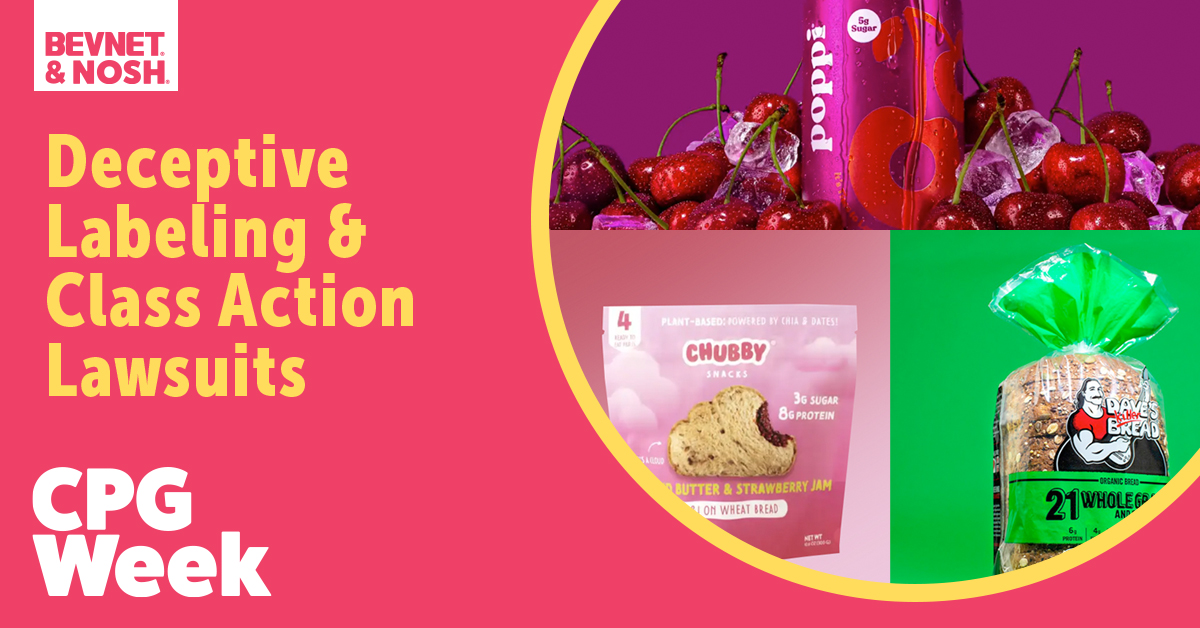
On CPG Week, the podcast team talks about a number of lawsuits across food and beverage including another chapter in the PB&J wars and a couple deceptive labeling complaints for growing brands.
Nosh managing editor Monica Watrous kicked off the episode highlighting her hometown football team’s star athletes’ various food and beverage brands. The podcast hosts go on to talk about the bubbling battle between J.M. Smucker’s Uncrustables brand and emerging competitor Chubby Snacks. Then, senior reporter Lukas Southard explains why a three-year-old class action lawsuit against Flowers Foods’ Dave’s Killer Bread is back in the news, before the team discusses the latest lawsuit to hit better-for-you soda brand Poppi.
Show Highlights:
0:30 – Starting with the Kelce brothers’ Garage Beer brand and moving onto their “Kelce Mix” cereal in partnership with General Mills, the group talked about athlete-endorsed food and beverage and why electrolytes might not belong in RTD coffee.
4:00 – The team discusses the most recent lawsuit from J.M. Smucker aimed at Chubby Snacks and why it relates to “healthy” food labeling.
10:00 – Senior reporter Lukas Southard explains what is happening with a multiyear class action lawsuit against Dave’s Killer Bread’s protein claims and why there seems to be more of these types of cases being brought against CPG brands. Hint: There’s one law firm throwing a lot of fuel on the fire.
12:15 – Senior reporter Brad Avery relates this all to soda maker Poppi’s multiple deceptive labeling lawsuits leading to a discussion about how much these various lawsuits relate to the products’ perceived health benefits and how much that is driving sales.
About the CPG Week
CPG Week is the podcast that explores the latest happenings in the consumer packaged goods industry. Join our seasoned reporting team as they dish out the week’s stories in quick, easy-to-digest episodes. Catch up on the top headlines of the week, dive into exclusive insights with the BevNET and Nosh teams, and set yourself up to make more informed business decisions. Tune in to stay up-to-date on the latest developments in the dynamic world of packaged food and beverage.
New episodes are released every week. Send us comments and suggestions anytime to cpgweek@nosh.com.
Show Highlights:
On CPG Week, the podcast team talks about a number of lawsuits across food and beverage including another chapter in the PB&J wars and a couple deceptive labeling complaints for growing brands.
Episode Transcript
Note: Transcripts are automatically generated and may contain inaccuracies and spelling errors.
[00:00:05] Monica Watrous: Welcome to the CPG Week podcast by BevNET and Nosh, your source for the latest food and beverage industry news. I'm Monica Watrous, Managing Editor of Nosh, here with my co-hosts, Brad Avery and Lukas Southard. If you're enjoying the show, please subscribe on your listening platform of choice. On the podcast today, we're discussing some of the latest legal battles brewing in food and beverage. But first, how about them chiefs? I tried the Kelsey beer this weekend, the garage beer that Jason and Travis Kelsey are involved in, I guess, as significant operators. And I started thinking about all of the different food and beverage businesses that they're getting involved in. And that made me think of you, Lucas, because I know you're our resident cereal expert. Have you tried the Kelsey mix yet that they made with General Mills?
[00:01:00] Brad Avery: In fact, Monica, I have not tried it. I will be honest, and I haven't really looked for it in the supermarket, but you know me, I have a regimen to my cereal, and it's usually some homemade granola, some Cheerios, and then some sugary. It has been Magic Spoon, but I'm getting off the Magic Spoon train. I'm looking for a new addition to my cereal combination.
[00:01:27] Lukas Southard: Friendship with Magic Spoon ended?
[00:01:29] Brad Avery: You know, like it's just getting a little old and I haven't really been that impressed. So I'm moving on. Variety is the spice of life.
[00:01:37] Monica Watrous: Well, and as a reminder, the Kelsey mix that was made in partnership with General Mills contains a combination of Cinnamon Toast Crunch, Lucky Charms and Reese's Puffs, which that sounds like something that I would have combined as a child. I loved like mixing cereals as a kid. Brad, do you eat a lot of professional athlete-endorsed or founded food or beverage products?
[00:01:59] Lukas Southard: Other than Chugging Prime? I don't think I do. I have tried is, speaking of the Chiefs, Patrick Mahone's Sports Coffee, Throne Sport Coffee. I don't think I've tried anything that tastes like such a pure hybrid of coffee and hydration sports drink before. And honestly, it's a little strange. It's hard to get used to. I'm curious what they do with the formulation. Lucas, you've also tried it. What was your impression of Throne?
[00:02:31] Brad Avery: I did write the story about Thrones launch. And so they sent me some samples and I will, I'll be the first to come out and say it. I'm not a fan. I like the flavored ones better than the non flavored or the black coffee, which I'm not a flavored coffee drinker, but for some reason, the aftertaste in all four of their varieties kind of just didn't sit with me very well. So I don't, I don't know if I'm going to be a return customer until they maybe do a reformulation, but I don't know if they're planning that.
[00:03:00] Monica Watrous: Well, I don't want to dunk on his coffee, but I will say something about his performance this season. He's been playing so poorly and somehow the Chiefs keep winning. We're undefeated so far. Yes, the Chiefs are my hometown team for those who are listening who didn't know that I'm the resident Kansas City person at BevNET. Yes, we just got to get it together and start playing like the Chiefs again.
[00:03:24] Brad Avery: Because you guys need more trophies.
[00:03:27] Lukas Southard: As the New England person here, now you get to know what it's like to be the evil empire. Enjoy that.
[00:03:36] Brad Avery: As a resident or as a former resident of the Bay Area and the resident Golden State Warriors fan, we've been the enemy for a long time. I've now passed the torch on to Brad and his Celtics can be the evil empire for basketball. We're all in the same boat here, just in slightly different ways.
[00:03:54] Monica Watrous: We're all evil. From the football field to the courtroom, today we are talks about some legal battles that are ensuing in food and beverage. And I want to start by talks about the James Smucker Company suing Chubby Snacks. And Smucker has been after them for a while, but what's the latest, Brad?
[00:04:14] Lukas Southard: So last month, the J.M. Smucker Company filed a lawsuit against Chubby Snacks, going after them for false advertising, trademark violations, disparagement. A lot of this complaint goes after Chubby for social media posts that specifically call out Smucker's Uncrustables brand, the original uncrusted peanut butter and jelly sandwich package. So Chubby has made an enemy of Uncrustables. It's consistently inferred that Uncrustables is not healthy and that Chubby is. It's in one social media post called Uncrustables the scum of the earth of a food. And at a certain point, Smuckers has decided to hit back in the form of a pretty robust lawsuit. In addition to the social media posts, Smuckers is also alleging that Chubby has committed false advertising. They are going after the alleged health benefits of the product itself, saying that the nine grams of protein that Chubby touts is not qualified. They don't explain what the quality of the protein is or provide a percentage of daily value. That's one point to Smucker's Hitsamon. Another is that they're saying that they violate the standards of identity for jam, because their recipe for jam is a little different than what the government says. Clearly, there's some bad blood between these two companies. And Chubby may be the David that has gone after the Goliath, and now Goliath is hitting back pretty hard here. One other point that might be important for context here is that when Chubby first launched in 2020, Smucker was very quick to hit them with a cease and desist for using the round circular sandwich model that Smucker actually owns a patent on. So that is what led to Chubby's cloud shaped sandwich that we have today, but it also provides a bit of legal backstory for how these two companies have come to buttheads.
[00:06:16] Monica Watrous: Having read the complaint that Smucker filed, we're talks about Uncrustables is a almost billion dollar brand. And it's saying that what it's accusing Chubby of having done with disparaging remarks and false advertising has created some kind of irreparable harm to the business, which I just, it's hard for me to believe that. I can't imagine Chubby is taking that much market share from Uncrustables.
[00:06:46] Lukas Southard: Yeah, it's about $650 million in reported sales. But still, Chubby's profile is pretty small still as a four-year-old startup. How much damage is really being done is hard to measure, I would say. Obviously, Smuckers is claiming that there has been irreparable harm. And in the social media posts, some of them can be pretty clear that Uncrustables is unhealthy, quote, unquote.
[00:07:17] Monica Watrous: Not to keep talks about Travis Kelsey, but I think I read somewhere that he eats like 90 Uncrustables a day or something on game day. So I think they're- 90? Something stupid like that. I find that hard to believe, but you know, maybe nine? Maybe nine. Maybe it was just nine.
[00:07:31] Lukas Southard: Okay.
[00:07:32] Monica Watrous: He's a big man. He can handle 90.
[00:07:34] Lukas Southard: He's a lot of sandwich. Here's the thing is I believed you.
[00:07:38] Monica Watrous: I was just impressed. We only report the facts on CPG Week.
[00:07:42] Brad Avery: you know, to weigh in a little bit here, I do think there, there's kind of two things at play. One is that you have this big food company basically going after a little competitor and somewhat picking out some things that, that are a little bit far-fetched in terms of like irreparable harm to the brand. But at the same time, like Chubbies has to kind of understand that they're, they're poking the bear a little bit and, and they've been poking the bear for years now and They have to assume that at a certain point they're going to get pushback.
[00:08:17] Lukas Southard: It definitely provides a cautionary tale for brands when you're making the challenger product. and you want to position yourself as better than the competition. It may pay off to tread carefully when you're using your chief competitor's name, when you're making claims about the quality of their product versus yours. There's a reason you see a lot of more vague language on packages like less sugar than the leading brands rather than less sugar than trademark copyright, it can lead to situations like this. And so it is something to be careful of. I mean, again, there's a lot of specific posts that are cited in this lawsuit, mainly from a couple of years ago, though.
[00:09:05] Monica Watrous: It's hard to tell what's going to happen here, too, because Chubby doesn't have the resources to fight back. And Smucker is demanding a jury trial and seeking damages and an injunction to stop Chubby. It's going to be a tough road for Chubby, but also it's kind of flattering, I would think. I mean, obviously Smucker perceives this brand as a threat and is trying to put it out of business.
[00:09:30] Brad Avery: All press is good press kind of situation. Are they going to do- All losses are good losses. Yeah, but does the jury get to do a taste test? Do they get to try the two and does that play into how they make their decision?
[00:09:42] Monica Watrous: Oh, man. I want to be on that jury.
[00:09:46] Brad Avery: So is Travis Kelsey.
[00:09:50] Monica Watrous: In other legal news, we covered a lawsuit against Dave's Killer Bread for similar claims, deceptive advertising. Lucas, can you tell us more?
[00:10:03] Brad Avery: Yeah, so this situation is not necessarily two companies going after each other. But this is a situation where you have a class action lawsuit coming from the consumers targeting flour foods Brad Avery's Killer Bread. So this legal situation is playing out in a California federal court and the complaint, which was filed in December, 2021. So this is a three-year-old lawsuit alleges that Dave's Killer Bread deceived consumers with its on-pack protein claims. So in a similar way, it does revolve around this idea of how much protein is being claimed is in the product. The plaintiffs in the case claim that some of the brands labels violate FDA regulations because they do not calculate the protein content properly. Um, it, it gets a bit complicated there, but basically they're saying that the, I believe five grams of protein in a lot of Dave's killer bread, um, products is, is not actually what is digestible when the consumer has it. So Dave's is also fighting a case in Illinois over the, same protein claim issue. But what stood out to me in our colleague Adrianne DeLuca's story, which is titled Dave's Killer Bread Can't Kill Off Deceptive Ad Suit, is that it's part of a series of deceptive labeling suits that have all been filed from one law firm, Sheehan & Associates. And it appears this attorney, Spencer Sheehan, has made a whole industry out of deceptive labeling class action lawsuits. I'm going to preface my next statement with a thought saying that I do think there should be oversight in food labels and we should push back on deceptive labeling claims. But in saying that, it does seem like that we're kind of pushing the boundaries, or at least this law firm is pushing the boundaries of what is reasonable in terms of how litigious we are in policing food and beverage brands.
[00:12:05] Lukas Southard: You're right, Lucas, that these lawsuits are a dime a dozen. There's a flood of them every year. And in fact, actually, Poppy, the prebiotic soda brand, has faced multiple class actions this year coming at it for labeling claims and advertising slogans. allegations about the quality of the product itself. So Poppy, last week, faced its second class action that said it's claims about health and wellness on its product and slogans like gut health never tasted this good are misleading and that the sugar content in Poppy would do more harm than the benefits from the prebiotics. Now, poppy is a fairly low sugar product, especially by soda standards. It's about max of five grams of sugar per can, a little lower depending on the flavor. But it's been facing some allegations from a previous class action that says the amount of agave, inulin, and prebiotic fiber content in the drink is not up to snuff for the benefits that it claims to provide. Now, I reached out to Poppy for a story I wrote on this case. If you want to know more about the case, the story's Poppy Faces Fresh Class Action Against Health Claims on BevNET. But, this was the brand's response, and I'll quote them here. Now, of course, the brand wants to defend itself here and co-founder Alison Ellsworth said back at the Beverage Forum earlier this year that they found that the number one reason people buy poppy is mostly for the flavor. And they actually are planning to phase out potentially a lot of this focus on gut health. The product itself, she did not say any plans to change the formulation, but the messaging is shifting. Again, it's where you get into trouble with the use of the word health that I think really comes into it. It's where regulations come in. It's where what can you call healthy really matters. And so this class action really seems to be seizing on sugar, the fact that there is sugar in the product, and whether or not the prebiotic content is large enough.
[00:14:39] Monica Watrous: It seems like such a subjective thing to try to define or make claims around, but the FDA has set parameters for what can be labeled as healthy.
[00:14:51] Lukas Southard: Yes, so actually the FDA is currently working on updating its listing for healthy. The existing definition, a quote from their website here, has limits for total fat, saturated fat, cholesterol, and sodium. To qualify, foods must also provide at least 10% of the daily value for one or more of vitamin A, vitamin C, calcium, iron, protein, and fiber.
[00:15:12] Brad Avery: You also have to think about both the Dave's Killer Bread case and the two cases of Poppy in that these are also, well, they're big brands that are, that are growing and have enough clout amongst consumers that. They recognize them, they understand them, and they're coming to these brands for a proposed health benefit. In the case of Poppy, it's that it's a better-for-you soda that has possibly some gut health benefits. And for Dave's Killer Bread, it's a multi-grain bread that is higher in protein than a lot of the other conventional breads on the market. And so these are two trends that we've talks about a lot, gut health and high protein, that are really driving consumers to buy more and more of these products. And in the case of Dave's Killer Bread, the plaintiffs actually did a survey if people would buy that product over other products based on the protein content and the price point. And the judge is allowing that to be put into this class action lawsuit as, as kind of proof that like, this is moving the needle for some consumers in terms of the choices they make based on what they see on the label or what the marketing campaign is around it.
[00:16:25] Monica Watrous: I've said it before and I'll say it again. I don't know how many people are coming to poppy for their fiber content or fiber intake or prebiotic consumption. And I don't know how many people are going to bread to get their protein. So these just don't feel like substantial cases.
[00:16:44] Lukas Southard: At the same time, I would say certainly I'll pick up a poppy because it is the better for you option to say like a Coca-Cola. You compare the calorie content, you compare the sugar content, and it's no question. The prebiotic fiber is sort of a bonus in my opinion as a consumer, speaking as the consumer I see five grams of sugar, but it still tastes pretty full flavor to me. So that's why I reach for it, and I think that's exactly what Alison Ellsworth was saying at the beverage forum, that people are going to it for taste, and obviously it's not 40 grams of sugar for a 20-ounce bottle.
[00:17:29] Brad Avery: Yeah, it's not necessarily, in my opinion, that people are going to Dave's Killer Bread for protein. It's that if they're going to choose a bread, they might choose Dave's Killer Bread because the price point is where they want it and it has this protein claim as opposed to, you know, a private label option that is similar. So if they're going to buy bread, they might buy this because the protein is better.
[00:17:51] Lukas Southard: Nice little bonus.
[00:17:52] Brad Avery: Yeah. You're not convinced.
[00:17:56] Monica Watrous: No, I'm not.
[00:17:59] Brad Avery: I don't know if I'm convinced, but I'm just arguing the case.
[00:18:03] Monica Watrous: We will keep an eye on all of these cases and whatever else pops up in the next few months. Oh, that was good. Here are some other notable bits of news from the week. Inside the RxBar duo's plans to disrupt candy, Diageo adds Ritual Zero Proof to expanding non-ALC portfolio, and big picture foods acquired by Atalanta Corp. For these stories and more, become an insider at BevNET and Nosh. That wraps up this edition of CPG Week by BevNET and Nosh. Thank you to our audio engineer, Joshua Pratt, our director is Mike Schneider, and our designer is Aaron Willette. If you enjoyed the podcast, please subscribe on your listening platform of choice, and we will see you next time.
About CPG Week
CPG Week is the podcast that explores the latest happenings in the consumer packaged goods industry. Join our seasoned reporting team as they dish out the week’s stories in quick, easy-to-digest episodes. Catch up on the top headlines of the week, dive into exclusive insights with the BevNET and Nosh teams, and set yourself up to make more informed business decisions. Tune in to stay up-to-date on the latest developments in the dynamic world of packaged food and beverage.
New episodes are released every week. Send us comments and suggestions anytime to cpgweek@nosh.com.
Stay Informed, Stay Competitive
Unlock the articles, expert interviews, and data reports that power the food and beverage industry. Join our community and stay ahead with exclusive insights from BevNET and Nosh.