Search across the BevNET CPG Media network including BevNET, Nosh, Brewbound, Taste Radio, Nombase and CPG Jobs.
Pitch Slam 12 - Finals : Absurd Snacks
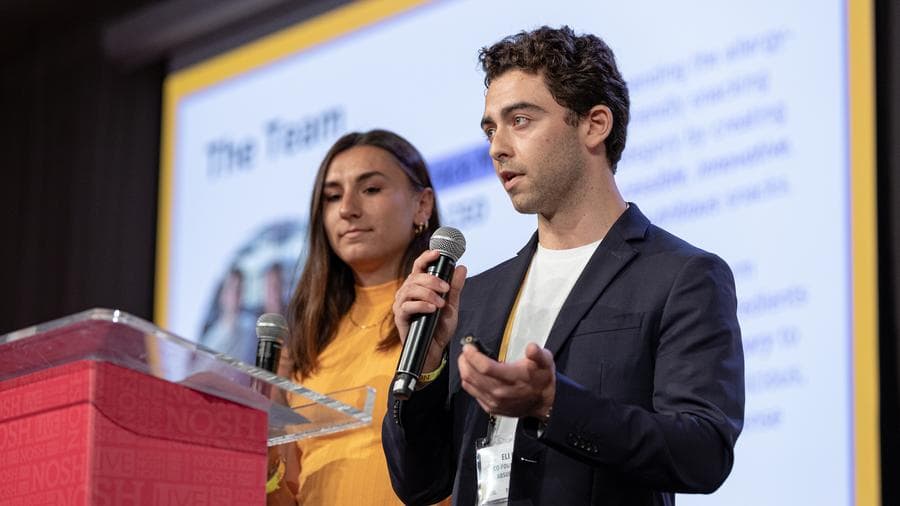
Featuring:
Grace Mittl, CEO, Absurd Snacks
Eli Bank, COO, Absurd Snacks
Transcript
Note: Transcripts are automatically generated and may contain inaccuracies and spelling errors.
Speaker 1 [00:13] Up next on the stage will be Grace Mittl and Eli Bank, the co-founders of Absurd Snacks. Come on up. You got 2 microphones. Please just keep it on your timer.
Eli Bank [00:28] Good morning, everyone. Thank you so much for the opportunity to be here. We're so excited. This is why we do what we do. But you know what's absurd? Tell me, Eli. 1 in 4 American families have a family member with one of the top 8 common food allergies.
Speaker 3 [00:43] You know what's even crazier, Eli? What we were undergrads at the University of Richmond when we found a really great solution. So before I tell you what we do, I'd like to start with how we got here. We were lucky enough to be part of an inaugural program called Benchtop Innovations at the University of Richmond, which enabled us to create a packaged food product in just 6 months. The inspiration for the product came from a fellow student. His name's Dan. He has a severe peanut and tree nut allergy. So what are absurd snacks? We are an allergy-friendly snack company that creates unique, delicious, and accessible snacks for people with common food allergies. We are allergy friendly, free of the top 9 allergens. We're also gut-friendly as both of our mixes are only sweetened with pure maple syrup, and we are vegan as we are powered by plant protein. So we use simple yet striking ingredients. Chickpeas, fava beans, and green peas are the stars of our show, and we've coupled them with a seed-based granola consisting of hemp seeds, flax seeds, sunflower seeds, and even sprouted quinoa. We have our two flavors, maple, cinnamon chocolate, just sweetened with pure maple syrup, so they're just subtly sweet, making them a super versatile snack.
Eli Bank [01:54] So this is Grace. I'm Eli, and our 3rd partner, Maeve, who unfortunately couldn't be here today, are so excited for the opportunity to go full-time on Absurd Snacks. We want to give a huge shout out to the local Richmond community that's been so supportive, our mentors and network that have helped us get to where we are today, as well as the CPG food space as a whole for being so generous with their time and providing us with very key insights that have helped us get to where we are. So since our launch at the end of March, we've done about $36,000 in gross revenue with a 28% blended margin. Uh, we started in independent retailers, many of which are focused on, um, local and healthy, uh, food options. Uh, we also sell online D2C on our website, and, uh, catch us at the farmers' markets on weekends, interacting with our customers. The community engagement has been really important in helping us turn cases. We also experimented with with B2B options, selling into corporate offices, uh, for them to stock their stack stock their snack shelves. Uh, in the stores, our prices are about 999 cents for a 10 ounce pouch, uh, and 399 cents for our smaller 4 ounce pouch. And online, you could purchase for, uh, it's, we sell in packs of 210 ounce pouches for $20.99 with shipping included.
Speaker 3 [03:16] So these are the people that we're serving. Our target customers are young to middle-aged adults who prioritize the products they put into their body. They also enjoy outdoor sports, um, and they also identify with having one or more of the common top 9 allergies found in the US, particularly nut allergies and gluten allergies.
Eli Bank [03:33] Our fans have found really creative ways to enjoy absurd snacks. Of course, by the handful as a traditional trail mix, but also on top of their yogurt with fruit on a smoothie bowl, um, in their, in a cereal, uh, as well as, as a crunchy topping on top of their salad. We've also been able to leverage this as part of our, our, our marketing tactics. So we're still experimenting with our go to market strategy, um, and we continue to optimize our efforts to where, uh, conversions are most efficient. Uh, we are going to continue to maintain and grow our relationships with independent local grocers, uh, and keep engagement as high as possible to maintain those repeat sales. And we hope in the future to mimic the strategy and lookalike markets all across the United States to grow our footprint but maintain that small brand feel. In order to achieve this, we are creating meaningful relationships with new distribution partners, uh, while leaving plenty of white space for growth. Over the next 8 to 12 months, we plan on, uh, continuing some customer discovery to learn more about the needs and desires of our target customer, uh, test and experiment with new recipes as well as iterate on our current ones. Uh, we are giving our brand a little refresh and helping it be more mature, as well as fostering this, uh, really engaging community around our brand.
Speaker 3 [04:56] To wrap up, we have big plans for the next 3 to 5 years with achieving a $10 million run rate, um, being top 25% in our category and achieving a 40% target margin. Um, of course, we'll maintain our independent retailer relationships and continue to grow in that respect, but to be more accessible, we'd love to sign on with a new regional retailer and do a nationwide rollout in the next 3 to 5 years. Thank you for your time and really appreciate your, your insights today.
Speaker 1 [05:26] Nicely done. Thank you. Uh, yeah, you can, you can slide up over here. There you go. Um, so I thought that was a great presentation, but Holly, you know, uh, what do you think of it? Did you see anything in there that you really liked, or was there anything there, in there, in there that was a little absurd?
Speaker 4 [05:40] Nothing, nothing too absurd. It was great. Um, we all thought that fla flavor was great too. Um, strong flavors, we would say could be a little stronger. I think we got a, a great flavor in the cluster in the chocolate and love the cluster. And then, um, otherwise it was very heavy chickpea flavor but really liked the flavors and thought the packaging was great, um, as a start to the conversation.
Speaker 1 [06:04] Yeah, let's stick with the packaging, Ibrahim, you know, in terms of the label hierarchy and what you saw from the slides, um, and what you saw when you were doing the sampling, what do you think of absurd snacks packaging?
Speaker 5 [06:13] Yeah, I have two comments and actually a question for you guys. So first of all, I love the packaging. I think it's fun. It's kind of playful and colorful, and um, so that that part resonated with me. What I do think might be missing from the packaging currently is kind of the key point of difference versus traditional trail mix. So you're kind of left to assume, is it protein? Is it lower sugar? Is it you know, high, lower carbs, um, and you guys mentioned. That you actually have a brand refresh underway. So I'm just curious, what are you looking at in that process and what are the things you want to change? Yeah,
Speaker 3 [06:40] absolutely. We've been doing a ton of customer discovery. We have a survey with about 200 respondents and in-depth interviews with retailers and prospective and current customers, and you'd be surprised how many, how much time people spend in the grocery store reading ingredient. And the greatest piece of feedback that we've gotten is our customers want to read the front of the label and not have to think twice about what's in it, especially if our customers with gluten and nut allergies. Um, so you know, we want it to scream nut-free, allergen friendly from a mile away so our customers can make the easy conversion and go right to the checkout line.
Speaker 5 [07:12] Very cool. I think that's smart. Yeah.
Speaker 1 [07:14] And Carol, I mean, you know, the trail mix space, uh, it doesn't feel like there's a ton of innovation in that space, but what do you think about Absurd Snacks as sort of bringing new, newness and fun and playfulness to that category? Well, I think just to the packaging point, it does, it's really nice to have, uh, a strong point of view in a set that's like often very bulk, uh, or private label. However, I'm not actually sure if a. Trail mix is the right name for it because of the four ways you showed it, like they were, it seemed like it would also be easier to use, you know, trail mix is something you eat on the go. This might be a little difficult, um, unless you kind of did the, I've seen some long shot packs that you can kind of pour into your mouth. Otherwise, I just think it gets a little tricky to eat, um, and so maybe it should be somewhere else in the store. And Mia, I mean, you were asking about price point when we were uh in the sampling room. Yeah, we got the price point here. I mean, is that in line with where you think people are willing to spend that kind of spend for this kind of product? Yeah, I
Speaker 6 [08:12] mean, it's, it's obviously high on the high end of things. I think, um, if you could get to like the 799 or, um, but I also agree with what Carol was saying where I think it could be, you know, where is it gonna live? Is it gonna live with the granolas because I think. Your use cases are more similar with that of a granola than a trail mix necessarily so I think that's something to think about as well, um, but I'm glad to hear that you are doing a package refresh to call out because I think that was one of my things too is, is just like you really wanna make sure that that it's all about the, you know, allergy free because that will be your differentiator for when you have to be a little bit more of a premium price.
Eli Bank [08:48] Yeah, absolutely, thank you.
Speaker 1 [08:50] Holly, um, you know, we saw a go to market strategy sort of outlined that they were still in development, um, anything that you would recommend in terms of where that go to market strategy should be highlighted or focused?
Speaker 4 [09:00] I thought that was great and I, I should have taken more notes of exactly what it said on that slide because it did. I think you, you hit an approach. I obviously think what you're doing with getting direct feedback is so important. And I think because you mentioned DTC, I think you could do more with getting people to write reviews, incentivize them to, to give you even more information from the buyers you work with to your customers. I would continue to get feedback so I can go a long way as well as, I mean, I know we mentioned the price point and getting under 999 could be good for the 10 ounce, but I actually thought the 399 was pretty strong for a 4 ounce. And so I think, uh, continue to look at what your peers are doing too to help influence where you might pivot as you take, as you go forward.
Speaker 1 [09:41] Absolutely. I think Holly mentioned taste, but I can't remember if anyone else did. Ibrahim, did you mention the taste?
Speaker 5 [09:45] Um, I didn't, but I thought it tasted very strong. I think Holly's point was a good one in that they're like the granola chunks, so I think that maybe they're quinoa, they tend to have the strongest flavor, and then the beans are just, they're lightly dusted, right? So I would just think about, you know, whether that's through application or making those pieces even stronger in their flavor, right, so that the chocolate can carry through a full handful. That would probably be my only comment.
Speaker 1 [10:07] Can I add something to Holly? So when you said with the go to market strategy, I think $10 million run rate and 45% margin, um, I think as you present this to investors and retailers explaining how you think you're gonna achieve those metrics is really important because those are impressive numbers. So if you wanna seem like a sustainable business, you kind of need a, and, and I know, I know we're limited on time, but I would focus on that a little bit too. All right, great feedback, great presentation. Well done. Thank you much. I.