Search across the BevNET CPG Media network including BevNET, Nosh, Brewbound, Taste Radio, Nombase and CPG Jobs.
NOSH Live Summer 2022: Pitch Slam Semifinal Round
Transcript
Note: Transcripts are automatically generated and may contain inaccuracies and spelling errors.
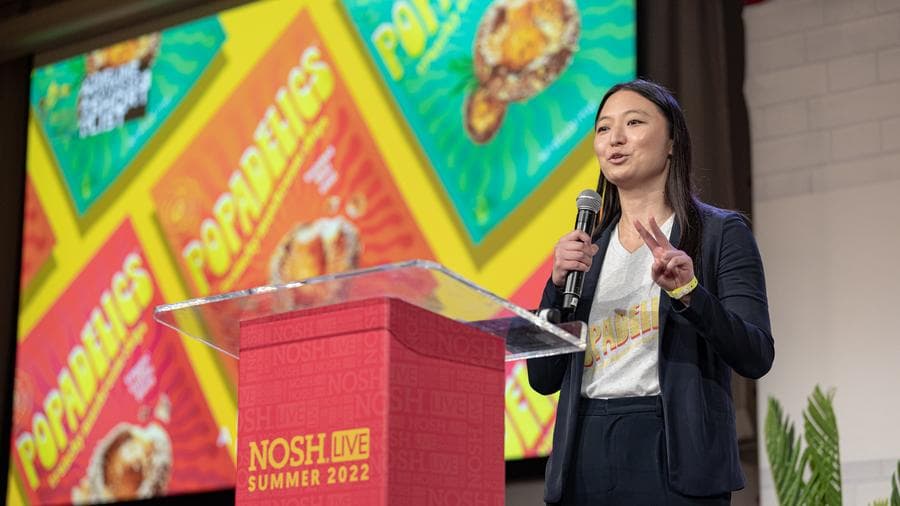
Ray Latif [00:11] My name is Ray Latif. I'm the editor and producer of Bevnet's Tace Radio podcast and the host of today's Pitch Slam. The pitch lamp gives early stage and promising brands the opportunity to present their business plans and products to a panel of expert judges and the audience watching on our live stream. The winner of the two day competition will receive a $10,000 industry awareness package and join a short list of brands that have triumphed in the competition, including Beckon Ice Cream, Creation Nation, Kolkata, Elite Sweets, Tribali, and Bronx Hot Sauce. We're, we're kicking off the pitch slam with a semi-final round in which entrepreneurs from 11 brands will have 2 minutes to deliver their best elevator pitch. If they attempt to go over the 2 minutes, they will hear this sound. It's very clear you don't want to go over 2 minutes. Our judges will provide approximately 2 to 3 minutes of feedback following each pitch. The judges have already sampled the products. After all the brands have presented, the judges will pick 5 brands to move on to the final round. The 6th finalist will be chosen by audience vote. At the end of today's semi-final round, we're going to show a list of the participants and a number next to the brand name. Live stream viewers will have an opportunity to vote by texting the number corresponding to your favorite brand to a phone number that we'll provide. You can also do that here if you're in the audience. We're going to show that phone number at the end of the semi-final round. You'll have until 5:00 p.m. Eastern time to vote. We'll announce our six finalists here at the happy hour and also on Nosh.com. Let's now meet our panel of esteemed judges, beginning with Adrianne DeLuca, who is a reporter for Bevnet and Nosh, where she covers a range of industry-related topics with a specific interest in new sustainable innovations, regulatory and legal matters, as well as the intricacies of the supply chain. Next up we have Jason Starr, who is the founder and managing director of Consumer Ventures. Jason has over 2 decades of experience spanning operations, technology, venture capital, and private equity. He's again the founder of Consumer Ventures, a venture capital firm focused on investing in and building emerging consumer brands and companies. Before Consumer Ventures, Jason was the fund manager at Circle Up in San Francisco, through which he invested in dozens of consumer ventures. Up next we have Karen Ivanus Rogers, who's the director of business ventures for Albertson's Companies. Karen co-leads the Albertsons Growth Accelerator program, whose mission is to accelerate the growth of select emerging consumer brands by providing distribution, merchandizing resources, and analytics to increase brand awareness, sales, and velocities. Karen participates in the prospecting, prospecting and selection of new brands. She leads the operations team that supports portfolio companies and acts as a problem solver, strategic thinker, and connector to emerging entrepreneurs. It's clear why we have her on stage. Last but certainly not least is Matt Weiss, who is the founder and CEO of Rynd Snacks. After a nearly two-decade career in finance, Matt launched Rin, a better for you snack brand focused on whole fruit nutrition in 2017. Prior to Rin, Matt spent 20 years in investment research at Baron Capital, where he covered consumer growth stocks. Very happy to have Matt with us. If you haven't had his snacks, please go ahead and try some before they're all gone. All right. Let's get to our first semifinalist of this round. That is Marilyn Yang, who is the co-founder and CEO of Papaelics. OK, microphone, please just mind your timer. It's over there. Hi everyone, my name is Marilyn Yang, and I'm the co-founder and CEO of Fun Gal Snacks, which is the parent company of Papadelics. Very excited to be here today at Nosh Pitch Slam 12. And even though we just met, there's really only two things you guys really need to know about me. One, I love mushrooms, and two, I love snacking. So naturally, as a picky yet adventurous eater who happens to love mushrooms, it really hit me one day that mushrooms, especially crunchy mushrooms are noticeably absent from grocery store shelves. I've had kale chips and carrot chips, so why shouldn't there be mushroom chips too? So if like me, you also love mushrooms, you're going to love Pappadelics. But if you're a mushroom doubter, you're still going to love Pappadelics. Take everything you've ever known about mushrooms and throw it out the window because pappadelics are shiitake mushrooms reimagined for the modern superfood snacker. Papadelics aren't just a snack, they're an experience. When I founded Pappadelic's, our goal was to create a better for you snack that actually tasted good. Packed with incredible flavor and a dense, crispy texture, our snacks will have you tripping off the taste. To produce its signature crunch, Pappadelic's leverages a unique cooking method called vacuum frying. Which allows foods to cook at a lower temperature while retaining much more of their color, nutrients, texture, and flavor. Pappadelics are also vegan, non-GMO, and a good source of protein and fiber. Pappadelics is currently available in three addictive, mouthwatering flavors trip and truffle parm, twisted Thai chili, and rad rosemary and salt. Purchases also support the Fungalo Snacks Foundation, a charitable foundation we also started that supports various causes centered around health and wellness. As for Fungal snacks, Papadelics is only the beginning. We want to become a platform for innovative snacks that leverage not only the benefits of mushrooms, but other under-loved veggies. In the meantime, I can't wait for all of you to transport your taste buds to a new level in superfood snacking with Papaellic's crunchy mushroom chips. Thank you. your microphone. Well done, Marilyn. All right, uh, let's start with Karen. Um, Marilyn mentioned that the, uh, grocery store aisle, that the snack aisle was missing mushroom chips. Does it need mushroom chips? It might actually. Um, I'm not a mushroom person and, uh, they were. Great. And there really is nothing like that on the shelf, so I think there is a spot for them. Yeah, let's stay on the flavor for a second. Uh, Matt, you, uh, market some crunchy snacks as well. Uh, what do you think of the taste of these? And, you know, does it sort of, is there a point of reference for these products that currently exist on the shelf? Um, I thought they were dynamite. Uh, they were very palpable. The crunch was stellar. It's one of the best crunches I've had in a snack. So the vacuum frying, it really delivered. The flavor profile was excellent. Um Again, I don't know if the world needs a mushroom chip on the shelf, but I don't think it also needs 6 kale chips on the shelf. So I think this serves a unique, you know, slot, and it could earn its right because it was so tasty and fun. Adrian, we've seen a lot more mushroom products come to market. You've reported on quite a bit as well yourself. Um, how do you poppadello's kind of fit into this emerging category, this emerging ingredient? They definitely stand out. Um, like my co-judges have said, the taste was fantastic, and it was an incredible crunch. The one thing that Kind of tripped me up. Um, took a little too long to notice that these were not actually a psychedelic mushroom. They wouldn't go, you know, floating off into space after eating them. So that would be a one tip on the packaging, I'd say. Yeah, I mean we can talk about the packaging. I mean, Jason, you know. Does Poppadelic's pop when it comes to its branding? I think it did. I liked both the packaging and the product. I think one of the questions as investors, we ask a lot is, is this a product or is this a company? We want to see that there's a bigger picture, more of a runway. I think it's very interesting that the pitch kind of ended with this idea of a platform for underloved veggies, which I think people are being very successful. I think there's a real need for that. That doesn't mean there's not a need for the mushroom, but you may think about whether or not your pitch is about the platform where the mushrooms is your first foray into the platform, or whether the mushrooms is your is your pitch and that you may someday do other things, because from an investor those can sometimes be seen as two very different things. Excellent. Karen, did you want to say something? I do. This was the first time I've seen mushrooms that there wasn't functional benefits with it, so that was a bit of a disconnect. Gotcha. All right, great feedback. Let's move on to our next semi-finalist. That's Kyle Rudd, who is the co-founder of Start Right Foods. Kyle, come on up. Very good. Please just keep an eye on your timer. Thank you, Ray. Thank you all for being here. It's really exciting to be up here on stage. My name's Kyle Rood. I am the co-founder of Start Right Foods. We're focused on delivering convenient protein-packed breakfast foods for even the most hectic mornings. And our journey began way back in 2015, 7 years ago, when my co-founder and I, sort of fresh off of being athletes in college, were like there wasn't ever anything good to eat in the morning that we could get out the door, really enjoy. We were both convinced that protein waffles were the next big thing. And if you guys go to a grocery store right now, you'll see we were right, but you won't find Start Right protein waffles in the case there because our company wasn't quite ready for that growth. So what we did, like any nimble entrepreneur would do, is we pivoted. We retooled our design and our manufacturing to focus on the waffle slider breakfast sandwiches you guys see up here, and even more convenient way to deliver protein, protein in the morning. And so as we retooled and as we re-engineered, we focused on three main things. One, reformulating our product to make sure it was the most delicious product we could possibly make. 2, rebranding to stand out in a sea of yellow and red that's in the freezer case currently. And fourth, or 3rd was actually making sure that we had the ability to grow and expand as this category takes off. So now looking at us today, we finally got into around 1700 stores nationwide ranging from the conventional consumer that shops at a Walmart who's looking to be a little bit health curious, eat a little bit better for themselves, to the health conscious consumer that shops at Sprout's Farmers' Market. And we have a range of, uh, category, range of skews that cater to those consumers as well. We have our classic sausage and egg, and an indulgent chicken and waffle products, which I got to admit is my favorite. We also have the health health conscious turkey sausage and egg white, and we just launched a plant-based sausage with egg patty for those vegetarians in mind. So we're convinced we have something for everybody, and we'll let you know that with Start Right, breakfast is solved. Thank you. Very well done. Uh, Adrian, this was a post lunch lunch, I guess, for you guys. It wasn't, it wasn't for breakfast or you didn't eat them as for breakfast, um, but what do you think of the flavor? What do you think of this idea of waffle sliders? So I actually did not end up sampling the product. Um, we had the turkey one back in the sampling room, and I'm vegetarian, but I did really like the packaging and the callouts, um. I like what they're trying to do with it. Um, it's intriguing, especially with the food imagery. I think they did a great job branding it for what the product is, um, and really the branding and positioning. Just fit and pop on shelf. Jason, uh, you know, what do you think about the opportunity in breakfast right now? What do you think of, uh, Start right within that opportunity? Yeah, I really like the name because kind of to my prior comment, it sounds like a good basis for a platform for breakfast products. Um, I thought the packaging, um, really was professionally done, you know, I think, um, one concern I would have in terms of the broader opportunity is, you know, as with most things in, in. Consumer, it's already a crowded aisle, and so it's hard to be just healthier for everyone. And with the high protein, my, my question would be, is there a target customer that you're really focused on to kind of nail that core customer first and branch out from there and I didn't really kind of hear that in the pitch and it's sometimes it's just kind of hard to be something for everyone. It's it's better to start with a smaller target market. So I guess that's where I would have questions. Karen, we heard from Kyle about the traction they've had at retail. Um, how much do you factor that into your evaluation of the brand? We definitely want to see velocities. So, um, if I understand it right, they're in Walmart and Sprouts, and that's an excellent place to start looking. We factor in a lot. And what do you think of the taste of the product? Did you get, did you get to try it? I did, yeah, um, I, I think it's a, um, really interesting individual components. I think the waffle is a nice differentiator. Because of the waffle, I felt like there should be some maple flavor or some kind of sweet or I don't know, it was a little dry, um, but I think it's excellent and it might be easy to tweak or maybe that's an option for some consumers. And Matt, you know, as an entrepreneur that education is really important. Consumer education is important. Do you think this is at a good foundation for, you know, educating people and making people more aware about Start right? I think it's a good foundation that they can build off of. I thought the product tasted really good. Um, I think they're solving a need state, a complete meal, attacking the morning day part that isn't a breakfast burrito. I think is, is great. I actually felt like their packaging was a little too safe. I think it felt already like something a big company might be, might put out there, and I would rather have them take more risks with their presentation of the product and be a little bolder, but I thought there's a great foundation here. Excellent. All right, let's move on to our third semifinalist. That's Craig Morantz, who's the founder of Snack Conscious Conscious Conscious, yes, sorry about that. Uh, either one. Can you spell conscious? No, I won't. Um So our origin story is a familiar one. We couldn't find what we really wanted, what we craved, so we went out and created it. And uh it sounds easier, obviously we've all kind of thought that. um, what we craved was something really indulgent. It was the beginning of COVID. We were home, we were on Zoom call after Zoom call. We wanted indulgence, but we also knew that we had to have something that really made us feel good. But we kind of started thinking well what is feel good? It's feel good that it tastes incredible it's feel good that it's got a whole bunch of uh you know uh qualifications like vegan and organic is is feel good that you don't feel guilty is feel good. That you have that nostalgic feeling when you bite into it. So what we decided to do was define what feel good means because we thought it was really important to make sure that yes, have something that tastes good but also feel good. So number one for. was it had to have incredible taste and texture, full stop. We're going after this zero compromise consumer who will not compromise anything around taste or texture. Number 2 was the gut. We knew that. If you want to feel good, your gut, you have to treat your gut. You have to have something that's not going to make you feel bloated. So we made sure that our formula had prebiotic fibers, had a very effective probiotic that was also shelf stable. We used a fermented protein that not only makes it easy to digest but also tastes good. Um, and then we used high fiber adaptogens and then finally we knew that you had to have that connection between your head and your taste buds and so we wanted to make sure that you felt something nostalgic, something that remembered reminded you of something that didn't necessarily always, uh, you know, that you had to be reminded of something really good. Thank you. You don't have to be silent, you can clap clap. There we go. There you go. All right, um, you know, functional sweets or, you know, treats with functional ingredients seems to be on the rise. Uh, Jason, you know, what do you think of the concept within again that rising category? Yeah, I think conceptually it's, it's a really compelling product and I like the way that he talked about it. The challenge that we had, and we had a different package format, it was a smaller format, is very little of that came through to me on the actual physical product and There was a whole lot of really, really small words and so I think a challenge for a company like this with a product that has a lot of functional benefits is how do you convey that and I just think that that's a big challenge for them is that right now the product isn't conveying to me what I heard from him in the pitch. Adrian, I saw you nodding. I mean, what do you think about the packaging in terms of explaining Well, Craig talked a lot about the taste and how good, shockingly good the taste is. Does that come through on the packaging? Not necessarily. I agree it was a fabulous tasting product. We all were surprised when we took a bite of a protein ball, and it was, you know, it tasted like a dessert, um, but when I look at the packaging, my eye was bouncing between the words on the top, bottom, and the middle without really understanding what it was and what was inside. Um, so I feel like there's a need for a hierarchy of callouts on PAC. Got you, Karen. Were these as shockingly good as you would have expected them to be? I mean, again, Craig talked a lot about the importance of getting the flavor right. They were better than I expected. I thought they were really delicious, and I agree with him, and taste and texture was really there. Um, what I would call out in conventional grocery stores, I don't know where this product goes. I, I can't think of the home. So that, in addition to the package challenge are things that I would really call out as something that needed to be worked on soon because you got to find a home and then from that, it's not it's not, there's no natural home for this product. Matt, you get the last word on snack conscious. Did I get that right this time? I think so. Uh, I thought the texture was one of the best that I'd had, but I do think there are some competing messages going on. I didn't even appreciate the good for the gut was a call out of theirs. Um, I thought the package gave off a cool vibe but left me a little confused, and, um, but the taste and the texture were very good. Outstanding. All right, good stuff. Move on to our 4th semi-finalists for this round. That's Airym Momtora, the founder and pastry chef at Ruani. Come on up. You can use any one of those microphones and please keep an eye on your timer.
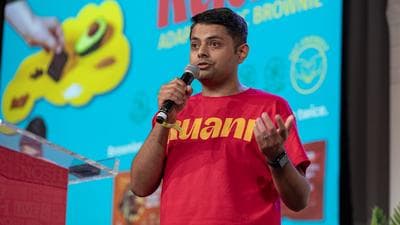
Speaker 2 [19:15] Why do desserts have to be bad and why do the ingredients inside have to be so bad with a lot of sugars and chemicals and junks? And can we replace them with better ones and have you added benefits to it? Can we still preserve the texture and taste as well? Well, these are the questions that came to my mind. Hence, I started running. Hi everyone. My name is Anirud Mamtora and I'm the founder and pastry chef of Ruani, and we are a better for you dessert company. We're on a mission to create high quality scrumptious desserts that are joy for your taste buds while focusing on gut health. So I've been a pastry chef for the better part of a decade now, and I've worked all around different continents made from the smallest of the pettifores to the biggest of the wedding cakes and everything in between. So I knew that I had the expertise to pull a product off. All I needed was figuring out what kind of ingredients. So any time I bought a store bought dessert, I would get 90 seconds of bliss and 90 minutes of pain. And that was true for everybody, literally. Like the minute you eat something, you feel good, and then for the 90 minutes, either you have a bloated stomach or you have a skin reaction or a massive headache. I had, most of the time I had all of 3, so, um. This led me to, you know, create a product that did not have any of the bad things but had ashwagandha as an adaptogen, was gluten-free, dairy-free, no soy, non-GMO, was made without any refined sugars, also had all the textures, flavors that you associate with a traditional brownie and was better for you and your gut. So I don't know if you guys have already tried it. Please do if you haven't, because our brownies are so nice. You'll definitely want them twice.
Ray Latif [21:14] Let's be careful. All right. Um, Karen, I'd love to hear your thoughts on Roani and adaptogenic brownie. I think you made a comment earlier in the last presentation about where do these types of products go on in the store. Do you have a better sense for Rouhani? Uh, first of all, it's absolutely delicious. It's incredibly delicious, and it's shocking that it doesn't have any of the bad things in it. Um, I don't really know where this goes in the store. I, I couldn't tell from the packaging. We were talking about that a bit in the room. It's easier to imagine this in a specialty grocery store than in a big conventional grocery store. I, I don't know. Yeah. You know, Matt, I mean, as an entrepreneur, you don't sell functional products per se or explicitly functional products, um, but when you are shopping and we are looking at other people's brands, I mean, how do you assess functionality in these types of products and what do you think of Rawai in general? Yeah, I, I think he's done a great job, delicious product. Um, I think his story is really, really interesting, compelling, comes across. I think going to market as an adaptogenic brownie. My own take would be you'd be better served going as a better for you brownie, where you're, I'm still waiting for someone to tell me what ashwagandha is or does for me. And so they have a great PR team, whoever Ashwagandha uses. So, um, but I think it's a little bit, it makes it more niche than more universal, and the taste should be universal here because it was that good. I would go with better for you brownie. And the function is, is the cherry on top, but not the main story. I, I think it didn't taste like you had any compromise. It was great tasting brownie that happened to be better for you. So let's stay on that for a second, Adrian. You know, um, adaptogens, as Matt was talking about, it's all over the place. Everyone adaptogen in everything, um, but leading with adaptogens, are there enough consumers out there? Is there enough, uh, household penetration for adaptogens at this point for people to really appreciate what Rohani is doing? I'm not sure. I kind of agree with Matt on the point where I would definitely go with the better for you positioning. I feel when we saw that there was Ashwagandha in it, I was surprised, but I think that also might turn people off, um, just due to flavors associated with it. Neither, none of us realized there was adaptions in them. I think until after tasting them, so the taste really comes through, but I worry that might deter people that language, yeah, and Jason, how do you evaluate products like these as, as an investor? How do you think about functional sweets once again, um, and what do you think of Irani overall? I mean, I'm going to sound like a broken record on a couple of things. It was an amazing product and I really like how clear they were in the labeling in terms of, you know, what was missing and not included and it was still an amazing product. I think for me as an investor, anytime I encounter something like that, being trained to be the skeptic is I want to know, like, you know, what's your price point, what's your gross margins, and what have you done in order to make the product this good that may prevent you from being Successful in stores and so I don't know if that's necessarily anything that he could have covered in the pitch, but that's going to be an immediate concern as an investor is trying to understand kind of if a sound counterintuitive, but if a product is that good, like what have you put into there and how is that going to potentially hurt your margins and ability to be a good business on top of being an amazing product. Outstanding. All right, we are. Moving along here for the Nash pitch slam, let's move on to our next semi-finalist for the round. That's uh Kaja Bonsey or Basne, the owner of Romantic Chocolate. I apologize for butchering your name, but please go ahead. Hello everyone. My name is Kasha Bosne. I'm founder and CEO of Romantic Chocolate, which is women owned business located in New York City. We handcraft fresh daily small batches of plant-based energy protein bars and rope into a variety of raw organic, delicious chocolates. All bars are unprocessed, gluten-free, dairy-free, soy-free, lactose-free, nut-free, but definitely not taste-free. We often, we offer, uh, sugar-free options. They are non-GMO, no refined sugars, and no preservatives. We are also CI certified and trademarked. Ideally they should be refrigerated, but they are also shelf stable, and the shelf life is one year. We launched about 4 years ago when I was still simultaneously running a full-time fashion business, and at the time I thought I had the best job in the world because I was shopping every day. Today I know I have a much better job because I can eat chocolate every day. I spent over two decades in the fashion industry working with women from all over the world, and I was listening very closely to all their health challenges and struggles, and I became very passionate about nutrition because I wanted to help, but foremost I needed to squeeze them to the Chihuahua size dresses. Today you can find romantic chocolate through our flagship retail store located in New York City. Also, we sell through several specialty retailers like Whole Foods, RO. West Side Market food co-ops. We also sell through luxury hotels, airports, wellness centers, yoga studios. We also sell direct to consumer through our website. We're also on Amazon, Lucky Vitamin, and several other e-retailers. Our target market, it's 5 to 65 years old and ideally. We would like to accelerate our growth and focus on children category. We believe that children are often victims of malnutrition, and we would love to partner with some schools to be able to offer kids much healthier, much better snack. Let's be done. Well done. Now I know people are probably wondering why do you have, you know, similar position products three in a row. All the, uh, semi-finalists have been randomized, so this is not in any particular order. It just kind of happened that way. Um, Adrian, let's start with you. Romantic chocolate, um, you know, it seems like it's, uh, a much better for you option than some of the products out there. Um, is this a project, product that you would reach for? Um, I'm not quite sure. We sampled the berry flavor and I love the packaging. I would definitely like pick it up and turn it around and try to figure out, I guess what it was for, um, but that wasn't quite clear, so I'm not too sure. Um, that I would, you know, necessarily go to buy it, Matt, you know, in terms of, uh, the opportunity, the the use case, um, does that come through in the, in the packaging? Did that come through, through in the presentation? Um, I'm not quite sure. I felt like each of the packaging had what looked like runners, um, so I wouldn't, I'm not quite clear on the children opportunity. Um, I thought there were some good flavors there. I felt like that with 7 skews. You'd be well served to have a little bit of focus. I felt like to have like a carob and a chocolate skew was a little competing. Um, and so I think dialing it into your top three and being as focused as you can on your core market would be a really good move, but there were some good flavors there, but I think there was some confusion about where it sits. Jason, uh, again, you know, from an investor standpoint, what are some of the things that you liked in the packaging that you liked in the presentation? What are some of the things that you have questions about? Yeah, I mean, I thought the name, I really liked it. I mean, for folks that are looking for raw, I think that's a really clever name. I thought that beyond kind of the headline branding, the packaging was hard to read again the fonts were kind of small, and the challenge is, you know, the bar aisle is, you know, maybe one of the most crowded aisle, and so the bar is set higher and so I think that The more that you can get a product like this in front of folks to make sure that there aren't issues with the packaging, that you've nailed the test, and I kind of hate to say it, but, but with the bar category it's just a whole different level of competition and you really need to stand out, so that would be my concern. And Karen, you know, on shelf, we're seeing a lot more brands emphasize low sugar formulation. Um, the taste is so important. I mean, how do you think about the taste of these products, you know, within the context of a lower sugar, I guess, future? I think this bar is just very different from any of the other bars I've ever tasted, so I, I don't think it's really comparable. Um, it definitely screams health. Great. All right, great feedback. Let's move on to our 6th, I believe our 6th finalists, our semi-finalists for this round. We have Grace Middle, who is the CEO of Absurd Snacks. Come on up. Hi, my name is Grace. I'm one of the co-founders of Absurd Snacks, an allergy-friendly snacking company that creates unique, delicious, and accessible snacks for people with common food allergies. Our flagship product is an alternative trail mix that replaces your traditional peanuts and tree nuts with crunchy roasted beans. We officially launched in late March into retailers in and around Richmond, Virginia, selling online D2C through our website and working farmers' markets on the weekends. We've entered a rapidly growing category including vegan snacking, healthy, and allergen-free snacking. My co-founders and I were lucky enough to be part of a pilot course at the University of Richmond where we just graduated from a month ago called Bench Shop Innovations. It enabled us to create a packaged food product in only 6 months. Now that we've graduated, um, Eli, who's in the crowd with me today, uh, Maeve and I have decided to commit 100% of our time to growing and building Absurd Snacks. Chickpeas, fava beans, and green peas are the stars of the show, and we've coupled them with a seed-based granola consisting of hemp, sunflower seeds, flax seeds, and even sprouted quinoa. You're probably wondering why beans. Well, I've been roasting chickpeas in my oven for years, and it turns out they make the perfect substitute for that crunch and texture of traditional peanuts and tree nuts. It also turns out that beans are high in protein and fiber, making them an excellent snacking choice for people who have a vegan or vegetarian diet. We currently have two flavors maple, cinnamon, chocolate, both of which are only sweetened with pure maple syrup. Because we only use natural sweeteners, they're just subtly sweet, making them a super versatile snack. Our super fans eat absurd snacks by the handful on top of their yogurt, oatmeal, ice cream, and a salad, and even butternut squash soup. Shout out to my mom for that one. We take a community-oriented approach to a sales strategy, catches in our retailers, interacting with our customers every week, doing demos and learning how to best serve them. We have big plans this summer, including recipe testing, our first savory flavors set to launch in September. Thank you very much and appreciate the audience for listening today. Well done. All right, absurd snacks. Jason, it seems to hit, the brand seems to hit on three pretty relevant trends, allergen-friendly, vegan, and gut-friendly. Is that something that really interests you to see the sort of confluence of those in one brand? Yeah, I mean, I think that again this is a very crowded category and I and I think a lot of these things have become table stakes and so the question is how do you differentiate yourself and the good thing is I thought once we all tried absurd snacks I thought we kind of had a wow factor. That they were different ingredients. It wasn't the traditional oats and nuts, so the product itself was great. The challenge was that I didn't experience that until I opened the package. And so I think that she's checked the boxes and actually created a very different product. The question is how do you communicate that without having to have people open the package first? And I think if she can do that, that there's a real opportunity because it's a great product and it is different. Karen, 2 minutes isn't a lot of time to present your brand and talk about your vision, your backstory. How do you think Grace did in terms of the presentation? I think she did a great job. Yeah, I was. Impressed. And is it something that would whet your palate to say, I want to learn more about the brand and sort of the metrics that it got to where it is today? Yeah, definitely. You know, Matt, when I talk, when I think about Trail Mix, I think about sort of a category that really hasn't evolved. There's not a lot of innovation right there. Do you think there's an innovative component that they're bringing to this category that's really different? And I do. At first I'd say it's super impressive for students to have just graduated and created a brand. And navigate the, uh, the grocery ecosystem and the package snacks space, that's not easy, uh, at any age, so super impressive. Uh, I love the name. I think it's fun and I do think it's a new twist on trail Mix and I do think there's room for that. Um, I, I don't get it from absurd as a name, but when I flipped it over and read their opening line about why do beans have to be boring, um, they kind of had a good hook. And I think a bean-based and oat-based trail mix is a cool, clever twist I hadn't seen before. Yeah, the, the, the packaging definitely has a fun vibe to it. I mean, is that something that interests you? Is that something that's going to interest consumers, do you think, Adrian? Definitely. It draws me in, and I wanted to learn more, and I love the little character on the front, and I also love you can see right into the bag, especially with a product like this with peas and chickpeas and things you don't normally find in a trail mix. I think that was a great touch. So great, great, Karen, did you want to say one more thing? No. All right, let's move on to our next semi-finalist for this round. We have Aman Blana, who's the founder and CEO of Growy Foods. Come on up. Thank you. I need Mike, and please keep an eye on your time, yeah. Hi everyone, my name is Aman Bhana, and I'm the founder of Growy Foods. Growy Foods is a veggie and seed-based vegan spread company based out of Atlanta, Georgia. Our spreads are made from simple plant-based ingredients like fresh produce, sunflower seeds, apple cider vinegar, and tons of flavor, and the result is a creamy, delicious, rich product that you can spread on your toast, mix in your salads, and even dip with your chips. Um So what's special about Groy? A lot of other vegan spreads and dips are focused around imitating meat and dairy products. And Groy Spreads are carving out a new category that add plant-based nutrition to all of your meals, and all of our products are non-GMO, gluten-free, vegan, and nut-free, palm oil-free, and made from locally sourced ingredients in Georgia. And because they are so nutritious and simple ingredient based, our customer base ranges from 6-year-olds to 60-year-olds, people who are snackers but also who love to cook. We currently have 3 skews ready for it curry, zucchini, spiced mango, and 3 pepper spread. All of them have more than 65% veggies and with flavors that you love and recognize. And since our launch in February of 2022 this year, we have been selling to our own website, third party e-commerce websites, and also to 22 retailers across the Southeast. And the most prominent development has been part of Cay's Trend Finder program which will give us access to the national retail accounts, and we are looking to launch in the tri-state area beginning July. We're also looking to launch on Amazon beginning July. Grow Foods is on a mission to make plant-based foods and vegan diets less scary, more natural, more simpler, just like things that come from plants. Well done. You know, for me that's, uh, curry zucchini looks pretty darn tasty, um, but when do I use it? Is the use case understood is the use case easily understood, Karen? Um, I think so, especially if you're somebody that's shopped at Trader Joe's. You're kind of familiar with these types of products, yeah, and so I mean the use case is one thing, but then there's a, a, a need state too. I mean, is this something where the shelves are your shelves in particular might be better off having a product like this there? Well, I know we're definitely trying to offer more world flavor products and plant-based products. That said, it kind of does get stuck in an aisle with products from all over the world, and how it will be introduced to the consumer is probably the big challenge. Adrian, did you get to try these products? Unfortunately we did not get to try them. Um, they didn't make it in time. But if you had tried them, I mean, I think what you're looking at in the package, I mean, do you feel the same way I do in terms of, you know, a product like this or the packaging like this really interesting you and saying, you know what, this is something I do want to pick up, this is something I do want to try. I guess what I'm asking is, what do you think of the packaging, the label, the design? Definitely, I would. Definitely pick this up off the shelf and try to figure out what it is. I love that there's different veggies, spices, and it's like a ready-made sauce, um, and there is a lot of use occasions for it, so I think I'd definitely give it a try. Um, I'm not too sure it'd be like a repeat purchase, but it's, it's a very interesting. Yeah, Jason, you know, Karen noted the uh interest in more ethnic foods, uh, more people gravitating towards savory flavors and things like that. Um, how do you feel about sort of the emergence of that interest, that consumer demand? I think there's certainly a real opportunity for different flavors, different flavor excuse me, flavor profiles and especially different international flavors. The challenge of this one is it doesn't really fall cleanly into one or the other, so I don't really know what I mean, the flavor profiles sound good, but you know, is it of this international flavor or is it Georgia flavor or what is it, so. I actually had some issues kind of with that use case like what would I use this for, and I was a little bit confused because the brand didn't really speak to me in terms of of what what is in the product so I was just a little kind of think there could be some tightening up overall of how that all fits together and what it is you're presenting to the customer for them to buy, yeah. Matt, having interacted with a lot of retail buyers, um, you know, is this a product where retail buyers are gonna have a lot of questions, or is it something that's relatively understood, easily understood? Um, no, I think there'd be a lot of questions, but I think it's intriguing. Um, it doesn't mean it's, it's gonna face, uh, any greater chance of success or failure, but it's gonna be a challenge because it sounds like, uh, spreads is the storyline, and when I think of a snack, I think of more of a dip. This sounds like it's more substantial, and spreads, I think, are traditionally sweet. This seems savory, so instead of jams and jellies, it's vegetable plant-based. I don't know where it would go, but I'm very intrigued and fortunately we didn't get to try it, but the flavors sound really cool. All right, great feedback. Up next for the semifinal round of Nosh Pitch Slam 12 is Allison Elliott, who is the CEO of Farmer Foodie Everything Cheese. Why not? How are you? Oh great, just grab one of those mics and please keep an eye on your timer.
Speaker 3 [41:32] Hello everyone. My name is Ali, and I'm the founder and CEO of the Farmer Foodie. I'm a product and recipe developer, and I created the Farmer Foodie in January 2020 as my plant forward food blog. I have over 160 sustainable recipes published on my website, the Farmerfoodie.com. I'm here to talk to you about my delicious everything cheese product. It's one of our first product launches and it's primarily. a cashew parmesan alternative. It is inherently sustainable, shelf stable, and made with fair trade organic cashews. It's highly differentiated because it is a multi-use product, so you can use it like a parmesan on pizza or pasta or risotto, or you can hydrate it with boiling water and blend it into a queso, ricotta, or mac and cheese sauce. 30 seconds. Everything cheese is strategically positioned to fulfill the rapidly growing plant-based cheese market in the United States. Our consumer audience is extremely diverse. Actually, in the United States, more than 50% of the population have been eating more plant-based foods. So as you can imagine, everything cheese is the perfect solution. We are selling right now direct to consumer through EatEything Cheese.com. We're selling online and at farmers' markets, and we've received so much positive feedback from our consumers and the fancy food show this week. We're selling one unit at $14 and it's a 7 ounce bag. We are also expanding to other e-commerce distribution, um, you know, channels like Amazon. We have um 4 additional product skews that we're gonna be introducing down the line, Buffalo, caua pepe, truffle, and taco. We've built a lot of momentum, and we are hoping to receive a lot of, you know, exciting responses today.
Ray Latif [43:37] Well done. Well done. Ah, plant-based dairy, definitely seeing a lot of traction in that space, a lot of interest in that space. Jason, I mean, is everything cheese a product that you can see easily fitting in? Is there a need? Is there a white space for a product like this within that category? Absolutely, I think it's it's a great category and I thought it was a great product. I mean, when we had the fully made queso dip, there was a big wow factor, I think across the board, so it was fantastic, but the problem was then when I picked up the packaging, I almost had a hard time connecting the packaging with the product. because the packaging doesn't look ready for prime time and there wasn't really anything on the packaging that told me that that queso dip could be made from that product. So I think that there's a, a real opportunity here. I just think that there's still some work that needs to be done for this to be able to go after that opportunity. Karen, do you think, do you feel the same way? Do you think that's, you know, that the challenge in merchandizing this product will, will hold it back? Well, I definitely agree. I mean, first of all, I think the product was just surprisingly delicious. Um, when she mentioned that it's being sold in farmers' markets, that's exactly what it looks like right now, which is great for that stage, but, you know, you might consider another name and definitely um packaging that would be more stable, easier to use. I mean, this just looks like idea went to the farmer's market and it's awesome. Matt, you and I actually chatted yesterday about multi-use, for rind, and you know, most people just eat the product as a snack, but, um, you know, as outlined in the presentation, there is a multi-use aspect to what this is, um, but you need to be more specific, or, you know, does it give more options? Is it better to have more options with a product like this? I think it needs to be a bit better defined what the use case is before you can kind of branch out versatile, you know, with versatility, but the starting point is this was really great. So good job. This tasted great, but oh man, would I screw this up. Like there's homework involved in this and people would make this with different ratios of oil and everything. The sample I tasted was dynamite and it was like, you wouldn't know it wasn't a phenomenal nacho cheese, but if I were you, I would think about more of a ready to eat. Solution that's already made to certain specs and doesn't leave anything to chance because um I wouldn't know how to make what I sampled. Adrian, how was what you sampled? I mean, you mentioned earlier, uh, you're a vegetarian. I mean, is this something that um you've been looking for on the shelf? Is this something that you feel like you could use in your kitchen in your cooking? Definitely. I loved the aspect that it was versatile and you could use it for a ton of different. cheese-related, um, dishes, but, uh, we all kind of were commenting, it seems like it could be a little bit of everything, but not the best for one specific meal. Um, so I like hearing that you have other flavors coming that are a little more specified. Um, but yeah, overall I thought it was a great neutral tasting vegan cheese. Outstanding. Oh, sorry, Matt. One more thing as I was thinking about this, it looked like mustard a little bit, not a bad thing. Um, it tasted like a very like rich, uh, delicious creamy cheese, like a fondue. If it were in a single serve like ketchup or mustard packet, and again I don't know with the oil if this could be done shelf stable. I would reach for this and have it with a plate of tortilla chips, um, but in this bag, in this form factor, um, it felt like there were multiple steps to get to that satisfaction. All right, once again, great feedback. Thank you. All right, up next we have Jolene Rivera, who's the founder of Red Belly Honey and Rebel Bee Sweets. How are you? Anyone you want to take and please keep an eye on your timer.
Speaker 4 [47:40] Hi everyone, I'm Jolene Rivera, the founder of Eat Your Greens, also known as Red Belly Honey. In 2014, I was training for a triathlon. The harder I trained, the worse I felt. My, I was gaining weight, my body was inflamed, and I felt ill. I saw four different doctors who accused me of not being honest about how much I was exercising and what I was eating. Then I met Dr. Paul Severage, a 25-year MD and integrated medicine specialist. He not only told me he would believe me, he told me he was going to help me, and he did. My blood test showed extreme inflammation and insulin resistance. I was well on my way to type 2 diabetes, like many in my Hispanic family. Instead of recommending an OTC or a pharmaceutical, he wrote me a food prescription. That was the day I learned that food is medicine. I reversed my insulin resistance. I dropped 20 pounds of body fat. When I wanted sweets, I turned to honey. It's a functional food. It's sweeter than sugar, so you need less of it. It's anti-inflammatory, antiviral, and antibacterial. And then in 2019, I learned about a unique process where bees could add the CBD compounds from hemp to honey, doubling the anti-inflammatory benefits and also helping to reduce pain and anxiety, like right now. I was so in awe of this process, I knew I had to bring it to market, and red belly honey was born. It's the only honey in the world infused with CBD from hemp by honeybees. I often say, I know there's CBD in our honey, but I didn't put it there. The bees did. It tastes incredible. Food and Wine gave us food pick of 2020. Organic Insider called this the most efficacious food product they've ever eaten, and then I created Rebel Bee gum. made with functional ingredients like CBD, honey, passion fruit, citrus, blueberries, and cayenne. No refined sugar, no corn syrup, no artificial flavors or colors. I wanted my sweets. I just needed them to do more for me than satisfy a sweet craving. Eat your greens makes that possible without the guilt. I still see and work with Dr. Savage. He endorsed redbelly honey, and he sells it in his office today. Thank you.
Ray Latif [49:42] Hold on. Well done. All right, red belly honey. Um, interesting concept for sure. You've got CBD infused honey, but it's from the bees themselves. Jason, what do you think of this concept? Well, it took me a little bit to kind of grasp, which is always a challenge for a brand, and I think that um if you have to kind of Google to learn more about a product, there's a problem. And I think, you know, this whole idea of the bees kind of infusing it, you could really play with that and have some fun with it, you know, I don't know if that's the kind of brand you're trying to build, but But find a way to make it so that it's clear to somebody so that they know exactly what it is without having to Google it. So that was the first thing. And the second thing from a branding perspective is picked up the two different products. At first I didn't know they were from the same company. So you really have to build a brand that bridges the different products or maybe that was by design, but you know, you've got to figure out what this brand really is and how you communicate that and then be consistent in different against, excuse me, across the products. Uh, Adrian, you had mentioned, uh, the packaging is something you took note of, uh, when you were in the sampling room, um, in terms of sort of that, uh, that way of introducing yourself or introducing the brand to you, um, talk about that, talk about that experience. Yeah, definitely, um, like Jason had mentioned, we weren't quite sure that those two products went together. Um, the gummy packaging really popped and caught my eye, and it was very clean with its ingredients, um, but I'm A little worried about the pouch format for the gummies. Um, they were all kind of stuck together when we got to them. So I don't know if it was just a shipping issue, but I think that would be one thing kind of holding the brand back. Matt, are you a regular CBD consumer or casual one? And even if you aren't, no, not really, um. I didn't appreciate that there, I guess the bees, you know, pollinate this with hemp or CBD as opposed to anything being added. Um, the honey tasted great. I really liked it. Um, it felt more like something in the supplement space. Uh, I'd be curious to know where it's having, you know, a lot of traction and how your consumers use it. I could tell this was very functional and premium and quite good. Um, so, yeah. And Karen, you know, you get the last word on this. Um, in terms of, you know, fitting into the honey aisle or fitting into a different part of the store, I mean, what do you think of this opportunity for this brand? Is it positioned as hemp only or CBD? Because if it's ingestible CBD, it's not allowed in our stores. Um, and I would see it if and when in, um, the vitamin supplement category, probably, or maybe the honey near Manuka honey. All right. Good stuff. All right. Up next, we have Mihek Kira, who is the founder and CEO of Neremiah Foods. Come on up. I hope I pronounced your name correctly. OK, great. Please keep an eye on your timer. I'm sorry, and either mic here.
Speaker 5 [53:04] Hi everyone, standing here today, I'm filled with gratitude to introduce all of you to Narramaya Foods. If you would know me, you would know that my life has always been about standing against the odds, and so entrepreneurship was not different. In the meanwhile, if you're wondering how to have a wide variety of plants which are perfectly cooked, evenly seasoned, and inspired by the streets and homes of India, then look no further because your pantry staple and Good Samaritan is right here. I'm so pleased. To introduce you to the first line of products of Niramaya Foods which we call dips for dinner, because when salads and smoothies are not a winner, why won't you have a dip for dinner? See, we wanted to place ultimate nourishing convenience at the hands of the consumer, and plant-based eating was not a trend for me. I grew up eating plant-based foods that my mom made for me 3 times a day. And so when I was doing my MBA here, I was lucky enough to get a job at a big box retailer, and I learned a lot, but at the same time I was very stressed and I felt sick, and the only way I recovered was by taking care of myself like my mom took care of me and by eating plant-based meals. So I'm sharing them with you. As a bootstrapped solopreneur, I knew that if I would make it in the food industry, it would only be If 3 things were true. 1, I had good unit economics. Second, I had a scalable manufacturing partner. And third, I had a solid product that could weather all storms. And I'm happy to introduce you to these products because we've achieved all these 3 things in the last 18 months, and we are ready to launch. We are pre-launched right now, but we are ready to scale, and I hope that I can continue to tell the tale of Nirameya Foods tomorrow. Thank you.
Ray Latif [54:48] Nicely done. All right, Jeremiah foods, um, dips for dinner. What do you think of that concept, Matt? Um, I'm really intrigued. I actually, uh, I cracked open the super green Saag, and I thought the depth of flavor was really good. It had like a stew-like quality where, uh, I wouldn't mind just grabbing a spoon and going at it, um. I thought her, your story, wherever you are, was dynamite and your enthusiasm really comes across. Uh, dips for dinner, I think you're kind of blazing a new category, but sometimes that's the bigger risk is the bigger reward. So there's something, something cool here. Karen, the call-out of 15 g of protein per jar, uh, typically don't see a callout like that on a, on a dip. Um, you know, what do you think of that as a way to attract new consumers to attract consumers period? Oh, I hadn't noticed that it was a jar. Um, that is really unusual. It makes me think that the protein per serving, well, I don't know how many servings there are in a jar. So it's, I mean, it's I think it's confusing. And earlier you'd mentioned again more people interested in going to that ethnic aisle and shopping that aisle for products with a more nuanced flavor. Do you see Neremiah fitting into that aisle pretty easily? Oh yeah, definitely fantastic. And Jason, you know, again I think it's a question of use case, right? You know, do you see more consumers using this product, you know, keeping it in their kitchens, keeping it in their refrigerators? Yeah, I mean, I like the, the dips for dinner is clever. I think that it's, um, even if you don't know exactly what that means, it, it causes you to stop and think about it, so I think that was clever. I think the taste, taste profiles looked great. I, I'll kind of, uh, uh, answer something in regard to the pitch is that, you know, You only have 2 minutes. It's not a lot of time, and there's certain things that can really attract the attention of folks. And if you, if you drop the good unit economics bomb, right, that's really like my ears perk up. But if you're going to do that, then you should make a mention about what your price point is and your gross margin because that's really the trifecta. If you really do have good unit economics, then then follow through with that because it's a chance within 2 minutes to say something really meaningful. So that perked me up, but then I didn't hear anything behind it, so. Adrian, you get the last word. Uh, you know, these are products that I didn't get to taste, but I would love to crack them open. What do you think of the taste? Um, we actually didn't sample them either, but I did love the concept too. Um, I think dips for dinner and introducing these flavors and just a low stakes format, um, that you can then use for a sauce or whatever. I know she said there's some versatile use occasions. I think that was just a great concept and idea. You would reach for this on shelf if you saw it on the shelf. Definitely fantastic. All right. Our final semi-finalist for this edition of the Nosh Pitch Slam is Brian Malarkey, Chef Brian Malarkey, who's the GM of Chef's Life. Come on up. There he is. How are you? See you. Please keep an eye on your timer. All right. All right, here we go. This is going to get pretty wild, everybody, so listen up. All right, so chef's Life was born when I was doing some online cooking classes for our staff, or, um, we're raising some money, so I was invited to people's homes. I'd never been invited to people's homes before because everybody's scared of the chef. I realized that about 90% of you were cooking with extra virgin olive oil. I love extra virgin olive oil, but you're not supposed to cook with it. I went to the grocery store. I looked at the aisle, the segment, the category. It was all green bottles, outdated, old. I wanted to do something that would pop off the shelf. I reached out to my amazing friends at Beck's Brands, and we created this bottle that actually educates you and tells you what to do with it. It is polished. It is absolutely beautiful. We have taken the best cooking oils and combined them. You have avocado, grape seeds. Sunflower and second pressed olive. So in order to tell the whole story, I wanted to tell a story like a chef. All right, that's our cooking oil that makes things crispy, crunchy, nice, caramelized, making the natural sugars, the natural proteins pull out of everything, making everything better so you don't need all of the other stuff. Then we made a blending oil, some extra virgin olive oil, some grape seed, and some avocado, heart healthy to consume. Marinades, vinaigrettes, aiolis, and to finish it all off, we had to celebrate with our extra virgin olive oil. All right? You drizzle that on at the end. We told Kroger about this. They picked us up in 1800 grocery stores nationwide, first pitch ever. We're expanding the brand. We have more skews coming. We're reaching out to the world. This is a great, great category. We solved a problem that people didn't even know. know existed. We took on a category that everybody thought was extra virgin olive oil, and we are educating. Our content online is spectacular. We have a charitable give back program. We love to cook. This is the chefs giving their knowledge to the people. You guys, those are all amazing products, but if people cannot saute a carrot right, we've got to start at ground zero. Give me the bong. Hit it. 12. I wanted it. Thank you. You wanted it, you got it. There you go. I am energized. I am so, so excited all of a sudden. Um, chef's life, you know, it's hard to differentiate in the oil space, I would think, right, Karen? I mean, are you seeing something here that really strikes a chord? I think it's very interesting. It's very disruptive, informative, educational, um, yeah, I think it's interesting. In terms of, uh, you know, the three different varieties you have uses for cooking, uses for blending, uses for finishing, um, you know, is that something that you think people need? Is that, is that again one of those things that is addressing a need that wasn't out there before? I think it addresses the need of a certain type of shopper who considers themselves a scratch cook or healthy cook. Not everybody. Yeah, Jason, in terms of, you know, the, the potential for this brand, um, you know, what are your thoughts on the scalability of Chef's Life? I, I do really like the different use cases that are called out. I thought that was very clever, and I think that there's a, a, a need for that. Um, you know, I think the question is, you know, as I've said, kind of in some early ones, Chef's Life, it's a Chef's Life is a nice umbrella brand. You know, where else would you go with this? What other products could you go into, you know, I think the challenge is, you know, just the oil business probably isn't. As big a business as one would want to invest in, but with a brand like that, I think there's real potential. So to touch on that maybe a little bit again, I know a 2 minute pitch is really short, but to touch on what you could do with that, I think it's the groundwork for a very interesting brand that could have some real legs. Adrian, in terms of the, the branding, uh, front of pack, I mean, um, you know, what are your thoughts in terms of like how everything is presented, the hierarchy, uh, of how the, uh, the oil is presented, the ingredients are presented? I think it's excellent. I love how clear it is what each oil is for, and then the suggestion. um, dipped sauces as a chopper. Um, my one comment would be I'd also love just like a smaller size. I don't know how I'd want to buy all three, but I don't know how much olive oil I'm going through for all three of those use occasions, so maybe a smaller format because it's a pretty big bottle. Matt, you've been in pitch slams before, and, uh, as you know, you know, you don't get a lot of time to present yourself and to present your vision, you know, how do you think, uh, this presentation went? uh, very unassuming and quiet. No, you should bottle your energy because your passion for this comes across loud and clear, which is dynamite. Um, and I think what got me was How this spoke to me, it said use these 4 and it was like I can't really screw this up. When I, I think a lot of people in their pantry or cupboard, it's a bit of like an oil roulette, you see like 6 different kinds and They all sort of do well enough, but they're probably not optimal, um, and so it is such an often-used ingredient that something that tells you in an idiot-proof way exactly what the use case is, I think is quite clever and has a good, you know, good chance. Outstanding. Um, you know, I mentioned earlier and I mentioned every time we do these pitch slams that 2 minutes is not a lot of time. It's, it's almost It's, it's, it's tough. It's, we really make it tough on these entrepreneurs to really present their vision, their passion, their brands to us, and I think everyone did an excellent job today. So well done, all the semi-finals. Before we let our judges go and before we break, I didn't mention this to them earlier, but I want to do a very quick debrief, uh, in case some of these brands do get to the final round. What more do you want to see? What should they really highlight in that five minute pitch? Jason, let's start with you. Sure, yeah, I mean, I've said it a couple of times and that if there's a big picture, like, make sure you touch on that big picture. If your brand has the potential to go beyond the products. You know, make sure you talk about that platform. If you've got some key statistics, whether it's number of doors, gross margins, slip that in there because those are the things that really kind of show the traction that you're getting, the potential that you have in terms of the unit economics, etc. So again, 2 minutes is not a lot of time, but find some of those juicy nuggets to put in there that really kind of whet the appetite of what you could really do with, you know, the potential that's in the brand, Karen. Um, I'd like to understand what the price point would be at shelf and where you expect to be in the store, Matt. I would hone in on what problem you're solving. And our very own Adrian, I agree with, um, all three. I think just more information on where the actual brand and business is at in its life stage. Um, I think we got a great overview of what they're trying to do, but not necessarily where they're at. Outstanding. OK, before we break, just a couple of housekeeping notes. First and foremost, thank you so much to this outstanding judging panel. Very well done. The judges are going to deliberate and pick 5 brands to move on to the final round. The 6th brand, as I mentioned, is going to be chosen by audience vote. We need you guys to participate in that audience vote, folks here watching on the live stream. We're going to show here it is right there. There's the list. Please, if you want to vote, text the code. The code is that number that corresponds. 24,430, you can vote as often as you want. You will only be able to vote until 5 p.m. Eastern time. The voting will be cut off at that point. We're going to announce the six finalists around 5:15 p.m. Eastern time. We'll announce it during the happy hour here. and we'll announce it on Nosh.com as well. The happy hour will begin at 4:30 p.m. We hope to see all of you there, and we hope to see all of you tomorrow morning, uh, when the live, when the main stage begins again at 9:00 a.m. Until then, thank you so much, and we'll see you soon.
Related Videos
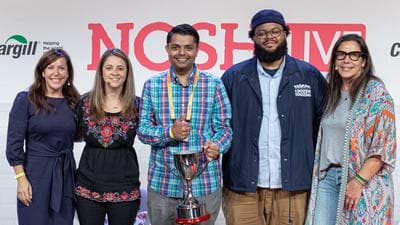
Pitch Slam 12 - Winner Announcement
The competition features 11 of the hottest startups in packaged food, all creating innovative products spanning a wide range of categories including confection, prepared meals, and more.