Search across the BevNET CPG Media network including BevNET, Nosh, Brewbound, Taste Radio, Nombase and CPG Jobs.
Best Of 2021 Awards + Pitch Slam Finalist Announcements
Transcript
Note: Transcripts are automatically generated and may contain inaccuracies and spelling errors.
Speaker 1 [00:18] We now have an exciting set of announcements. Um, we're gonna talk about our Pitch Slam winners and our award winners before we head to lunch. Um, so first off we're gonna talk about the Pitch Slam. Uh, let's give a round of applause to all of our semi-finalists. They did an amazing job and what I would tell you is that a lot of their products are out uh in the uh lobby to sample so make sure you try them. um, now it was a tight competition this year, but I do want to mention our audience vote winner which was Bob's Naturals. Congrats Bob's. And then finally, the moment you've been waiting for, sorry we don't have a drum roll, the finalists this year for the Nosh Live Pitch Slam are Munchrooms, M Rich Nuts, Cocata, Marco's Sweets and Snacks, and Bob's. Thank you guys. And be sure to watch tomorrow the finals, um, and now with that, uh, we're gonna announce our Nosh Best of 2021 awards. These are the brands that over the past year have stood out for their products, their packaging, and their business acumen. So without further ado, a quick video to introduce you to this year's winners.
Speaker 2 [04:25] Right now with the rise of plant-based foods, we're having this battle about nomenclature and it's a big one and we're having to get involved and voice our opinion about what we think the future of food is going to look like and why we should be able to call our products cheese or milk or or whatever so yes, we do have to get involved politically.
Speaker 3 [04:50] We could make this into a big media moment, this lawsuit, but to me that undercuts why we're actually engaging in it. We're not hoping to just get our names in newspapers or, you know, whatever social media. We actually want to win this legal fight and do it on behalf of ourselves and our whole industry.
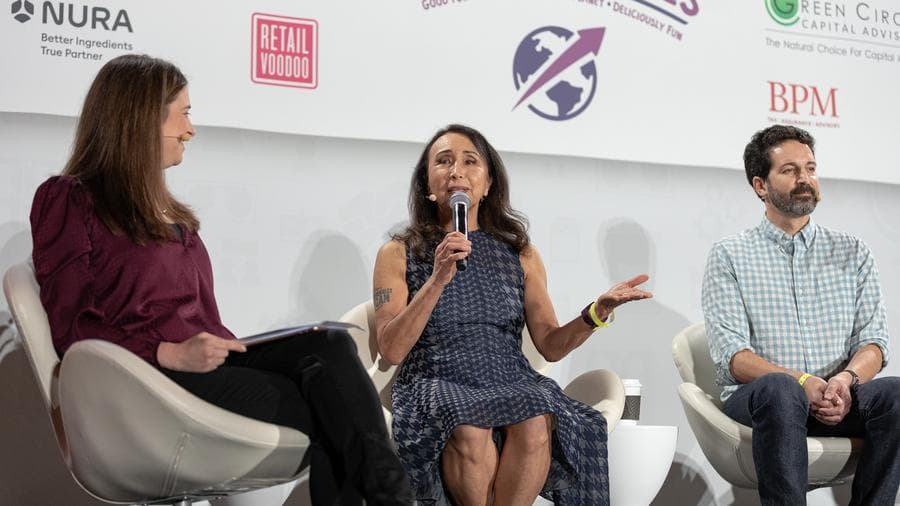
Speaker 1 [05:18] Right, well, congratulations to all of our nominees and winners this year. Let's give them a big round of applause. All of you have done an amazing job not only in light of the challenges of the past year but just overall in pushing the industry forward with flavor, sustainability and social justice initiatives. What I love about our award winners this year in particular is that we've got big brands, we've got little brands, we've got artisanal producers, and it's really hard. to see how you know all members of the industry are pushing us forward now to that end, uh, we're gonna do a quick interview and hear directly from, uh, we cheated it's not a Person of the Year, it's people of the Year who we have affectionately dubbed internally the Crusaders. Please welcome Miyoko Shinner and Jamie Athos. Guys, first off, congrats on this very well deserved honor. Um, what I wanna explain to everyone, um, and you can find out more about this on Nosh.com, we have, you know, kind of explanations into each brand is that these two have been fighting ongoing legal battles, uh, with in some cases state attorney generals. With, uh, meat companies with all different folks trying to make sure that plant-based food companies can use the terms that they want on their packaging, um, so I, you know, you both have said you feel really passionate about this personally and you don't do it for the attention so why do you do it?
Speaker 2 [07:11] Well, I think we have to this is our time to think about what sort of future we wanna create in the food system, not only for our own health, but to impact the health of the cli of the planet as well as the livelihood, the lives of all the animals. We have an opportunity to become warriors, to become crusaders, to become activists. We as an industry must. Take an affirmative stance on moving the future of food forward in a positive direction. We can't just sell products. We have to become movement leaders. We have to become revolutionaries in order to win and ensure that we have to live on this planet. And so this is so critical. This is why we have to do this. We don't do this just for ourselves, um, we don't do this just for ourselves. We're. OK, sorry about that. We can't do this just for our companies in order to sell products. We have to do this for the future of food in general.
Speaker 1 [08:10] Jamie, how about you? It's
Speaker 3 [08:12] hard to top that. That was very passionate.
Speaker 1 [08:15] You're so modest,
Speaker 3 [08:17] um, I, I agree, but I would also add to that. Why are we alive? Like, what are we doing with our time on Earth? And we could make products, we could make profit, or we can make a change and make some noise to make some change. And I, that just feels like a better way to live to me, you know, as just an individual, and we're at this time where everything is hanging in the balance, I think, for, for climate change and whatnot. And here we have a great solution in front of us, one that's palatable, that's desirable to consumers. And these forces are working to prevent that, to remove choice from consumers that just seems un-American or unhuman, inhuman ultimately.
Speaker 1 [08:59] So how do you talk to your employees about this? How do you explain like, hey, I might be a little busy this week, uh, you know, and, and still encourage them and make them understand that your focus is on the business as well because I think a lot of entrepreneurs in the audience sometimes worry if I take on this social justice initiative or this legal battle, you know, I, I only have so many hours in the day and I'm, I just have to focus on my business.
Speaker 2 [09:24] I think that is part of the business. I think there's a moral imperative for industry leaders to stand up for what is right because we have to move this forward. In fact, we're not going to sell product we're not gonna be successful as a business if we don't win on the no. Nomenclature of, uh, front, I mean if you think about it, food has been evolving for a long time and language has to keep up with the evolution of food. If I have to call my products, for example, in the very beginning when I started the company 7 years ago, cultured nut product. How is anyone gonna know what they're buying? Who goes into a store and says, oh, where's the cultured nut product? excuse me. I mean this is crazy so if we're going to succeed we have to use nomenclature that consumers understand and they understand how. To use it, what it's for, and what the functionality is.
Speaker 1 [10:16] I mean, cultured nut products also sounds just really delicious compared to butter and mozzarella, you know, that's, that's honestly what I tell my husband all the time. I'm really craving, um, Jamie, how about you? How do you kind of talk about this with your employees?
Speaker 3 [10:32] Um, well, I think thankfully that they, a lot of them are working there just because that they have an alignment, a personal alignment with the mission of this company, and it's been, if anything, an, an advantage with our business. There's so many passionate people out there, smart people, food technologists, you name any industry, and there's somebody who cares a lot about the same things that Tofurkey cares about. I think it's value added to our business, um. And yeah, ultimately you've got to be financially sustainable. We don't wanna just be a blip. We wanna be here for a long time and making impact for a long time too, so you have to be profitable to the point that you can sustain the growth and health of your business, but that doesn't mean that you have to take massive profits out, that it's just about the money, it's really just about the mission.
Speaker 1 [11:16] And I think that's a great point because as we heard from the first panel, like labor issues, uh, labor sourcing is a problem right now, and I know both of you self manufacture your products. Has that been kind of an advantage when you're competing against other brands and retailers and stuff to get people to come work for you?
Speaker 2 [11:36] Earlier this year it was a huge problem. It's not so much anymore. We're fully staffed, um, we also use co-manufacturers and we know that some of our co-manufacturers have had the same problems. This is absolutely systemic right now, uh, but we're in a good place. Right now I can also say that our mission is something just like at Tofurkey we discuss internally at all hands meetings on a regular basis and everyone at our company knows what we stand for what we're doing, and they're there because of that just like at Tofurkey.
Speaker 3 [12:07] Yeah, we do surveys of our, our, um, employees a lot and that's one of the things at the top of the list that's one of the reasons they work for us great benefits, good employer, you know, compassionate people, but they're part of something bigger than than themselves and I think we're all looking for that.
Speaker 1 [12:22] I alluded to this in my intro a little bit is that, you know, right now the plant-based space also feels a little divisive in that we've got like bleeds like meat and just eat vegetables and eat veggie burgers, you know, is that, you know, is that a helpful discussion you think we're having right now or should we just be focused on, you know, fighting these larger battles and kind of pushing towards one goal? What's, what's the importance of these discussions, do you think?
Speaker 3 [12:51] Um, well, I would offer that I think you know some of those attributes you're talking about bleeds like real meat, they really draw just attention to the conversation, you know, journalists are, are, are conduits to the consumers ultimately, and it's exciting to talk about. I'm a former scientist myself and those technologies are really kind of compelling to me. Um, at the end of the day though, what matters is that people buy it and that they enjoy their experience and they buy it again, you know, at the end of the day that's all that really matters. I don't care what technology we use to get there, we've just gotta get there.
Speaker 2 [13:21] Yeah I agree. I think there's a different story that resonates with different people and so we want all of these we're not competing against each other we have to support each other what we're trying to do is supplant an unsustainable. Industry that is destroying the planet, the animals, and our health, and so it's gonna take all of these new technologies, all these different approaches in order to create a new future of food.
Speaker 1 [13:47] Now, in addition to these court cases, both of you have also undertaken, you know, supply chain operations, marketing, um, efforts. We just saw Tofurkey's, uh, burger campaign for those of you who maybe haven't seen this, uh, they basically gave up their front of packaging. Uh, their brand is kind of small at the bottom and instead there were these big calls to action about to vote. Uh, it had, I think, the Capitol switchboard, uh, number on the front of them. Um, what motivated you to do that and how, you know, what was the effects you saw?
Speaker 3 [14:23] Well, uh, the, on the effects side, not every retailer is, is as forward about their kind of progressive intentions as, as, as we were. They didn't necessarily like that, but we're finding that lots of retailers do. They, they, they like that, that, that overt messaging. Um, I think what it really came out of though is a fundamental kind of optimism and faith in humanity. I think that we all want to do better and we're looking for ways that we can tweak our own habits and lifestyles to do so and sometimes it's just a little bit of a push that gets people to call their elected representatives and make their voice known, um, you know, I'm, I wish that more people would vote and, uh, I think as a consumer society a lot of the way that we actually engage in. Kind of the public dialogue is through what we buy and here we are putting tens of millions of packages out there it's like one of the best possible ways that we can communicate our intentions and have a dialogue of some sorts with our consumers.
Speaker 1 [15:19] And Yoko, I know you've done a lot of work with dairy farmers and farms. Can you tell us a little bit about that as well?
Speaker 2 [15:26] Sure, um, as we create this new path for. The future of food made from plants rather than from animals we, we thought, why don't we bring along some of the dairy farmers that have been working and feeding America for for centuries so we created a program called the Farm Transition Program where we're partnering with a dairy farmer to transition them to growing crops to become part of our supply chain in our research and development. Uh, dairy farming is a very, very difficult business, um. The majority of them, uh, derive about 38% of their income from government subsidies. The average dairy farmer makes $41,000 a year, and we think there's a better way for them. They have land. They have infrastructure. Let's help them participate in this new food system.
Speaker 1 [16:13] So we're uh unfortunately almost at the end of our time, you know I started our, uh, conference talking about how we as a community can help push the industry forward in light, you know, of all the challenges that we've had over the past. Last two years, um, you both are incredibly inspiring. I'm wondering if you can provide some advice on what you would like to see the industry do to keep moving us forward, to keep help supporting consumers to make healthy, better for you choices.
Speaker 2 [16:47] I'd just like to say I think consumers want to see leaders in industry that stand for something and you can see that in market research where 10 years ago most consumers really didn't care about the environment they do now. They care more about animal welfare. You see that social. Justice issues are taking hold of our country and people are beginning to care more and more and so it's important for the industry leaders to actually stand for something we're no longer at a point where we're just trying to sell product we have to sell a vision and I encourage people to do so.
Speaker 3 [17:21] And I would, that's great. I, I think we, we would also be helped by a more honest dialogue about the externalities in the animal agriculture industry. I, I don't think that we really have internalized the true cost, and we're starting to have that conversation now, but I think pushing that further would help to really point out the contrast between plant-based as a solution and animal-based.
Speaker 1 [17:48] Great. Well, thank you guys again and let's give them another round of applause. Thank you guys so much.