Search across the BevNET CPG Media network including BevNET, Nosh, Brewbound, Taste Radio, Nombase and CPG Jobs.
Pitch Slam Volume 12 - Finals : Niramaya Foods
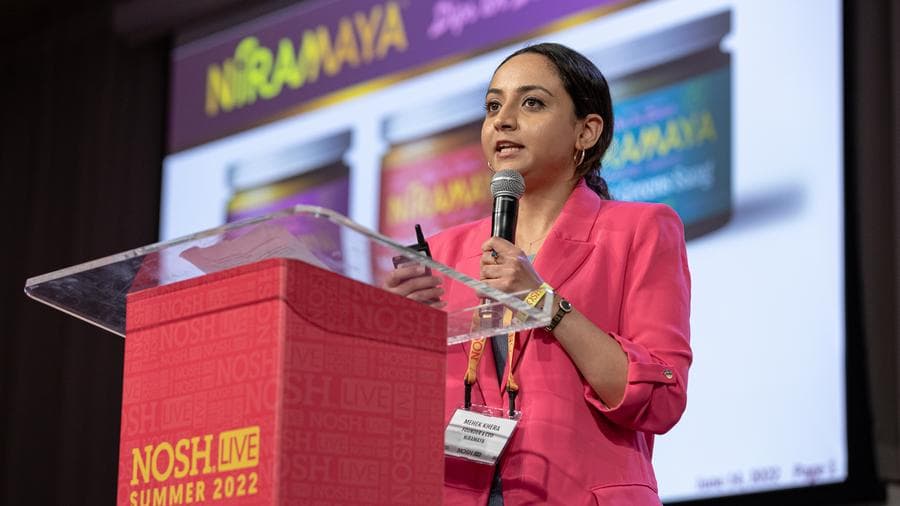
Featuring:
Mehek Khera, Founder & CEO, Niramaya Foods
Transcript
Note: Transcripts are automatically generated and may contain inaccuracies and spelling errors.
Speaker 1 [00:13] Our next finalist that will be presenting right now is Majk Kara who is the founder and CEO of Neiremya Foods. Come on up. If your microphones, please keep an eye on your camera.
Mehek Kera [00:32] Hi everyone, I'm the founder and CEO of Niramaya Foods. My name is Mehek Kera, and I'm here today to introduce you to our first line of products which we call dips for Dinner that you see on the screen right there. We make nutrient-dense plant-based, Indian inspired dips for dinner. Our consumers can use to just dip, uh, you know, a heat and eat or build nutrient-dense dinners with them by just pairing them with carbohydrates of their choice, so that they can really build dinners that are based on their dietary preference, are assembly in nature, and are quick. So I moved to the United States when I was 24 years old, and I literally fought with my mom to move 8500 miles away to do my MBA. She was not ready for it, but I was, and I saw dreams with wide eyes. When I was doing my MBA, I got a job with Walmart e-commerce, and I loved my job. I learned so much, but I also had a very stressful life to the point where there were so many headwinds in my life at that point, ranging from visa, immigration issues, where, where I work and how many hours I work was not governed by me, but the US government. And so standing here today to be able to present something that I've built from the ground up is a huge privilege for me and I'm grateful for it. On one day when I was traveling to LA on a work trip, I passed out, and that day I knew that I was stressed, and that stress was causing me to become more sick every day. And so I realized at that point that that was not just me. A vast variety of US population is stressed today, and they're sick because of it. Either their existing health conditions are getting accentuated or new ones are getting created, and they rarely have time to build, you know, good nourishing meals for themselves. And so they look for quick options that are often empty calories, right? So they are left overfed and undernourished, which is, again, pointing towards a bigger pandemic of diseases, which is obesity, diabetes, chronic ailments that have been here for decades, but are increasing every day. But they don't have to do that. See, I grew up on a plant-based diet. My mom made meals for me 3 times a day because North Indian cuisine is inherently very plant-forward. So it was a gift of culture. It was not a trend for me. Our products as they sit today are made with real plants. The nutrition, density, and the protein all comes from the nature's bounty and not a lab. We make these blends with healing herbs like turmeric, cumin, uh, caraway that are good for digestion, but also other boosting herbs like moringa, ashwagandha, spirulina, uh, you know, reshi mushrooms, and no one can tell that these exists in these plants, given the decadent nature and the buttery consistency of these dips. Niramya actually sits at a very unique intersection, and we continue to plan to build on this intersection. So when I started studying about the quick dips and the convenient foods category, it was a very growing category with the plant-based section being at $83 million based on a mental report and Good Food Institute. And people were really looking forward to options that were nutrient-dense, were different in flavors, and we're not completely moving away from the snacking category, but were indulging into fuller, filler dinners, but still being convenient so that they could have it on the go or when they want to have it slow. So we started thinking about how we can do it, uh, using the vehicle of Indian cuisine because I had been eating plant-based, plant-forward dinners all my life. So we innovated in these two categories to actually serve a bigger need, which is the consumers' need today to build plant-forward meals. And many people had been doing. that by using terms like curry bowls and curry dinners, but then we realized that curry is an umbrella term that actually shields the West from the intricacies of the East, where most of the, uh, products that we find are American versions of British adaptations of Indian food, and we really wanted to hone in to the actual flavors that I grew up eating and not mellow them down or make them easier to read or pronounce. So we build on those two categories to actually serve that bigger need, which is a $500 million market and growing, given the penetration of, uh, the want to eat plant-forward meals being at 63% on an average American household today. So it was very important for us to do some beta testing and find out who our target customer is so that we can strategically plan to grow our business. I found that after speaking with so many folks and reading thousands of reviews online about different companies, the consumer that we were actually looking for was the wellness whisperer of the family, that person in your family that encourages you to eat healthier, to look for cleaner labels, to buy better food, and to go for wellness goals. Thank you.
Speaker 1 [05:46] Well done and just wanted to say uh it's an honor to have you on stage and it's so great to see what you've accomplished as an immigrant. Thank you so much. Thank you.
Mehek Kera [05:54] Yeah.
Speaker 1 [06:00] Um, Ibrahim, let's start with you. Um, you know, I think dips for dinner, uh, is an interesting way to position this brand. I mean, what do you think about that use case or the suggested use case for this product?
Speaker 3 [06:12] Yeah, first of all I'll say I love the packaging. I love the flavor. We had a chance to taste two of them backstage, so the, the product is great, um, I, I think you should hone in on the dip side, which is what I think you're trying to do, right, of like of a unique savory more filling dip. I actually think calling it a dip for dinner is slightly confusing because it then makes you wanna use it as like a cooking sauce. So when, when I was tasting it, the thing that felt unique and different to me is like more of like a hummus usage, right, where it's like. It feels filling. It has that savory element it feels like more than just a dip, um, but I do think the risk you need to watch out for is like will people see it as a cooking sauce based on the flavor profiles, the jar that it's in, where you might end up in store, and so I'd be really careful about where you wanna position it and then make sure you kind of build the rest of the messaging around that. It makes sense.
Mehek Kera [06:58] Thank you. Yeah, no.
Speaker 1 [06:59] Carol, earlier in the sampling room you dipped into some Neremya, uh, seemed to be pretty happy with the taste.
Speaker 4 [07:04] I, I mean, I think we heard from Whole Foods that global flavor profiles, things that make meals easy, um, you know, are both trends. Uh, I certainly love them. I think, uh, you know, to the point about dips, like if you are gonna go that dip route, do you wanna package it in like the traditional hummus container? Um, if you wanna go the cooking sauce way, I feel like it needs that like taller container or pouch sort of format. Um, but thinking about like slotting fees and turns and things like what you're expected for both of those categories would be really important.
Mehek Kera [07:37] Absolutely. Uh, so the idea behind branding them as dips for dinner was to really make it accessible for the larger American audience because the data showed us that Indian foods lose dollars to, say, Mexican foods, other ethnic foods, Asian foods, and that's been going on despite the popularity of the South Asian cuisine. And so we wanted to make it as accessible and easy for the consumer to be able to be creative with it and not shy away from buying the sauce just because they had alien names on them. So I completely agree with where you're going, but it's, it's a trial and we're up for it.
Speaker 1 [08:13] Uh, we saw concentric circles, we saw, uh, plant-based, uh, meals, we saw Indian food, we saw dips, Neremy meeting in the middle of all of it. Mia, um, what do you think about that sort of positioning, that, that way of considering a business strategy for this brand?
Speaker 5 [08:27] I think I, I agree with what's been said here. I think the dips is misleading. Um, first of all, the product tastes amazing. Both, both of the flavors that we tried were awesome. It was interesting because the sog did not say spicy on it, but the masala did, and I found that the sog was way spicier. So just something to note. Um, and then I think as far as the use case I really do feel for me I feel as though it is more of a sauce type of product that I could see doing like with stir fried veggies, um, and your, your serving also kind of represents that because it's a half a cup versus in dips it's normally in the tablespoon measurements so I think that is one thing that I would just kind of either, you know, lean into either a dip or a sauce and you know, but um, but they're amazing and I love your packaging too.
Mehek Kera [09:14] Thank you, I really appreciate it.
Speaker 1 [09:16] Yeah, from a merchandizing standpoint, Holly, I mean, do you think this is something that could easily fit into retail shelves or retail stores?
Speaker 6 [09:21] I, I think everything we've all said leads to some people might be confused where to put it, right, obviously. Um, and to go over the conversation we're saying, it does, it was thick and really dense like a dip, and if it was used, I thought it would be great with chick chicken. I know it's plant-based, but I would love to combine it with other ingredients, but then it seemed really thick for that. So if, if people were to cook with it, we thought it could be in a smaller container, but um, I. I can't recall. Is it shelf stable or
Mehek Kera [09:50] refrigerated? It has a shelf life of 3 years,
Speaker 6 [09:53] and, and that's fantastic because that might open up the ability to place it in certain areas, but I agree with everything we thought was so delicious. It could be confusing to some. Yeah,
Mehek Kera [10:02] no, that's great feedback. Thank you.
Speaker 1 [10:04] From a nutrition standpoint, did you see what you wanted to see out of the front of the pack, uh, on Nieremeyer?
Speaker 6 [10:09] Um, I remember thinking I really liked the packaging. Well I like the packaging, but there might, um, might be part of it, right, is the explanation as to how you use it. There might have been a lot on the back if I remember correctly, so there might be a slight way to even clean up the packaging to drive home the main message when, when you pick, might have to pick a lane.
Mehek Kera [10:27] Absolutely, yeah, so, uh, with the first round of these, so the products that you all sampled were last week. So it's the first actual production run that you guys tasted. So it's definitely a trial and definitely something that the consumer comes up and tells us and then we hone into the messaging and get ready for retail. So our primary channels would be DTC and e-commerce for now and then going into retail, select partners, strategic partnerships and all of that good stuff.
Speaker 1 [10:54] Fantastic. Well done. Thank you so much.