Search across the BevNET CPG Media network including BevNET, Nosh, Brewbound, Taste Radio, Nombase and CPG Jobs.
Fighting Through Adversity with Scott Lerner, CEO, Farmhouse Culture

Transcript
Note: Transcripts are automatically generated and may contain inaccuracies and spelling errors.
Speaker 1 [00:14] Yesterday we heard a lot about the role of humility, the tenacity you have to have when running a food business, and how hard your job can be at times. It's easier to be a leader, so it seems, when times are good, but let's be honest, that's not always the case. So when push comes to shove, how do you rise up and support your team and help guide them through, as we heard yesterday, the grind. Our first speaker, Scott Lerner, the CEO of Farmhouse Culture, is going to help you master that skill. Since taking this role, Scott has rebranded the line, moved its headquarters, relaunched the product with a new manufacturing partner, and reformulated some of the SKUs. And can I mention he's done this in roughly a year. So if there's anyone to walk you through how to make hard choices while keeping your team engaged and excited, it's Scott. And with that, please welcome him to the stage.
Speaker 2 [01:24] Good morning. First of all, thank you to Carol and Jeff for inviting me to speak this morning. It's always an honor to be in front of my peers in the community and spread some wisdom and some experiences that I've had over time. As a brief introduction to my background so you can understand where I'm coming from, I've had the opportunity to start my own business in 2008 and ran that for 5 years and exited it. I worked in the green household cleaning products industry for a little while and then I started to migrate over into private equity recently before this company I was working with VMG on a company called Kernel Seasons and exited that and then took over farmhouse culture about a year ago. Before I got into smaller entrepreneurial opportunities after college, I actually was in the Marine Corps for 5 years, so I was an officer, and you'll hear about some of the lessons learned, and I applied over to the business world. Uh, prior to the, after that, I spent 12 years in big CPG, so Kimberly Clark, ConAgra, PepsiCo, and so I have a background in both large company and small company, and I try to apply lessons learned from both those worlds as I move forward. So currently I'm the CEO of Farmhouse Culture. We'll talk about that a little bit and we'll talk about some other of my previous experiences. So My team knows I like to use military analogies quite often, and they always look at me with gazed eyes and what are you talking about? But there is a lot of Crossover in terms of language strategy, whatnot from that world to the business world. So I direct your attention to this slide and give you a little bit lesson on what an ambush is and this is as it relates to a combat scenario and we're going to talk about in the business world. So essentially it's you're walking down a path or you're driving down a road and someone's hiding and ready to jump out and uh. You know, attack you and you don't know where it's coming. You don't know when it's coming and the basic principle of what we were taught in the Marine Corps is the one way to get out of an ambush is to fight your way out. If you stay stuck in the middle or you try to retreat, that's the worst case scenario that you can ever envision. So you have to do everything you can to push forward through that ambush so that you can get out through the other side. So with that being said, there are many business ambushes that we'll encounter probably on a daily, weekly basis as entrepreneurs, as small business owners, as growing emerging companies. Some of these are raising capital. Rising food costs when a manufacturer gives you a price increase out of the blue. I'm sure everyone's experienced that. Um, when you're a team member leaves. Unexpectedly, unexpectedly, uh, when you need to hire new team members, when your competitors are moving against you, we can't forget that we're not working in isolation. Our competition is making moves against us, and we need to counter those. So all these things I wish from my, from my experience would have been planned. Out, but in reality they never are. I mean, I think actually I was talking to Brian, my VP of marketing this morning, and not a huge ambush, but a question that came up just this morning as one of our sales people are going into a meeting on the east coast. So these things pop up all the time and I'm sure you've all experienced them. So what I want to talk about today is some of the ways that I fight through these business ambushes, some of the lessons learned, some experiences experiences I have had, and I'm just going to be really transparent and blunt with you because everybody who knows me, that's how I operate. When I was coming up starting my own business, Selixir, I looked for mentors that would give me the straight scoop and not kind of blow, you know what up, you know, you know what. So that's where we're going to go. This is another lesson that we learned in the military. Everyone has a plan until they get punched in the mouth, and no plan survives first contact. So if you remember Mike Tyson, for those that are old enough to know Mike Tyson, he was the heavyweight champion of the world and had packed quite a punch. The lesson here is that we think we launch a plan, we do a marketing plan, a business plan. Once it goes in the market, you don't know what's going to happen, so you need to be ready to react to that and be able to maneuver and look out for those business ambushes. Hopefully if you have an experienced team or you're experienced, you can kind of forecast some of those ambushes and build it into your plan, but in reality that just doesn't happen. How many times have we Done packaging and wish we would have changed something and we either write it off or flow it through or try to find some other outlet for it. How many times do we wish the formulation was different or pricing changes right after you do a formulation? I'm looking at Bill. He's nodding his head, so I know I'm not, I'm not crazy, uh, but these things happen and some of it can be controlled and some of it can't. So the reality is we have to control what we can control. So what do I do? I've kind of formulated an approach over the years. And it's funny, a lot of my team members, especially my younger ones, always say like, Why aren't you freaking out, man? Like, and I say, first of all, like nobody's going to die, right? And we're going to figure it out. And that's, I think, the first thing that I do is take a deep breath and kind of assess the situation. But more importantly, it's being decisive. I've been early in my career, I think I would have spent a week on trying to solve a problem, and by then the problem had changed or the solution that was needed, you know, is different. So what I've decided is, OK, be decisive, push my team to be decisive, but go through some practical steps to come up with a decisive decision. So it's not just making an ad hoc decision. So I talked about don't panic. I mean that's the first thing, right? There's There's no comparison to like business to war, but there are scary things in business, especially when it's your business or your lack, you don't have a lot of capital or whatever that might might be, but the biggest thing is like don't panic. Take a step back, really diagnose the issue, and make sure you're solving the correct problem. I think when I worked at the big companies they always taught us to make sure you're solving the right problem because sometimes you're working against a problem that isn't the one really to solve. It's really something different. So it's take a step back, diagnose the issue. Solicit outside feedback if you have a board of directors. It's a great way to use your board of directors. I can't tell you how many times I call Tyler up. Maybe it's late at night, maybe it's early in the morning, and say, Hey, what do you think about this? So it's a great way to get another point of view. Ask your team for feedback. Ask mentors that you have within your network. I can guar. Guarantee you within this room or within your network that each of each one of us has experienced a similar excuse me, ambush over time. So how did you deal with it? We have situations with retailers all the time and I'm like, Dave, go call one of our 301 Inc. partner companies and ask their VP of sale what happened. You know, we're going to a new new account, you know, we get a new. Category and target, you know, how is uh Perfect Bar growing there? Like we just, we went into Walmart last year, so we called Perfect Bar's head of sales and said, Hey, what's the best way to go to market there, you know, because we feel like we're the fees are too high. So use your network, get outside feedback, formulate an action plan. Really put it down on paper and say, OK, how are we going to approach this and take your team through that, weigh the financial impact. How, where are you in your, in your plan? Are you up? Are you down? Are your margins above your target? Are they below? Where's your capital? How much cash do you have? These will all dictate how you're going to approach attacking the plan, because you know if I'm crushing my number and my margins are above budget, maybe I have a little bit more leniency to make a decision based on. The financial reasons and then ultimately again make a decisive decision. We could go through all these steps and if we just don't make a decision then we're dead in the water. So go back to that ambush. Someone's waiting there. You've got to fight through. The point is make a decision and go. If it's 75% of the way there it's going to be better than just spinning your wheels. So a few lessons learned. Manufacturing changes, I think a lot of people have experienced that whether you had your own plant, moving to a code packer, whether you're working with the same code packer, whether you're switching code packers. This happens all the time. When I came into various businesses, whether it was Naked Juice when I was at Pepsi, Farmhouse Culture, other examples, the first thing I always do is look at my SKUs, look at what's performing and what's not, and make a quick decision where you're getting your revenue from. There's always an 80/20 rule in most businesses, and A lot of businesses just add SKU after SKW after SKU. It adds complexity, maybe lower margins. So I always look at SKW sales performance, gross margin targets. I've heard it mentioned a couple of times yesterday. I can't stress enough how that needs to be sort of how you run your business, how you dictate what you're going to do. We all think, OK, we can start with a 20% margin and it'll go to a 40 over time through efficiency scale, whatever it may be. The reality is like that's really difficult to predict and it's probably not going to happen and it's really difficult to run a business at like a 20% gross margin because you're going to need a lot of cash over time. So if your plan says, man, we've got to be at a 35% margin or a 40% margin, don't violate that and use that as a benchmark moving forward to solve the problem of your ambush. Understand your limitations. So I've been in a couple of situations recently where we were migrating maybe away from our own manufacturing to a cobacker, and yeah, in a perfect world we'd love to match up old to new. But processes are different, costs are different, and you just, in reality, can't always match up what you're doing, making yourself, going somewhere else. So you need to understand the limitations and work within those. And I talk about a lot about innovation within a box. Create those parameters and then get really creative within those parameters and solve the problem. Removing roadblocks, whether that be financial, whether that be from a partnership perspective, uh, those are things to do and then just get creative, right? There's always a way to solve the problem. We just need to think creatively, but if we create those parameters in terms of the manufacturing process, the ingredient list, like I go to my R&D guys all the time and like this is. What I want and he's like, Well, I only have 50 cents to spend. I'm like, OK, we'll go figure it out for that 50 cents and you know get creative. And so if I didn't give him those parameters of like go spend the 50 cents, he'd spend two months creating stuff that wasn't financially viable for us. And so that's where we really get focused on having those guardrails. Building the right team, uh, this is probably the number one thing that's going to make or break you. And what I've learned over time is you've got to right size your business. I've, I've started businesses. I've come into businesses with different teams, and sometimes they were right size and sometimes they weren't. Um, you know, recently had to make some tough choices in terms of moving people out, moving people in based on how we were restructuring our business, and that is going to really make or break you as sort of that business ambush because that's cash going out the door every single day and if they're not driving, it's not driving revenue. You and it's not right size, then it's going to be difficult. I mean, kind of the rule of thumb is for every million dollars of revenue you have one headcount. It's kind of a good guidepost to go by, but that's something that you really need to focus on. I like to look 1 to 2 years out, not 5. I've been in situations where I come in and, you know, you've got a CFO, a VP of sales, a VP of marketing, all these senior positions that are making a lot of money. And you're a sub $10 million dollar brand. Like it just doesn't make sense for the time. Now as you grow, it probably does, and unfortunately sometimes you've got to prune and change and whatnot. But if you set yourself up for 10 years from now, you'll run out of money before you know it. And so that's another lesson that I learned. Make sure you evaluate your cultural fit, so. When a new leader comes into the organization, uh, when you bring new people in, you know, sometimes unfortunately the existing team doesn't fit the direction that you want to go. And I guess you've got to make changes, right, because if people are what's going to drive success at the end of the day, then you need to make those hard choices at the end of the day. So what is your cultural fit, but really understand what it is. I mean, it's not having a ping pong table and going to drink beers. It's like, how do you want to, what speed do you work at? What skill do you need, and where do you want to go spend the money? You know, my board always says, OK, here's your pot of money, right, for SGNA. My job is to divvy it out. Like, do I want a stud in marketing like I have now, Brian, there you go, uh, in sales and want to go a little bit more inexperienced in maybe R&D or ops or vice versa. And so those are the things that you gotta need to understand is how you move the money around. Trust your gut. Um, I, I think I've gotten good at this, no pun intended, from farmhouse culture, but you know, hire slow, fire fast. Unfortunately, like when I came in here, I let go of two people the first day I came on board because I knew it just wasn't financially viable for us, maybe not a good fit, maybe how the structure was. But you just got to do it and my gut told me before I even got in there that's what I was going to have to do. It sucks and I never want to do it, but it made sense for us. It made sense for them in some way in this world, weird world, everything works out, you know. I've had people that I've let go and literally found them a job the next week that's a better fit for them. So trust your gut is super, super important. And then the last point here. Hire slow, fire fast. I kind of talked about that, uh, but I've, I do that a lot now. Um, I use my network a lot. I was talking to Dustin and Josh yesterday, uh, because I tend to find a lot of people through my own network in, in, in the key spots and it's really important cause it's almost like pre-vetted, uh, but I take time to do that and so. Like as an example with Brian, I knew I didn't need a VP of marketing until I kind of got through all the blocking and tackling stuff on this business because if I don't have a product to sell at a good margin, what's the point of marketing, right? So I knew at some point I'd need a senior level marketer, so I started having lunch with this guy. 6 months before I hired him and so that's like 6 months' worth of like interview time, not an hour coming in because that's risky, right? And that happened to me before, that's happened to me before where like, this person's awesome. I got to hire him. And then you know 2 weeks later you're like, yeah, that was a bad call for whatever reason, cultural fit, cultural fit, whatever it might be, but by taking your time knowing that if I'm a startup and I know that in 2 years I'm going to need a true VP of sales, start talking to people and start vetting them out. I think that's really, really important because when you need them, that's when you give them a call. Brand repositioning is another ambush that comes up a lot. I think undoubtedly any marketer, you know, especially when I was in big companies, it's like the first day you're on a new brand, it's like, oh we have to change the packaging or we've got to reposition the brand, right? It's like, OK, what else are you going to do? Same thing when you take over a new business because you feel like it's a fresh start, right? But I think the key thing here is like, do you need it? Why do you need it? Go back to those steps that we talked about. Diagnose the problem. Get outside feedback. Ask your board and say, Hey, what do you think? Like, to be honest, if I called Tyler up and he said, Hey man, you know I think everything's cool. Like let's not change the brand. Let's not change the packaging, we probably wouldn't have done that. But my board concurred with me on. Farmhouse culture specifically that we need a change for various reasons we were making some changes in manufacturing. It had some retail shelf issues and whatnot, so we made that change. But I've made the mistake in the past where like, man, I probably didn't need to do that and that was a waste of money and resources and time and I could have put my energy in other areas. Align your stakeholders on defined objectives. This is key with the board. So if you're working for private equity, especially, and you have a sophisticated board, make sure they understand the objectives of what you're trying to do, because at the end of the day if it's an opinion war, it can get ugly in many. Instances whereas if I'm saying I want better shopability, I want to clear my positioning to come out, you know, I want a more premium look, whatever it might be, those things will help guide the conversation at the end of the day because it's scary when you take something and you show someone something new and they've put a lot of money behind it in the past. So this is a way to kind of mitigate that. If you can conduct the consumer research but do it quickly, so we did a repositioning on farmhouse culture. We changed our our kraut and our gut shot, but we also changed our kraut crisps, which is the new packaging up here, and we were sure but we weren't. We had a couple questions, so. We decided let's go do some research. We had the money to do it, but we didn't necessarily have the time to do it, so we found a qualitative way to do it very quickly, and we got some really good answers and some things that probably What saved us at the end of the day because we had some preconceived notions going into the snacking category that weren't necessarily right after we talked to consumers. So we did research and that doesn't mean you need to go spend 40,000 to $50,000 but it means go talk to some consumers, go do some Whole Foods demos and treat it like a research project. Ask someone else's opinion. Don't drink your own Kool-Aid. Like that's, I've taught entrepreneurship at Northwestern for 5 years and I always tell, the first thing I tell the students is don't drink your own Kool-Aid, because you do that a lot as an entrepreneur and get some retailer feedback. That's helpful as well. We brought some ideas into retailers and they're like, no, so of course you're going to change it when Whole Foods says, hey, you know what do you think about this? So that's another lesson learned. So. Thank you for your time, uh, and I know Carol's gonna come up and chat a little bit, but I really appreciate it and uh I've enjoyed the two days, and if you have any questions after this, I'd be happy to answer it. Thank you.
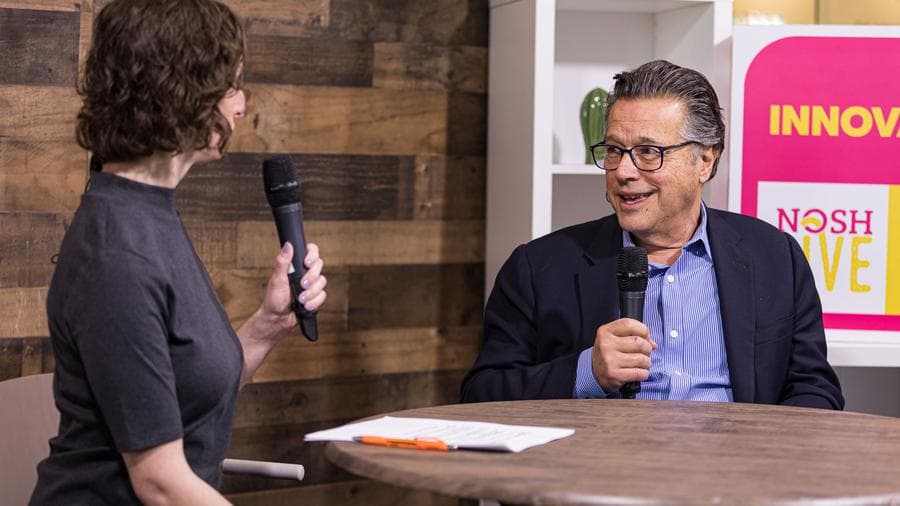
Speaker 1 [21:32] Come take a seat. We'll move this water bottle. Well that gave a lot to to mull over or to chew over, should I say, um, one of the things I wanted to talk about is I know team is really important to you, um, and you've developed a lot of people who will follow you from company to company, um. How do you advise young entrepreneurs who don't have that roster of people that have worked with them before or even a huge network to to go about building this team?
Speaker 2 [22:06] Yeah, I think first of all, especially if like I did it, I was a single founder and I was running my solicitor company for about a year by myself. It's like be nice to people in the industry and. Sort of catalog your questions and use them accordingly because you only have a certain amount of dollars to use so I guess my point is like. I've asked questions of true VP of sales from other companies in the past of how you would do things and it's so they're not my VP, but I can go get advice whether it be marketing, operations, what you know what it whatever that might be. I think that's first and foremost something that you should do as a young founder or a growing startup and then when you're starting out, I think you hire for sort of attitude first, skill second. Because a lot of the things we talked about, you know, higher 1 to 2 years out, not 5 years out. You've got to get a lot of just blocking and tackling done in the first year, and that takes tenacity, speed, effort, you know, someone that's going to want to go out and do demos, someone that's going to want to go bust down the door and get a copacker, so you might not need the sophistication that you need early on. So I think, you know, hire for attitude in a way and then skill second if that makes sense.
Speaker 1 [23:28] You also mentioned, you know, having a plan of attack, having this kind of box, uh, to help guide people in the company like R&D. How do you know when you need to deviate from the plan of attack or if like your box is too small, maybe you need to expand your box.
Speaker 2 [23:45] So it, I always say like we're slave to the plan, right? So the annual plan, the strategic plan, and that's really what guides the process, so. If we need to make adjustments, it's because we need more margin or we need to lower our burn rate or you know there's certain strategic things we want to go after partnerships with retailers so it always goes back to sort of data to the plan and it's just not made willy nilly and that plan is aligned. With the board so that everyone's in line. So when I say, hey, I want to go hire a new VP of marketing or a new VP of sales and it's a bump up in salary, everybody gets it because we're in that sort of next phase of growth. So it's really going back to having everything on paper. I always say to entrepreneurs like there's nothing that there's no one telling you you can't go do this exercise on paper. It doesn't require any money. It doesn't. All it requires is time and effort and so go do it on paper. And so that's what we do.
Speaker 1 [24:43] There also was kind of the reference between trusting your gut and soliciting feedback. At a certain point you kind of get feedback overload and you, you have to go to your gut. So how do you figure out when enough is enough and you just have to say, OK, I've gotten all the feedback I'm going to get, and I'm going to move on from here. To me it's
Speaker 2 [25:01] where you're at in your career and your experience level. Like now I make calls right away and My team, I don't, I sort of, uh, I don't keep any emails in my inbox like I have a 0, yeah, touched piece of paper once and my team freaks out a lot and they're like, how do you make decisions so quickly? Uh, it's just, I guess, through experience. When I don't have that experience or I'm not totally confident, that's when I'll reach out. But you need to be confident in yourself and again like in that ambush scenario, like make a decision and so if I feel good about it, I'm going to make it. I'll ask a quick, you know, feedback from Brian, Dave, whoever it might be, but in reality like we just go. But the ones that are more Complicated. We solicit feedback.
Speaker 1 [25:41] Well, what about when you were starting out and you didn't have that benefit of experience?
Speaker 2 [25:44] Yeah so I made, I made a lot of mistakes, right? Like, but I think at the end of the day it was better to make that mistake, fix it, than just panicking and sort of chasing my tail for a good bit of time. So that's, that's the difference. You know, starting out versus where I am now.
Speaker 1 [26:03] Well, thank you for sharing those lessons from along the way. I think you gave us a lot to think about today. Sure,
Speaker 2 [26:08] thank you. Appreciate it, Carol. Thank you.